
1275 Hold California: What Defendants and Families Must Do
A PC 1275 hold stops bail from being accepted the moment a court or officer finds probable cause that the money used to post bail was feloniously obtained. Under Penal Code §1275.1, the court cannot accept cash, property, or a bond premium until the source of those funds is proven clean. Your loved one stays in custody until that proof is delivered. The clock matters: if a declaration initiating the hold is filed but the court does not act within 24 hours, the defendant must be released upon posting the set bail amount. That 24-hour rule is one of the most useful pressure points in the entire process.
What to do right now:
- Call a criminal defense attorney immediately. The 1275 hearing requires legal argument, not just paperwork.
- Gather every financial record tied to the bail funds: bank statements, pay stubs, tax returns, loan documents, and receipts.
- Contact your bondsman. If a surety bond is involved, the premium source faces the same scrutiny as cash.
- Ask your attorney whether to request a closed hearing to keep private financial records out of the public record.
- If a declaration has been filed and 24 hours pass without court action, your attorney can invoke the release mechanic under §1275.1.
Armstrongbailbonds is available 24/7 to help coordinate bond documentation and guide families through this process while defense counsel handles the legal argument.
Table of Contents
- What Penal Code §1275.1 actually says and who can trigger a hold
- What situations commonly trigger a 1275 hold
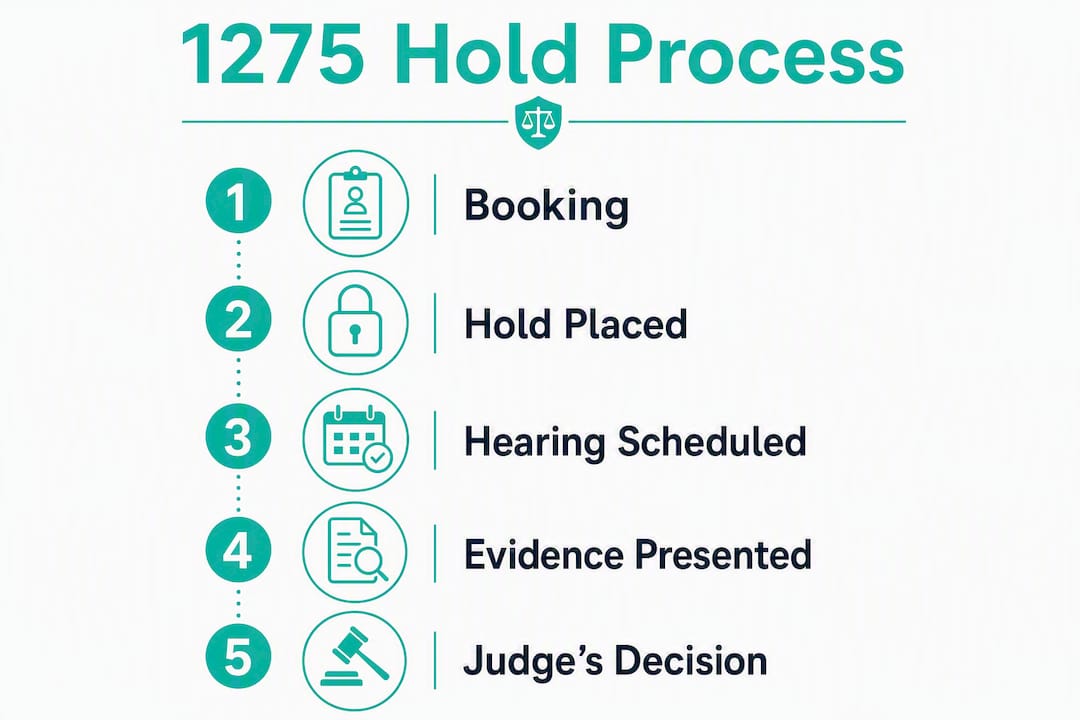
- How the process unfolds from booking to the 1275 hearing
- How to challenge a 1275 hold and what evidence actually moves judges
- How bail bonds interact with a 1275 hold
- What happens after the 1275 hearing
- Key Takeaways
- Why speed and organization decide most 1275 holds
- Armstrongbailbonds is ready to help when a 1275 hold hits
- Useful sources and further reading
What Penal Code §1275.1 actually says and who can trigger a hold
California Penal Code §1275.1 is the statute that gives courts and law enforcement the authority to pause bail acceptance when there is reason to believe the funds are tainted. The plain-English version: if the money looks like it came from a crime, the court will not take it until you prove otherwise.
Three categories of people can file the declaration that starts a hold:
- Peace officers (arresting officers, detectives) who observe suspicious funds at booking
- Prosecutors (district attorneys, city attorneys) who review the case file and find financial red flags
- Judges or magistrates who identify concerns during a bail hearing
Prosecutors who file a declaration have absolute civil immunity under the statute, meaning they cannot be sued for initiating the hold even if it is later removed. That immunity makes prosecutors willing to file declarations in borderline cases, which is why holds appear more often than many families expect.
Once probable cause is established, the burden shifts entirely to the defendant. Proving the funds are clean requires meeting the preponderance of the evidence standard: more likely than not, the money came from a legitimate source. That is a lower bar than “beyond a reasonable doubt,” but it still demands specific, documented proof, not a general claim of financial stability.
The 24-hour rule works like this: if a declaration is filed and the court does not hold a hearing or otherwise act within 24 hours, the defendant must be released upon posting the bail amount already set. Defense attorneys use this as a tactical lever, especially when court scheduling would otherwise drag detention out for days.
What situations commonly trigger a 1275 hold
Defense practitioners report that holds are placed most often in drug-related arrests when large amounts of cash are found at the scene. But the list of triggering offenses is broader than most families realize.
Common felony categories that prompt a hold include:
- Drug trafficking arrests where significant cash is found in a vehicle, home, or on the defendant’s person
- Money laundering cases where funds have moved through multiple accounts to obscure their origin
- Extortion and robbery where the alleged proceeds are still in the defendant’s possession
- Embezzlement from an employer, where the bail funds appear to come from the same accounts that were drained
- Felony grand theft, particularly when the stolen property or its cash equivalent is recovered
The red flags officers and prosecutors look for go beyond the amount of cash. Inconsistent explanations for where the money came from, funds that have bounced through several accounts in a short period, and a mismatch between the defendant’s known income and the amount available for bail all raise suspicion. A spouse arriving at the jail with $50,000 in cash and no clear explanation for its source will almost certainly trigger a hold, even if the underlying arrest has nothing to do with financial crimes.
One scenario that catches families off guard: a third party offers to post bail using funds that are legitimate but cannot be quickly documented. The court does not care that the money is actually clean. It cares whether you can prove it is clean, right now, with paper.
How the process unfolds from booking to the 1275 hearing
Understanding the sequence helps families know where they are in the process and what decisions need to be made at each stage.
| Stage | What happens | Typical timing |
|---|---|---|
| Booking | Officer places hold based on suspicious funds; defendant cannot post bail | Within hours of arrest |
| First appearance / arraignment | Defense counsel can raise the hold; court schedules 1275 hearing | 24 hours after arrest |
| 1275 hearing | Defendant presents proof of fund source; court rules on hold | Days to weeks after arraignment |
| Post-hearing | Hold removed or sustained; bail posted or detention continues | Immediately after ruling |
The numbered sequence below maps the decisions that matter most:
- Scheduling the 1275 hearing — The court sets a date. In many California counties this happens within a few days of arraignment, though complex cases or crowded dockets can push it further out.
Holds placed at booking in drug arrests are especially common, which means defense teams need to be ready to challenge the hold at first appearance, not weeks later.
How to challenge a 1275 hold and what evidence actually moves judges
The legal standard at a 1275 hearing is preponderance of the evidence. In practical terms, the defendant must show that it is more probable than not that the bail funds came from a lawful source. Vague testimony and general bank balances do not meet that standard.
Courts require granular documentation that traces the specific funds used for bail back to a legitimate origin. Here is what to prepare:
- Bank statements covering at least 90 days, with the exact transaction that funded the bail payment highlighted
- Pay stubs or employment records showing income consistent with the funds available
- Tax returns for the past two years to establish overall financial picture
- Loan documents if the money was borrowed, including the lender’s identity and the loan agreement
- Receipts or sale records if the funds came from selling an asset (car, property, personal property)
- Third-party affidavits from an employer, accountant, lender, or family member who can attest to the source
- Transaction records showing the chain of custody: dates, account numbers, and transaction IDs that link the funds from their origin to the bail payment
The difference between a successful and unsuccessful 1275 challenge often comes down to organization. Judges see many of these hearings. A well-labeled exhibit set with a clear transaction timeline reads as credible. A stack of unorganized statements does not.
Pro Tip: Request a closed hearing early and state the privacy interest on the record. A closed 1275 hearing keeps sensitive financial records, account numbers, and personal income details out of the public file. Your attorney should make this request at the first appearance, not the day of the hearing.
If the defendant meets the burden, the court must release the hold and accept the bail. That is not discretionary. A successful showing triggers release.
How bail bonds interact with a 1275 hold
The type of bail matters, and so does where the money to secure it comes from.
Cash bail means the defendant or a family member posts the full bail amount directly with the court. Every dollar of that cash is subject to scrutiny under §1275.1.
Property bonds use real estate as collateral. The equity in the property must be documented and its source traced, just like cash.
Surety bonds (bail bonds through a licensed bondsman) involve a premium, typically a percentage of the total bail amount. That premium is also subject to court scrutiny. The source of the premium must be traceable and documented, not just the bond itself.
Under §1275.1, if the defendant meets the burden of proof and will be released on a bail bond from an admitted surety insurer or a bail agent approved by the California Insurance Commissioner, the court shall vacate the hold on condition that the consideration for the bail bond is approved by the court. That conditional vacatur is significant: it means a bondsman’s paperwork needs to be ready to meet court approval quickly.
Coordination checklist for families working with a bondsman:
- Notify the bondsman immediately when a hold is placed, before attempting to post anything
- Prepare documentation for both the underlying bail funds and the premium payment source
- Confirm the bondsman is licensed as an admitted surety insurer or approved bail agent under the Insurance Commissioner
- Ask whether the bondsman can submit declarations or appear at the 1275 hearing if required
- Understand that payment plan options may be available even when a hold is in place, so financing the premium does not have to wait until the hold is resolved
One thing bondsmen generally cannot do: post the bond before the hold is vacated. The hold suspends acceptance of bail in all forms. The bondsman’s role during the hold period is preparation and documentation, not posting.
What happens after the 1275 hearing
Three outcomes are possible, and each one requires a different next step.
Outcome A: Hold removed, bail accepted. The judge finds the evidence sufficient, vacates the hold, and accepts the bail. If a surety bond is involved, the court approves the consideration and the bondsman posts. Release follows, typically within hours depending on the jail’s processing time. The defendant should understand any conditions of release set at arraignment still apply.
Outcome B: Conditional vacatur. The court vacates the hold on condition that the bail consideration is approved, often meaning the surety’s paperwork must clear a secondary review. This is common when the evidence is credible but the bondsman’s documentation needs a final sign-off. The defendant may remain in custody for a short additional period while that approval processes.
Outcome C: Hold sustained. The judge finds the evidence insufficient. The defendant remains in custody. At this point, the defense has several options: produce additional documentation and request a new hearing, file a motion for reconsideration, or in appropriate cases, seek expedited appellate review. Sustained holds in complex financial cases sometimes require forensic accounting support to build a stronger paper trail.
One clarification that matters: a 1275 hold is specific to bail funds. If a defendant also has an immigration detainer or a federal hold, those remain in place regardless of what happens at the 1275 hearing. Removing the 1275 hold does not automatically resolve other detentions. Each hold has its own legal mechanism and must be addressed separately.
When a hold is sustained and the defense believes the ruling was incorrect, escalating to appellate counsel quickly is worth considering. Prolonged pretrial detention has real consequences for employment, family, and the ability to assist in one’s own defense.
Key Takeaways
A PC 1275 hold under Penal Code §1275.1 suspends bail acceptance until the defendant proves by a preponderance of the evidence that the funds are lawfully obtained, and the 24-hour rule gives defense counsel a critical early pressure point.
| Point | Details |
|---|---|
| What a 1275 hold is | A court order under §1275.1 that pauses bail acceptance when funds may be feloniously obtained. |
| The 24-hour rule | If a declaration is filed and the court does not act within 24 hours, the defendant must be released upon posting set bail. |
| Top documents to gather | Bank statements, pay stubs, tax returns, loan documents, receipts, and third-party affidavits tracing the exact funds. |
| Coordinate early | Contact defense counsel and your bondsman immediately; bondsman paperwork must be ready for conditional court approval. |
| Armstrongbailbonds | Available 24/7 across Southern California to help coordinate bond documentation and guide families through a 1275 hold. |
Why speed and organization decide most 1275 holds
The families who get their loved ones out fastest are not the ones with the most money. They are the ones who called a lawyer within the first hour and started pulling bank records before the arraignment date was even set.
What most people underestimate about a 1275 hold is how little patience judges have for disorganized proof. A hearing is not an opportunity to explain that the money is legitimate. It is an opportunity to demonstrate it, transaction by transaction, with labeled exhibits. Judges who handle these hearings regularly have seen every version of “we have the money, we just can’t show exactly where it came from.” That explanation does not move the needle.
The closed hearing option is also underused. Families hesitate to request it because they do not want to seem like they are hiding something. The opposite is true. Requesting a closed hearing signals that you take the financial privacy of the proceeding seriously and that you have real, sensitive records to protect. It is a credibility move, not a defensive one.
Coordinating defense counsel and a bondsman from day one, rather than treating them as separate tracks, is what compresses the timeline. When the attorney knows what the bondsman needs and the bondsman knows what the court will require, the paperwork moves in parallel instead of sequentially. That coordination is the difference between a week in custody and a month.
Armstrongbailbonds is ready to help when a 1275 hold hits
When a 1275 hold is placed, the window for action is narrow and the paperwork requirements are specific. Armstrongbailbonds has been navigating Southern California’s bail system since 1926, and that depth of experience matters when a hold complicates what should be a straightforward release.
Armstrongbailbonds operates 24/7 across Los Angeles, San Diego, and the surrounding region. When a hold is in place, the team helps families understand what documentation the court will need for the bond premium, coordinates directly with defense counsel to align timelines, and prepares bond paperwork to meet conditional court approval as quickly as possible. Flexible payment plans are available, so financing the premium does not have to wait until the hold clears. The process starts online or by phone, any time of day.
If your family is dealing with a 1275 hold right now, learn how a bail bond works and what Armstrongbailbonds can do to get the process moving. You can also review the bail bond benefits that apply even in hold situations. Contact Armstrongbailbonds directly to speak with someone who knows this process and can start working your case tonight.
This article is general legal information, not legal advice. Penal Code §1275.1 procedures can vary by county and case facts. Consult a licensed California criminal defense attorney and verify current rules with the court or a qualified professional.
Useful sources and further reading
For statute text, court rules, and authoritative explainers on PC 1275 holds, these are the most reliable starting points:
- California Penal Code §1275.1 (FindLaw) — the full statute text with annotations; start here for the exact statutory language and burden-of-proof provisions
- PC 1275 — California Legislative Information — the official California Legislature page for the base bail statute; use this to verify current codified text
- What Is a 1275 Hold? — WKLaw — a detailed defense-practitioner explainer covering documentation requirements and hearing tactics
- What Is a PC 1275 Bail Hold in California? — KEG Lawyers — clear summary of the preponderance standard and what happens when the burden is met
- 1275 Hold: When the Court Seizes Your Bail Money — Shouse Law — covers common triggering offenses and practical defense strategies
| Resource type | Best source to consult |
|---|---|
| Statute text | California Legislative Information (leginfo.legislature.ca.gov) |
| Burden of proof and hearing procedure | FindLaw §1275.1 annotations |
| Document checklist and hearing tactics | WKLaw and KEG Lawyers explainers |
| Local court rules and scheduling | Your county superior court’s self-help center or defense counsel |