
Bail Pending Appeal: What Defendants and Families Need to Know
Bail pending appeal is not an automatic right in the United States. After a conviction, the legal presumption flips: you are no longer presumed innocent, and release becomes a privilege governed by statute and judicial discretion rather than a constitutional guarantee. The primary federal authority is 18 U.S.C. § 3143, which sets a two-part test requiring clear and convincing evidence that the defendant is neither a flight risk nor a danger to the community, plus a showing that the appeal raises a substantial question of law or fact likely to result in reversal or a new trial. State courts operate under their own frameworks, from California Penal Code § 1271.1 to New Hampshire Rule 32, and the differences between jurisdictions are significant enough to change outcomes entirely.
Three things determine whether a court will grant release during an appeal:
- Flight risk and danger to the community: The defendant bears the burden of proof, and in federal court that burden is “clear and convincing evidence,” a high bar that most defendants do not easily meet.
- Substantial question or state equivalent: The appeal must raise a genuinely debatable legal or factual issue, not a long-shot argument or a delay tactic.
- Purpose of the appeal: Courts deny bail outright when the appeal appears frivolous or is filed primarily to postpone serving a sentence.
Bail is categorically restricted or barred in many jurisdictions for violent offenses, capital cases, terrorism charges, and sentences above certain thresholds. If a court does order release, a commercial surety bond is one of the most common forms of security required, and that is where a licensed bail bond agent enters the picture.
Table of Contents
- What does federal law require for bail pending appeal?
- How do state rules differ from federal law?
- What factors do judges actually weigh at a bail hearing for appeal?
- How do you request bail pending appeal, step by step?
- What security and conditions do courts require for release?
- How long do appeals take, and why does timing matter?
- What are the realistic odds, and what happens if bail is denied?
- What can a bail bond agent actually do in a post-conviction case?
- Key Takeaways
- The case for taking bail pending appeal seriously
- How Armstrongbailbonds helps Southern California families act fast
- Authoritative sources on bail pending appeal
What does federal law require for bail pending appeal?
The Bail Reform Act of 1984 deliberately raised the post-conviction release standard above the pretrial threshold. Before 1984, courts had broader discretion; the Act shifted the default toward detention after sentencing, prioritizing public safety and prompt enforcement of sentences.
Under 18 U.S.C. § 3143, a defendant sentenced to imprisonment must satisfy two independent requirements to obtain release pending appeal:
- Substantial question: — The appeal is not taken for the purpose of delay and raises a substantial question of law or fact likely, if decided favorably, to result in reversal, a new trial, a sentence that does not include imprisonment, or a reduced sentence below the time already served.
The “substantial question” standard is where most federal bail-pending-appeal motions succeed or fail. Courts have split on what it means. Some circuits require only a “fairly debatable” question — one that is close enough that reasonable jurists could disagree. Others apply a narrower reading, demanding a stronger showing that the issue is likely to change the outcome. Legal scholarship tracking these circuit splits confirms that where your appeal is filed can matter as much as what the appeal argues.
The heightened bar gets even steeper for certain offense categories. Defendants convicted of crimes of violence, terrorism, drug offenses carrying long sentences, or offenses with maximum sentences of life imprisonment or death face an additional “exceptional circumstances” requirement. In practice, that standard is rarely met. For all other defendants, the two-part test still demands more than a colorable argument: the defendant must show the appeal has genuine merit and that release is consistent with public safety.
How do state rules differ from federal law?
State law varies more than most people expect. Some states give judges broad discretion to release defendants pending appeal in almost any case; others restrict post-conviction bail by statute for specific offense categories or sentence lengths; a handful make release nearly automatic when the sentence is short and the appeal timeline is long.
Key patterns across representative jurisdictions:
- California allows post-conviction bail in many cases under Penal Code § 1271.1, which permits a court to admit a defendant to bail after conviction if the appeal is not frivolous and the defendant is not likely to flee or pose a danger. The statutory language is more permissive than the federal standard and gives trial courts meaningful room to exercise discretion.
- Florida takes a more restrictive approach. Florida Statutes § 903.132 limits bail on appeal for certain felony convictions unless the appeal is taken in good faith and on nonfrivolous grounds, and courts scrutinize the record carefully.
- Texas addresses the issue in Code of Criminal Procedure Art. 44.04, which permits bail pending appeal for most misdemeanors and some felonies but bars it for defendants convicted of certain violent or capital offenses.
- New Hampshire codifies the process in Rule 32, which sets out the procedural steps for seeking bail after conviction and gives the trial court initial jurisdiction before the matter can go to the appellate court.
- Connecticut illustrates a common-law approach: courts exercise inherent power to grant bail with significant caution, and OLR research confirms that statutory language in many states simply defers to judicial discretion without spelling out a precise standard.
One factor that cuts across nearly all jurisdictions: when the expected appellate timeline will outlast the sentence, courts are more likely to grant release. Serving a full sentence before an appeal is decided makes a successful appeal largely meaningless, and many state courts treat that practical reality as a reason to lean toward release.
| Statute / Rule | Jurisdiction | Short Effect |
|---|---|---|
| 18 U.S.C. § 3143 | Federal | Two-part test: no flight/danger (clear and convincing) + substantial question |
| Cal. Penal Code § 1271.1 | California | Post-conviction bail permitted if appeal not frivolous and defendant not a flight/danger risk |
| Fla. Stat. § 903.132 | Florida | Bail on appeal restricted for certain felonies; good faith and nonfrivolous appeal required |
| Tex. Code Crim. Proc. Art. 44.04 | Texas | Bail permitted for most misdemeanors and some felonies; barred for violent/capital offenses |
| N.H. Rule 32 | New Hampshire | Trial court has initial jurisdiction; procedural steps codified in court rules |
What factors do judges actually weigh at a bail hearing for appeal?
Courts look at a cluster of factors that go beyond the statutory text. Understanding them is the first step toward building a motion that has a real chance.

Community ties and stability carry significant weight. Long-term residence, family obligations, steady employment, and deep local roots all signal that a defendant is unlikely to flee. Courts want to see documentation, not assertions: lease agreements, employment letters, family declarations, and evidence of financial ties to the area.
Criminal history and prior failures to appear are often dispositive. A single prior FTA can sink an otherwise strong motion. If the record is clean, that needs to be front and center in the motion.
Seriousness of the offense and sentence length work against the defendant. Longer sentences for violent felonies create a strong incentive to flee; shorter sentences for nonviolent misdemeanors generally do not. Courts are more willing to grant release when the stakes for the defendant are lower.
Merit of the appeal is evaluated differently in federal and state courts. In federal court, the substantial question standard requires showing a close, genuinely debatable issue — preserved in the record, supported by conflicting precedent, or arising from a procedural error that affected the verdict. A preserved objection at trial is worth far more than a new argument raised for the first time on appeal. In state courts, the threshold is often lower, but “not frivolous” still means something: the appeal must have a real legal basis.
Risk of tampering matters in cases involving witnesses who are still accessible or evidence that could be compromised. Proposing conditions that address this directly (no contact orders, restricted travel to areas where witnesses live) can neutralize the concern.
Pro Tip: One of the most persuasive, least-used arguments is a concrete appellate calendar estimate. If the appellate court’s docket shows an average timeline for similar cases that exceeds the defendant’s sentence, that math alone can shift a judge’s thinking. Put the numbers in the motion with a citation to the court’s published statistics.
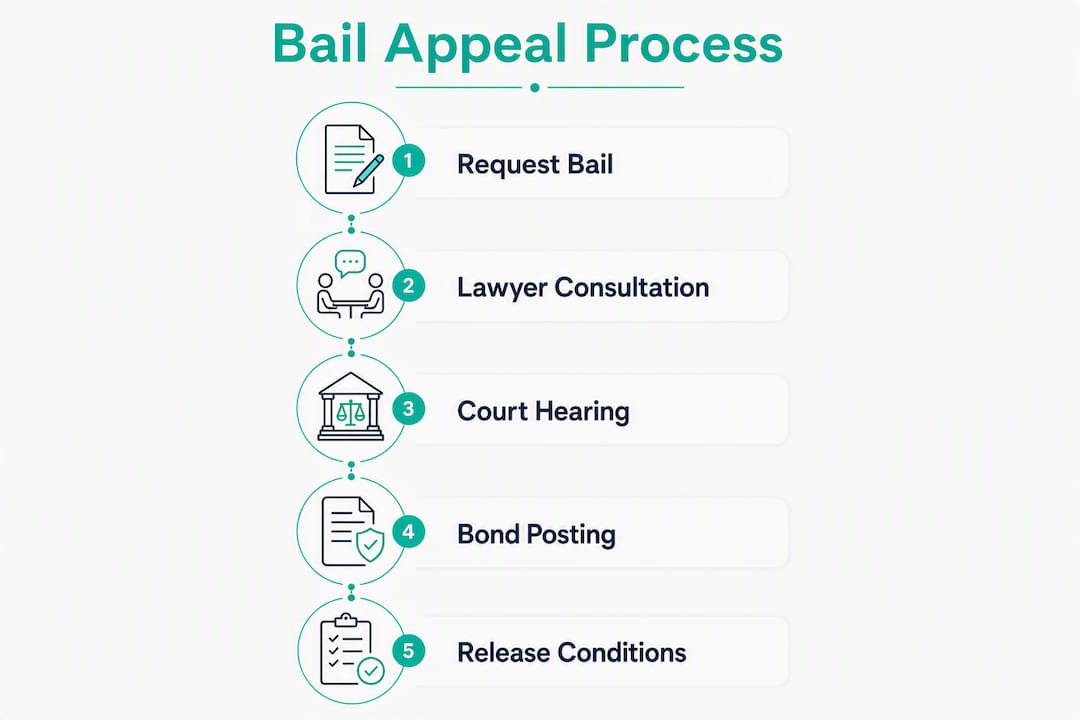
How do you request bail pending appeal, step by step?
The process has a specific sequence, and missing a step can cost you the motion entirely.
- File a timely notice of appeal. The motion for bail pending appeal typically cannot be heard until the notice of appeal is on file. Check local rules for the deadline — in federal court it is generally 14 days after sentencing for the government and 30 days for the defendant.
- Consult appellate counsel immediately. Trial counsel and appellate counsel have different skill sets. If the same attorney is handling both, confirm they have appellate experience. The motion must identify the substantial question or state equivalent, which requires knowing the appellate record cold.
- Check whether the motion must go to the trial court first. Many jurisdictions, including federal court and states like New Hampshire, require the defendant to seek release from the trial court before the appellate court will hear the matter. Skipping this step can result in a procedural denial.
- Draft the motion with this structure:
- Caption and procedural posture (conviction, sentence, date of notice of appeal)
- Statement of the legal standard (cite 18 U.S.C. § 3143 or the applicable state statute)
- Facts addressing flight risk and danger, with specific evidence
- Argument on the substantial question or state equivalent, citing preserved issues and relevant precedent
- Proposed conditions of release (specific, not generic)
- Attach supporting exhibits: declarations from family members or employers, employment records, lease or mortgage documents, letters from community members, surety offers from a licensed bondsman, and any relevant circuit or appellate authority on the legal issue.
- Request an expedited hearing if the defendant is serving the sentence. Every day in custody while the motion is pending is a day that cannot be recovered.
- Preserve appellate review of any denial. If the trial court denies the motion, file an emergency motion with the appellate court promptly. The standard for reversal is abuse of discretion, but a strong factual record from the trial court hearing gives the appellate court something to work with.
Working with both a lawyer and a bondsman early in this process tends to produce better outcomes than bringing in the bondsman only after the court rules.
What security and conditions do courts require for release?
Courts have several options for the financial security they require, and the nonfinancial conditions they attach can be just as consequential.

Financial security types
Cash bail requires the full bail amount deposited with the court. It is returned at the conclusion of the appeal if conditions are met, but tying up that much cash is impractical for most families. Understanding how bail money works before committing to cash is worth the time.
Surety bonds are the most common alternative. A licensed bail bond agent posts the bond on the defendant’s behalf in exchange for a nonrefundable premium (typically a percentage of the bail amount). The bondsman becomes financially responsible for the full amount if the defendant fails to appear or violates conditions. There are practical reasons to use a bond even when you can pay cash, including preserving liquidity and the bondsman’s accountability function.
Property bonds use real estate as collateral. Courts require equity equal to or exceeding the bail amount, and the process involves title searches and court approval, which takes time.
Supersedeas bonds (also called appeal bonds) appear more often in civil cases but can arise in criminal contexts when a fine or restitution order is part of the sentence. They stay enforcement of the financial judgment while the appeal proceeds.
Nonfinancial conditions
Courts routinely attach conditions to release pending appeal: surrender of passports, travel restrictions (often limited to the state or a specific region), electronic monitoring via GPS ankle bracelet, regular check-ins with pretrial services or a probation officer, and no-contact orders with victims or witnesses. In cases involving drug offenses, random drug testing is common.
Pro Tip: When a court is hesitant because of flight risk, propose layered conditions rather than asking for unsecured release. A combination of commercial surety, GPS monitoring, and restricted travel addresses the court’s specific concern on each dimension. Courts that would deny a simple release request often accept a carefully structured package of conditions.
How long do appeals take, and why does timing matter?
Appeals in criminal cases routinely take months to over a year, depending on the jurisdiction, the complexity of the issues, whether oral argument is scheduled, and the appellate court’s caseload. Federal circuits vary considerably; some state intermediate appellate courts move faster, but even “fast” appellate courts rarely resolve a contested criminal appeal in under six months.
That timeline creates a real injustice when the sentence is short. A defendant serving a 90-day sentence for a misdemeanor conviction could complete the entire sentence before the appellate court even schedules oral argument. If the appeal then succeeds, the victory is largely symbolic. Courts in many jurisdictions recognize this and treat the sentence-versus-timeline calculation as a meaningful factor in the bail decision.
Short sentences, particularly misdemeanors and jail terms under a year, are the category most likely to produce a grant of bail pending appeal precisely because the injustice of serving the full sentence pre-appeal is most acute. Longer sentences for serious felonies face the opposite dynamic: the flight incentive is higher and the statutory restrictions are tighter.
While an appeal is pending, defendants and families should track:
- Appellate briefing deadlines (opening brief, response brief, reply brief)
- Any stay applications filed in the trial court or appellate court
- Oral argument scheduling notices
- Any motions to expedite or requests for supplemental briefing
- Compliance deadlines for all conditions of release (check-in dates, monitoring requirements)
What are the realistic odds, and what happens if bail is denied?
Denials are common, particularly in federal court and in state cases involving violent offenses, long sentences, or defendants with prior failures to appear. The statutory test is genuinely demanding, and judges applying it are aware that post-conviction release is the exception rather than the rule.
Success is more likely when the appeal raises a preserved, genuinely debatable legal issue; the defendant has strong community ties and a clean record; the sentence is short relative to the expected appellate timeline; and the proposed conditions of release are specific and credible. Courts are more receptive when the defendant addresses each judicial concern directly rather than making a general argument for release.
If the motion is denied, the options are:
- Motion for reconsideration in the trial court: Useful when new evidence is available (a stronger surety offer, additional community tie documentation, or a change in the defendant’s circumstances). Not a second bite at the same apple — it needs something new.
- Emergency motion to the appellate court: The standard is abuse of discretion, which is a high bar, but appellate courts do reverse trial court denials when the record shows the lower court misapplied the statutory standard or ignored relevant evidence.
- Petition for supervisory relief or writ: Available in some jurisdictions as a last resort when ordinary appellate review would be too slow to provide meaningful relief.
Pro Tip: If the first motion is denied, do not simply refile the same motion. Tighten the factual record: add declarations from additional sureties, propose more restrictive monitoring conditions, and obtain a concrete estimate of the appellate timeline from the court clerk’s office. A stronger factual package gives the appellate court a reason to intervene.
Practical steps for families after a denial:
- Contact appellate counsel within 24 hours to discuss emergency appellate relief
- Identify additional sureties willing to sign indemnity agreements
- Document any new evidence of community ties or changed circumstances
- Prepare a specific, layered conditions proposal for the next filing
What can a bail bond agent actually do in a post-conviction case?
A bail bond agent’s role in the bail-pending-appeal context is narrower than at the pretrial stage, but it is still practically important. When a court orders surety bail pending appeal, the bondsman posts the required security at the jail or clerk’s office, allowing the defendant to be released while the appeal proceeds.
The mechanics work the same way as a pretrial bond: the family or defendant pays a nonrefundable premium, the bondsman executes a surety agreement guaranteeing the full bail amount, and the bond remains in effect until the appeal concludes or the court orders otherwise. Indemnity agreements and collateral requirements apply, and the bondsman has the right to surrender the defendant if conditions are violated.
What an experienced bondsman adds beyond the financial transaction:
- Speed. A bondsman who knows the local jail and clerk’s office can complete the posting process in hours rather than days.
- Coordination with counsel. A good bondsman understands appellate timetables and can help counsel structure proposed conditions that are both acceptable to the court and manageable for the defendant.
- Realistic underwriting. Not every defendant who receives a bail order will qualify for a commercial bond. Bondsmen evaluate risk independently, and a defendant with a history of failures to appear may find that bondsmen are unwilling to write the bond even after the court grants it.
Pro Tip: When vetting a bondsman for a post-conviction situation, ask specifically about their experience with appellate bonds. The timetable is longer than a pretrial bond, indemnity obligations extend through the entire appeal, and the conditions of release are often more complex. A bondsman who handles only routine pretrial bonds may not be equipped for the nuances of a multi-year appellate case.
Families should also understand what happens if the defendant fails to appear during the appeal: the bond is subject to forfeiture, the bondsman will pursue the defendant, and the indemnitors (co-signers) become liable for the full bail amount.
Key Takeaways
Bail pending appeal is limited, often discretionary, and controlled by statutes like 18 U.S.C. § 3143 at the federal level and varying state law, with success depending heavily on the strength of the appeal, the defendant’s risk profile, and the conditions proposed.
| Point | Details |
|---|---|
| Federal standard is demanding | 18 U.S.C. § 3143 requires clear and convincing evidence of no flight risk or danger, plus a substantial question likely to result in reversal. |
| State law varies widely | California, Florida, Texas, and New Hampshire each have distinct statutes or rules; some are more permissive than federal law, others more restrictive. |
| Timing can be decisive | When the expected appellate timeline exceeds the sentence length, courts are more likely to grant release to avoid a hollow appellate victory. |
| Layered conditions improve odds | Proposing commercial surety plus GPS monitoring plus restricted travel addresses each judicial concern and is more persuasive than requesting unsecured release. |
| Armstrongbailbonds can post surety bail | If a Southern California court orders bail pending appeal, Armstrongbailbonds offers fast posting, flexible payment plans, and 24/7 availability to get the process moving immediately. |
The case for taking bail pending appeal seriously
Most commentary on bail pending appeal focuses on the legal standard and stops there. The harder question is what happens when the system works exactly as designed and still produces an unjust outcome: a defendant serves a full sentence, wins the appeal, and walks out of prison to a hollow victory. No amount of legal vindication gives back the time.
The 1984 Bail Reform Act made that outcome more likely, not less, by raising the post-conviction release bar in the name of public safety. That was a deliberate policy choice, and there are legitimate arguments for it. But the practical consequence is that defendants with genuinely meritorious appeals, particularly those with short sentences, often serve their time before the appellate court even hears the case. Courts that recognize this tend to be more receptive to bail when the numbers are laid out plainly.
What gets overlooked in most discussions is the role of preparation. A motion for bail pending appeal that arrives with a concrete appellate timeline, a specific layered conditions proposal, strong surety backing, and a well-preserved legal issue is a fundamentally different document than a generic request for release. The legal standard does not change, but the judge’s confidence that release is manageable does. Families who move quickly, engage appellate counsel immediately, and line up a reliable bondsman before the hearing tend to get better results than those who treat the motion as an afterthought.
The bail system, for all its imperfections, still has room for defendants who make the right arguments in the right way. The window is narrow, but it is real.
How Armstrongbailbonds helps Southern California families act fast
When a court in Southern California orders bail pending appeal, the clock starts immediately. Every day between the court’s order and the bond being posted is a day the defendant stays in custody, and that delay is almost always avoidable.

Armstrongbailbonds has been posting bail across Southern California, including Los Angeles and San Diego, since 1926. For post-conviction surety bonds, that experience matters: the firm knows the local jails, the clerk’s offices, and the procedural steps that can slow release down if you are working with someone unfamiliar with the system. Flexible payment plans, including options for qualifying clients, mean the premium does not have to be a barrier. Bilingual staff (English and Spanish) and 24/7 availability mean you can start the process the moment the court issues its order, not the next business day.
If you have received a bail order pending appeal, the practical next step is straightforward: call to confirm the bail amount and the specific conditions the court imposed, then have your appellate counsel and the bondsman coordinate on any proposed monitoring or reporting requirements before the bond is posted. Getting those details right at the start prevents complications later.
Learn more about how a bail bond works and the steps to get one posted, or reach out to Armstrongbailbonds directly, any time of day or night, to get the process started.
Authoritative sources on bail pending appeal
These primary sources and explainers are the best starting points for deeper research. Bring the statutory citations to appellate counsel for precise application to your jurisdiction.
| Source | URL | What to expect |
|---|---|---|
| 18 U.S.C. § 3143 (Cornell LII) | law.cornell.edu/uscode/text/18/3143 | Full federal statute text on release or detention pending appeal |
| Florida Statutes § 903.132 | flsenate.gov | Florida’s post-conviction bail restrictions for felony convictions |
| N.H. Rule 32 | courts.nh.gov | New Hampshire court rule governing bail pending appeal procedure |
| Justia Criminal Law Center | justia.com | Plain-language overview of bail during appeal, federal and state |
| Nolo Legal Encyclopedia | nolo.com | Practical guide on appellate timelines and bail eligibility |
| UFL Law Review (Substantial Question) | scholarship.law.ufl.edu | Academic analysis of circuit splits on the “substantial question” standard |
| Congress.gov CRS Report R40221 | congress.gov | Congressional Research Service overview of federal bail law architecture |
| Connecticut OLR Report 97-R-0104 | cga.ct.gov | State-by-state overview of discretionary and statutory approaches |
This article provides general legal information, not legal advice. Laws and court rules vary by jurisdiction and change over time. Consult a qualified appellate attorney and verify current statutes with the relevant court or legislature before taking action.
Recommended
- Armstrong Bail Bonds | When Bail and Criminal Defense Overlap: Why Early Legal Representation Matters
- Armstrong Bail Bonds | How Does Bail Help Those Who’ve Been Arrested?
- Armstrong Bail Bonds | Surprising Things You May Not Know About Bail Bonds
- Armstrong Bail Bonds | Bail Bond Conditions For Defendants Before Their Court Date