
Get Release in 30 Minutes: Bail With Bad Credit in Southern California

Yes, bad credit usually will not stop you from getting a bail bond. Agents look at flight risk and stability, not your FICO score, and most will work with you through a cosigner, collateral, or a larger down payment. Your best move right now: gather the booking details and call a licensed bail agent, such as Armstrong Bail Bonds, and tell them upfront about your credit situation so they can offer the right alternative fast.
TL;DR:
- Most bail agents prioritize court appearance risk, community ties, and employment stability, rather than solely relying on credit scores.
- Alternatives like a cosigner, collateral, or higher down payments can help offset poor credit and expedite approval.
- Payment plans are available but should be confirmed in writing with clear fee schedules and late payment penalties.
- Bad credit rarely results in outright denial but shifts the required assurances and risk mitigation measures.
- Experienced agencies can process bond releases quickly, often within 30 minutes, if proper documentation and backup are prepared.
Table of Contents
- What Do Bail Agents Actually Check Besides Your Credit Score?
- What Are Your Options if You Have Bad Credit?
- Quick Checklist: How to Bail Out With Bad Credit Right Now
- Will Bailing Someone Out Hurt Your Credit?
- What Nearly a Century in the Business Teaches About Bad-Credit Bail
- Get Fast, Flexible Bail Help Even With Bad Credit
- Sources
- FAQ
What Do Bail Agents Actually Check Besides Your Credit Score?
Bail agents care far more about whether you or the defendant will show up to court than about a three-digit number on a credit report. Most bondsmen skip deep credit analyses entirely and reserve them for high-value bonds or financing requests. For a routine bond, the underwriting looks a lot more like a background check than a loan application.
What agents typically weigh instead:
- Flight risk signals: prior failures to appear in court, outstanding warrants, or a history of skipping hearings.
- Community ties: how long someone has lived in the area, family nearby, and whether they own or rent locally.
- Employment stability: a steady job, even a modest one, often carries more weight than a credit score.
- Charge severity: a minor misdemeanor gets a different level of scrutiny than a felony with flight-risk history.
Credit checks do happen, but usually only when the bond amount is large enough that the agency wants proof of repayment ability, or when the applicant is requesting a payment plan instead of paying in full upfront. Some agents run a soft check for smaller bonds and lean on employment verification and references instead. When credit is a concern, offering a cosigner, collateral, or a bigger down payment upfront reduces the agency’s risk and speeds up the conversation considerably.
What Are Your Options if You Have Bad Credit?
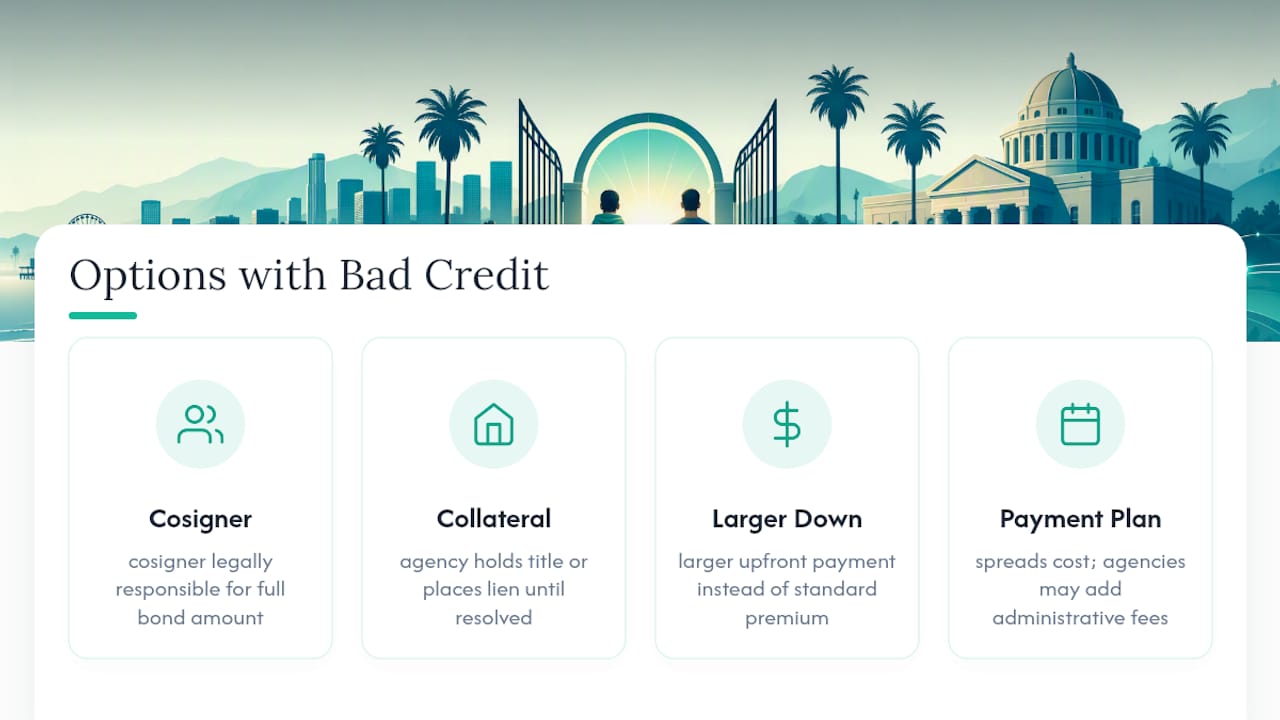
Bad credit changes the shape of the deal, not whether a deal happens. Most agencies will still write the bond. What shifts is which assurance they ask for in place of a clean credit history.
A cosigner. Someone with steady income and a clean record can cosign, legally agreeing to cover the bond if the defendant skips court or misses payments. Agencies generally want proof of income and identification, and the cosigner takes on real financial responsibility for the full bond amount, not just a portion.
Collateral. A vehicle title, a property deed, or a high-value item like jewelry can secure the bond in place of a credit check. The agency typically holds the title or places a lien until the case resolves and the bond obligation is settled.
A higher down payment. Instead of the standard bond premium, some agencies ask for a larger upfront payment to offset the added risk of an applicant with poor credit or unemployment.
Payment plans. Financing spreads the cost over weeks or months, but some agencies add administrative or financing fees for payment plans, and terms vary widely from one agency to the next.
Pro Tip: Ask for the payment plan terms in writing before you sign anything, including the exact fee schedule and what happens if a payment is late. A verbal promise means nothing if the agency later claims different terms.
A low credit score rarely causes an outright denial on its own; it just changes which of these four levers the agency pulls.
Quick Checklist: How to Bail Out With Bad Credit Right Now
Speed matters when someone is sitting in jail, so work through this list in order rather than jumping around.
- Get the booking details. You need the defendant’s full legal name, date of birth, the jail facility name, and the booking number. Most jails post this on an inmate locator, or the agency can look it up for you.
- Gather financial backup in advance. Pull together a potential cosigner’s ID and recent pay stubs, plus bank statements or a vehicle title if you’re offering collateral.
- Call a licensed bail agent and be upfront about your credit. Ask directly which alternative (cosigner, collateral, higher down payment) would get you approved fastest. Agencies commonly accept applicants with poor credit or no job when a cosigner or collateral is on the table.
- Get any payment plan in writing. Confirm the fee schedule, due dates, and default penalties before signing. Walk away from anyone unwilling to put terms on paper or who isn’t licensed in your state.
- Confirm the release timeline. Ask exactly what paperwork happens after payment and how long processing typically takes at that specific facility.
Statistic Callout: Armstrong Bail Bonds reports that clients who arrive with booking information and financial documents already in hand often see release processing completed in as little as 30 minutes once the agreement is signed. Facilities and case types vary, so treat that as a best-case benchmark rather than a guarantee.
Will Bailing Someone Out Hurt Your Credit?
A bail bond is a surety contract, not a loan in the traditional sense, so posting one typically does not create a credit bureau entry by default. Your credit score generally stays untouched just for signing the agreement.
The risk shows up later, in how the bond gets paid off. A hard credit pull becomes more likely on high-value bonds or when you apply for financing to cover the premium. And if a payment plan goes unpaid, the debt can be forwarded to a collections agency, which does hit your credit report.
A few habits protect you here:
- Avoid high-interest financing when a cosigner or collateral arrangement is available instead.
- Keep every receipt and signed payment agreement in one place.
- Set calendar reminders for payment due dates so nothing accidentally lapses into collections.
The bond itself is rarely the problem. Mismanaged repayment is what turns a short-term bail solution into a long-term credit headache.
What Nearly a Century in the Business Teaches About Bad-Credit Bail
Armstrong Bail Bonds has been writing bonds in Southern California since 1926, and that history shapes how the company evaluates applicants with less-than-perfect credit. Nearly a hundred years of working the Los Angeles and San Diego court systems means the agency has seen every version of “my credit isn’t great” and has a playbook for most of them.
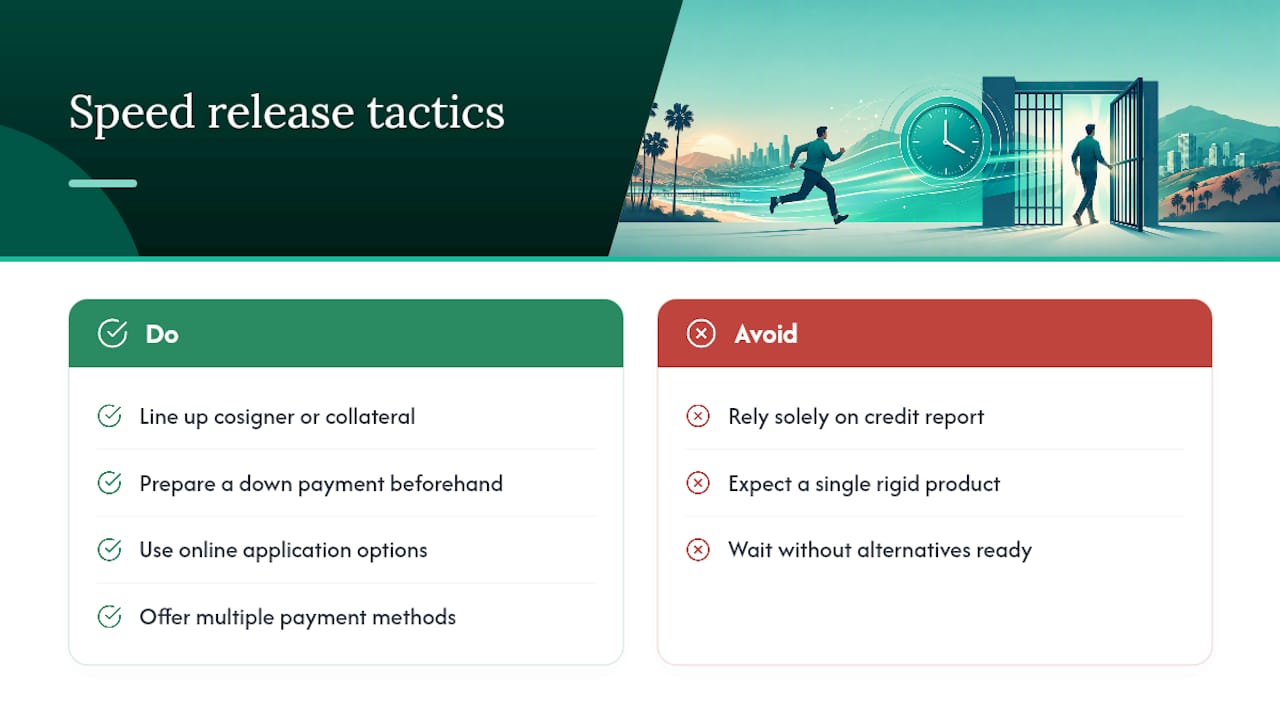
That experience shows up in how fast cases move. Armstrong’s process is built around getting clients through California’s court paperwork quickly, often resulting in release within 30 minutes once terms are agreed and signed. Speed like that depends less on a credit report and more on having the right alternative, cosigner, collateral, or down payment, lined up before the call.
The company also leans on flexibility rather than rigid underwriting: online applications and multiple payment options mean a bad-credit applicant isn’t funneled into a single rigid product. That flexibility is the difference between a family stuck waiting and a family reunited the same day.
— Jake
Get Fast, Flexible Bail Help Even With Bad Credit
Some bail bond agencies provide the option to speak directly with a licensed agent 24/7, offering arrangements such as a cosigner, collateral, or structured payment plans instead of relying solely on credit-based approvals.
If cash is tight and a lower upfront cost matters most, the 1% Bail Bonds or 2% Bail Bonds programs are worth asking about directly, since they’re built around exactly this kind of situation. Whatever your credit history looks like, the fastest path forward is the same: call now or submit a request through Armstrong’s online application, be upfront about your finances, and get the payment terms in writing before you sign.
Sources
For deeper detail on how credit factors into bail decisions, see BailMarket’s breakdown of bail with bad credit and Air Capital Bail Bonds’ explainer on credit checks. Rules and licensing vary by county, so confirm specifics with a local, licensed agent before you commit.
This article is general information, not a substitute for advice from a qualified lawyer. Consult a qualified legal professional about your own circumstances before acting on anything here.
- BailMarket — ‘Can you get bail with bad credit’
- Air Capital Bail Bonds — Do bail bondsmen check your credit?
- Beehive Bail Bonds — How credit affects bail bonds
- City of Denver / Reds Anytime Bail Bonds — Can I get a bail bond with bad credit or no job?
FAQ
Can You Bail Someone Out With Bad Credit?
Yes, in most cases. Bail agents typically prioritize flight risk and community ties over credit history, and alternatives like a cosigner or collateral usually cover the gap left by a low score.
Do Bail Bond Agents Run a Credit Check?
Sometimes, but usually only for high-value bonds or when a payment plan is requested. For smaller bonds, many agents rely on employment verification and references rather than a formal credit pull.
What if I Have No Job and Bad Credit?
Agencies commonly still write the bond when a qualified cosigner or acceptable collateral is offered, since these substitute for income and credit verification. Being upfront about your situation when you call speeds up finding the right arrangement.
Does Getting a Bail Bond Hurt My Credit Score?
No, not directly. A bail bond is a surety contract, and signing one usually doesn’t create a credit bureau entry, though missed payments on a financing plan can eventually land in collections.
How Fast Can I Bail Someone Out With Bad Credit?
Timing depends on the facility and how prepared you are with booking details and financial backup. Armstrong Bail Bonds notes that clients arriving with paperwork ready can sometimes see release processing completed within 30 minutes of signing.