
Credit Card Bail Payment: How to Use a Card and Avoid Surprises

Yes, you can use a credit card to post bail or pay a bail bond premium in many U.S. jurisdictions, but three things can trip you up fast: the facility may not accept cards, your card issuer may treat the charge as a cash advance, and convenience fees are almost always non-refundable. Before you drive to the jail or courthouse, spend five minutes confirming these details.
Immediate checks before you swipe:
- Does the jail or court accept credit cards? (Policies vary by county and docket type.)
- Is there a per-transaction cap? Westchester County Jail, for example, caps credit card bail at $20,000.
- What is the convenience fee, and is it refundable? (Almost never.)
- Will your card issuer code this as a purchase or a cash advance?
Pro Tip: Call the jail clerk or bondsman before you leave home. A quick two-minute call can save you a rejected transaction and an unnecessary trip.
Table of Contents
- How does a credit card bail payment actually work?
- What fees and limits should you expect?
- Using someone else’s credit card to pay bail
- What to do before you pay bail with a credit card
- When should you use a bail bondsman instead?
- Key Takeaways
- The part most people skip until it costs them
- Armstrongbailbonds is ready when card payments hit a wall
- Sources and further reading
How does a credit card bail payment actually work?
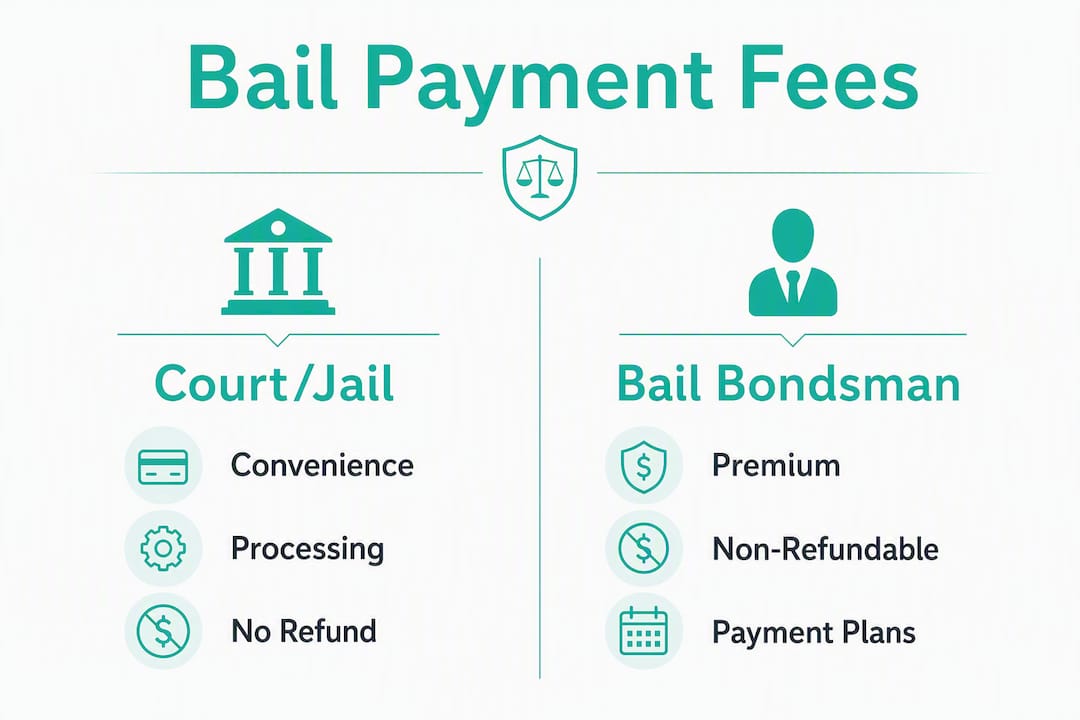
There are two places your card payment can go: directly to the court or jail to post the full bail amount, or to a licensed bail bondsman to pay a non-refundable premium. The path you choose changes the cost, the refund rules, and how fast the defendant gets out.

Paying the court or jail directly
When you pay the court or jail, you are posting the full bail amount. If the defendant appears at all required hearings, the court refunds that amount after the case resolves. Many facilities now accept cards through online portals, lobby kiosks, or phone payment lines. Pennsylvania’s unified court system, for instance, accepts Visa, Mastercard, Discover, and American Express through its PAePay portal, though availability differs by county and docket type. Third-party processors like GovPayNow handle the transaction behind the scenes for many local governments. Pima County, Arizona accepts cash, credit, and debit cards at lobby kiosks 24 hours a day.
To complete a card payment at most facilities, you will need the defendant’s full legal name, booking number, the bail amount, and your own photo ID matched to the card.
Paying a bail bondsman
When you pay a bondsman, you are not posting the full bail. You are paying a premium, generally a portion of the total bail amount, as a fee for the bondsman’s service. That premium is non-refundable, even if charges are later dismissed. Most bondsmen accept major credit cards for the premium, and many offer payment plans.
Paying a bondsman’s premium is usually coded as a retail purchase by the card issuer, often avoiding cash-advance treatment. The court route carries more coding uncertainty, so confirming with your issuer before you pay is worth the call.
What fees and limits should you expect?
The sticker price of bail is not your total cost. Three separate fee layers can stack on top of each other.
Convenience and processing fees
Courts and third-party processors charge a service fee for card transactions. PAePay charges a non-refundable 2.75% per transaction. Some counties charge more: Cass County, North Dakota, for example, charges 8% for credit card bail payments through GovPay. These fees stay with the processor even if the court later refunds your bail in full, per Alaska Courts’ bail payment policy.
Bail bond premiums
| Payment Type | Typical Fee Range | Refundable? |
|---|---|---|
| Court convenience fee | 2.75%–8% of bail | No |
| Bail bond premium | 10%–15% of bail | No |
| Card cash-advance fee | 3%–5% of transaction | No |
Cash-advance classification
This is the fee most people miss. Card issuers often classify bail-related transactions as cash advances, which triggers immediate interest from the posting date, a higher APR, and a cash-advance fee of 3%–5%. There is no grace period. On a $5,000 bail payment, a 5% cash-advance fee adds $250 before interest starts running.
Statistic callout: PAePay charges a non-refundable 2.75% service fee per transaction; Cass County ND charges 8% through GovPay. Add a potential 3%–5% cash-advance fee from your card issuer and the total surcharge on a direct court payment can reach 11%–13% before interest.
A large bail charge can also push your credit utilization above the commonly cited 30% threshold, which tends to lower your FICO score until you pay the balance down. Paying it off quickly reverses most of the damage. Missing a payment does not.
Pro Tip: Call your card issuer before you pay and ask specifically how they code bail-related merchant transactions. If the answer is “cash advance,” consider whether a bondsman’s premium, which is usually coded as a retail purchase, is the cheaper path.
For payments of $10,000 or more in cash, facilities may be required to file IRS Form 8300 and request your Social Security number. Electronic payments can trigger similar identity verification in some jurisdictions, so bring ID and be ready for the paperwork.
Using someone else’s credit card to pay bail
Using a family member’s or friend’s card is common, but it carries real risks that most people do not think through until something goes wrong.
Most facilities require the cardholder’s photo ID to be presented at the time of payment. Some require the cardholder to be physically present. Chenango County, NY, for example, requires a valid photo ID to complete a credit card bail transaction. If you show up with someone else’s card and no matching ID, the payment will be rejected.
The refund problem is trickier. Courts typically treat posted bail as the defendant’s property, which means refunds after case resolution go to the defendant, not to whoever paid. If a third party used their card, they may not automatically receive that money back. This creates a real complication if the relationship sours or if the defendant does not cooperate.
Chargebacks are another hazard. Disputing a bail payment with your card issuer after the fact can be treated as a breach of the payment agreement by the court or bondsman. Courts may view a reversed charge as a failure to post bail, which can lead to the defendant’s re-arrest. For more on credit requirements and documentation when posting bail, the rules vary by facility.
Pro Tip: Get an itemized receipt and a transaction confirmation number before you leave. If you are using a family member’s card, bring the cardholder with you when possible. Written proof of payment protects everyone if a refund dispute comes up later.
What to do before you pay bail with a credit card
Run through this checklist before you attempt any card payment. It takes ten minutes and can prevent a failed transaction or a surprise fee.
Call the courthouse or jail clerk and ask:
- Do you accept credit cards for bail?
- Is there a per-transaction cap on card payments?
- What is the convenience or processing fee, and is it refundable?
- How long after payment should we expect release to occur?
If paying a bondsman, confirm:
- Will the premium be coded as a retail purchase or a cash advance?
- Do you offer payment plans or card-based financing?
- What information does your bail bondsman need to process the payment?
Bring with you:
- The credit card and a matching photo ID
- The defendant’s full legal name and booking number
- Proof of relationship if the facility requires it
After payment:
- Get a printed or emailed receipt with a transaction confirmation number.
- Confirm the refund policy in writing: who receives the refund, when, and how.
Pro Tip: Call your card issuer last, after you have confirmed the facility accepts cards. Ask whether bail-related merchant codes are treated as purchases or cash advances, and what fees and interest rates apply. This one call can change your decision entirely.
When should you use a bail bondsman instead?
Three situations make a bondsman the smarter call. First, the jail or court does not accept cards at all. Second, the bail amount exceeds the facility’s card cap. Third, you do not have enough available credit to cover the full bail, but you can cover a 10%–15% premium.
A bondsman posts the full bail on your behalf. You pay the premium, which is non-refundable, but you avoid the full cash outlay. Most bondsmen accept Visa, Mastercard, and other major cards for the premium, and many offer payment plans for clients who need to spread the cost. If you cannot cover even the premium upfront, payment plan options exist through many agencies.
There are also reasons to use a bondsman even when you can post bail directly: preserving your cash, avoiding the credit-utilization spike from a large charge, and getting professional help navigating the paperwork.
Armstrongbailbonds has operated in Southern California since 1926, covering Los Angeles, San Diego, and surrounding counties. The agency is available 24/7, has bilingual English/Spanish staff, and offers an online application so you can start the process before you reach the facility. Release within 30 minutes of processing is a stated operational goal. Payment options include major credit cards and flexible payment plans; premium rates typically run 10%–15% of the bail amount.
When a court payment fails because of a card cap or a rejected transaction, calling a licensed bondsman immediately is the fastest path to release. Every hour of delay is an hour the defendant stays in custody.
Pro Tip: Ask the bondsman directly whether their payment processor codes the premium as a retail purchase. Most do, which avoids cash-advance fees, but confirming takes thirty seconds and can save you real money.
Key Takeaways
Using a credit card to post bail is possible in many U.S. jurisdictions, but convenience fees, cash-advance classification, and per-transaction caps mean the true cost is almost always higher than the bail amount alone.
| Point | Details |
|---|---|
| Cards are accepted, with limits | Many courts and jails accept Visa and Mastercard, but caps and availability vary by county. |
| Fees stack up fast | Court convenience fees run 2.75%–8%; card cash-advance fees add another 3%–5% on top. |
| Refunds go to the defendant | Courts typically return bail to the defendant, not the cardholder, so get a receipt and confirm the refund policy. |
| Call ahead every time | Confirm card acceptance, transaction caps, and the exact fee before you leave home. |
| Armstrongbailbonds is the fast alternative | When card limits or court policies block direct payment, Armstrongbailbonds offers 24/7 bondsman service with flexible card-based payment plans across Southern California. |
The part most people skip until it costs them
The single most common mistake in a credit card bail payment situation is not the fee. It is the assumption that a successful payment means an immediate release. Payment confirmation and release processing are two separate steps. A charge can post to your card while the defendant sits waiting because the paperwork was not submitted to the right window, or the booking desk has not received the clearance yet.
The fix is simple but almost nobody does it: after your payment is confirmed, ask the clerk specifically which department handles release processing and whether there is anything else you need to submit. At many facilities, a release order has to travel from the payment window to the booking unit, and that handoff can stall for hours if nobody follows up. A licensed bondsman who works with a facility regularly knows exactly who to call to move that process along.
The other thing worth saying plainly: if you are weighing whether to post full bail by card or use a bondsman, the math often favors the bondsman when bail is large. A 10%–15% non-refundable premium sounds worse than getting your money back eventually, but factor in the convenience fee, the potential cash-advance interest, and the credit-utilization hit, and the gap narrows considerably.
Armstrongbailbonds is ready when card payments hit a wall
When a court rejects your card, the transaction cap is too low, or you simply need someone who knows the facility’s release process cold, Armstrongbailbonds is the faster path. With nearly a century of experience in Southern California, the agency handles misdemeanor, felony, and property crime bonds across Los Angeles, San Diego, and surrounding counties, 24 hours a day, every day of the year.
The agency accepts major credit cards for bond premiums and offers flexible payment plans. Bilingual staff and an online application mean you can start the process right now, from wherever you are. Premium rates typically run 10%–15% of the bail amount. Learn how bail bonds work and what to expect, or call Armstrongbailbonds directly for immediate help getting your family member home.
Sources and further reading
Local jail and court policies on card payments change without notice. Your clerk is always the authoritative source for accepted payment methods, current caps, and exact fees. The sources below are the most reliable starting points.
- Westchester County Jail: Posting Bail: Covers cash and credit card bail procedures, including the $20,000 card cap and accepted card types.
- PAePay Bail Online (Pennsylvania Unified Court System): Official portal for electronic bail payments in Pennsylvania; lists accepted cards and the 2.75% service fee.
- Cass County, ND: Paying Bail: Details the GovPay processor and the 8% credit card fee; explains refund routing to the defendant.
- Chenango County, NY: Credit Card Bail: Shows the Government Payment Service phone process and photo ID requirement.
- Pima County Sheriff: Pay a Bond: Lists 24/7 kiosk and online card payment options at the main jail complex.
- Milwaukee County Sheriff: Pay Bail: Explains IRS Form 8300 reporting requirements for large payments.
- Alaska Courts: Bail Information: Confirms that convenience fees are non-refundable even after bail is exonerated.
- LegalClarity: Can You Pay Bail With a Credit Card?: Explains cash-advance classification, premium refund rules, and credit-utilization effects.
- Armstrongbailbonds: Do I Need Sufficient Credit to Bail Someone Out?: Covers credit and documentation requirements for posting bail in Southern California.
- Armstrongbailbonds: What Information Does Your Bail Bondsman Need?: Step-by-step list of what a bondsman requires to process a bond.
This article is general information, not legal or financial advice. Bail payment rules, fees, and accepted methods vary by jurisdiction. Confirm current policies with your local court clerk or a licensed bail agent before acting.