
Drug Testing on Bail: What Families Should Expect
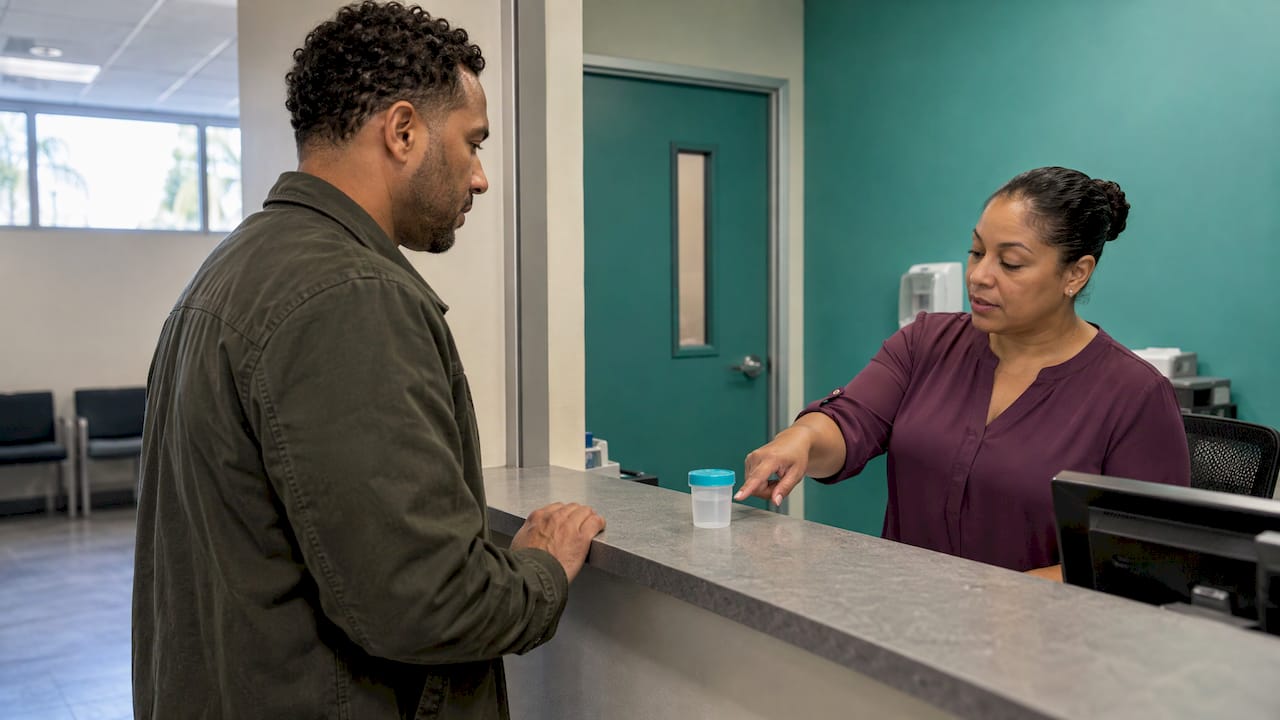
Yes, a person released on bail can be drug tested, but only when a judge orders it as a condition of release. A commercial bail bond gets your loved one out of jail. The court’s conditions, including any testing, then govern what happens next. At Armstrong Bail Bonds we are a family-owned business that has served Southern California since 1926, and we walk families through those conditions before anyone signs, so that nothing about release day is a surprise.
TL;DR
- Testing is not automatic. A judge adds it as a release condition when it is tied to appearing in court or protecting public safety.
- Where it is ordered, it usually means urine screens at set or random times, plus regular check-ins with a pretrial officer.
- A missed, refused or positive test is reported to the court. The judge decides the response, which can range from a warning to stricter conditions or revocation of release.
- Rules differ by state and county, so read the written release order and ask your agent what applies.
- Call us 24/7 at the start so the paperwork and the conditions are clear before release.
Table of Contents
- Who can order testing, and why
- How testing usually works
- What happens after a missed, refused or positive test
- How long conditions last
- How to prepare your loved one for release
- Getting someone out first
- Our perspective
- FAQ
- Sources
Who can order testing, and why
Bail has two parts. The first is the money or bond that secures release. The second is the list of conditions the judge attaches. Testing belongs to the second part.
In federal court, 18 U.S.C. § 3142© lets a judge require a person to refrain from using controlled substances without a prescription and to undergo treatment for drug or alcohol dependency. The judge must choose the least restrictive condition that reasonably assures the person will appear and the community stays safe. The U.S. Courts’ reference guide on substance use testing says testing may be imposed on its own or as part of a treatment condition, with frequency matched to the person’s risks.
States set their own rules. Washington’s RCW 10.21.045 lets a judge require compliance testing when it is needed to protect the public from harm. Louisiana requires testing within 24 hours of booking for people arrested on controlled-substance or violent crime charges.
What this looks like in California
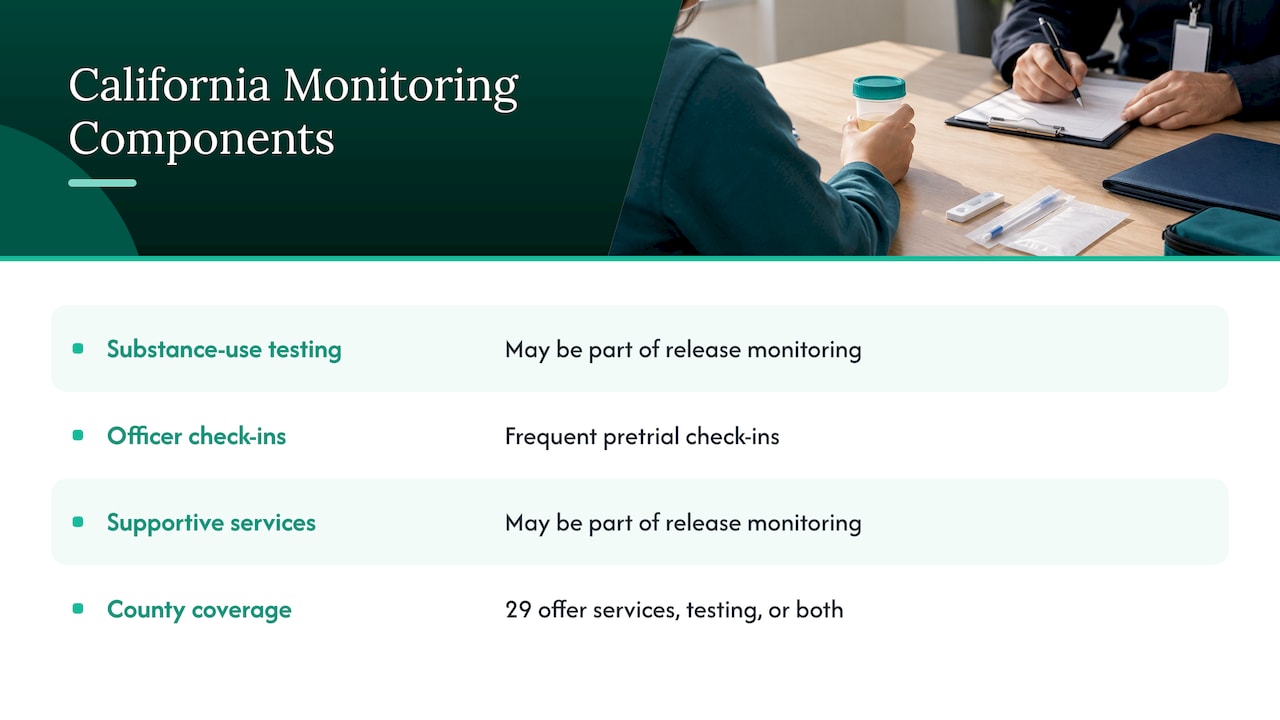
California counties run pretrial programs differently. The Judicial Council’s 2026 report on pretrial services says release with monitoring can include substance use testing, frequent check-ins with pretrial officers and supportive services, and that 29 counties offer drug services, testing at required check-ins, or both. So a person released in Los Angeles or San Diego may or may not face testing. It depends on the charge, the person’s history and the judge’s order.
Drug-related charges make testing more likely, though it is not limited to them. Our page on bail bonds for drug crimes explains how those cases usually move.
How testing usually works
Timing. Federal pretrial services try to collect a sample before the first court appearance or right after it, according to the federal drug testing manual. Illinois law also has the initial sample collected before release.
Method. Urine is the standard. The federal manual and Illinois law both rely on it. Some programs use saliva swabs, and breath tests are used for alcohol.
Frequency. It varies a lot:
| Program | Typical pattern |
|---|---|
| Illinois statewide pretrial policy | Initial screen within 60 days of supervision; random screens at least every 90 days for higher-risk people; no routine random screens after two negatives |
| Eastern District of Michigan | Monthly or random testing |
| D.C. pretrial services | Daily call-in line; reporting may be required on any day, including weekends and holidays |
Many programs use a call-in line. You phone a recorded message each day, learn whether you are selected, and report to the testing site if so. The Northern District of New York asks people to bring photo ID and give an unadulterated, observed sample. Missing the call or the test can itself count as a violation.
If your loved one will be tested on a schedule like this, it helps to understand how supervised urine screening is run so the routine feels less intimidating.
What happens after a missed, refused or positive test
The test does not decide guilt. The federal manual says results go to the judge and both attorneys and are used to set release conditions, not to prove a new charge. It also says a positive result alone should never trigger an automatic recommendation of detention. Positives are retested with a second test, and a negative retest is what gets reported.
What comes next depends on the court and the county:
- Illinois: a first confirmed positive means more frequent testing and a warning. A second confirmed positive can lead to a hearing, and bail may be increased (725 ILCS 5/110-6.5).
- Virginia: violations can bring stricter conditions, contempt proceedings or revocation of release, and a contested positive must be reconfirmed (Va. Code § 19.2-123).
- Dane County, Wisconsin: the court may issue a warning, schedule a bail hearing or issue a warrant (county pretrial services).
A missed test is often treated more seriously than people expect. In Illinois policy, a refusal is documented and reported to the court, and a defendant who cannot produce a sample within 2 hours of the request may be treated as having refused.
In California, a violation of release conditions can affect the bond too. Our guide to bail violation consequences in California lays out what families should know, and bail bond conditions before the court date covers the everyday rules.
Prescriptions and honesty at intake
A prescription from a licensed medical provider is generally treated differently from illegal drug use. The federal statute speaks of use “without a prescription,” so keep prescription labels and a provider’s note available and tell the pretrial officer about medications before a test. Someone with a medical condition or a question about what a result could mean for their case should speak to their defense attorney.
How long conditions last
Usually until the case ends. Virginia’s statute, for example, allows testing as a condition until final disposition of the case. The judge can change conditions at a later hearing, and a defense attorney can ask the court to reduce testing if the person has complied.
What do researchers say? The Advancing Pretrial Policy & Research summary reports that decades of studies find no clear effect of testing on court appearance or new arrests. That is one reason many courts now try to match testing to individual need. The U.S. Courts’ guide likewise says the intensity of testing should fit the person’s circumstances. For families, the practical takeaway is that a judge has room to adjust conditions, so ask the defense attorney whether a change is appropriate once a loved one is doing well.
How to prepare your loved one for release
- Get the written release conditions. Ask for the order and read every line. Know whether testing, check-ins or treatment are required.
- Write down the schedule. Note call-in hours, testing sites, hours of operation and the time by which a sample must be given.
- Plan transportation. A missed test is often a violation, so arrange rides for the whole period of the case.
- Keep prescriptions documented. Carry labels and a provider’s note.
- Do not use anything that could show on a screen. That includes substances the order forbids, even where laws are looser elsewhere. The conditions of release control.
- Tell your bail agent about any problem early. If a test is missed or a check-in is hard to make, a quick call is better than silence.
- Keep every court date. Testing is only one of the conditions. Appearing is the one that matters most.
If the person is re-arrested, the consequences are different and more serious. See our guide on being arrested while on bail.
Getting someone out first
Testing rules only apply after release, so the first job is getting your loved one out. Our bail premium is 10% of the bail amount, and we offer payment plans, including 2% bail bonds and 1% bail bonds options, as well as no collateral bail bonds. You speak with a licensed agent, not a call center, around the clock. Staff are bilingual in English and Spanish, and you can start the application online or in person.
In Los Angeles County, start with our Los Angeles County bail bonds page. In San Diego, see San Diego County bail bonds.
When you call, tell us the charge and the jail. We explain the cost, the timing and what the court may require after release, so your family knows the conditions before anyone signs. Our 24-hour bail bonds service means that call can happen at any hour.
Our perspective
Families often call us worried about the bond and surprised by everything that comes after it. Drug testing is a good example. People assume it is a punishment. In most cases it is a tool the court uses to keep a release workable, and a person who treats it as a routine, like a work shift, usually gets through it.
We have been in this business since 1926, across four generations, and our advice has stayed simple. Read the conditions on day one. Put the testing schedule on the fridge. Call us before a problem becomes a violation. Our agents are licensed, available 24/7, and happy to talk through what the paperwork means in plain language.
The cost of the bond should never be the hard part of this. That is why we offer flexible payment plans and an online application, so a family can focus on helping their loved one meet the court’s requirements.
Jake
FAQ
Can you be drug tested while out on bond?
Yes, if the judge ordered it. Testing is a release condition, not an automatic feature of every bond. The U.S. Courts’ guide says it may stand alone or be part of a treatment condition. Check the written order for your loved one.
How many days can we get bail?
There is no fixed number of days. Bail is generally set at arraignment or according to a county schedule, and release can happen once the bond is posted. Timing depends on jail processing. We often see release within about 30 minutes of posting once the paperwork is complete, and you can start the process any time of day.
Is it better to bail out or stay in jail?
Bailing out lets your loved one work, meet with their attorney and prepare their defense from home, while following the release conditions. If the bail amount is a worry, ask us about payment plans.
Do bail bondsmen have police powers?
No. A bail agent is a licensed professional who posts the bond and helps make sure the defendant gets to court. Arrests are carried out by law enforcement. Our job is to explain the process, keep you informed of court dates and be reachable when questions come up.
Sources
- 18 U.S.C. Chapter 207, release and detention (GovInfo, 2024 edition)
- U.S. Courts: Substance Use Testing and Substance Use Disorder Treatment
- RCW 10.21.045, Washington
- Louisiana pretrial drug testing law
- California Judicial Council 2026 pretrial services report
- Federal Drug Testing Procedures Manual
- Illinois Office of Statewide Pretrial Services drug screening policy
- U.S. Pretrial Services, Eastern District of Michigan
- U.S. Pretrial Services, District of Columbia FAQ
- Northern District of New York urinalysis page
- Illinois 725 ILCS 5/110-6.5
- Code of Virginia § 19.2-123
- Dane County Pretrial Services
- Advancing Pretrial Policy & Research: Pretrial Drug Testing