
Sign Bail Electronically in California for Families: §1633 & Rule 2.257

Yes. Electronic signatures are legally valid for bail bond paperwork in California, provided a licensed bail agent underwrites the bond and the signature meets state verification standards. The signer’s identity must be confirmed, the record must stay tamper proof, and the agent still has to post the bond through the jail or court. Most delays come down to county-level ID checks, not the signature itself.
TL;DR:
- Electronic signatures are legally valid for bail bonds in California if the signer provides verified identification and the record remains tamper-proof.
- California Civil Code §1633 and Rule 2.257 ensure e-signatures hold the same legal weight as handwritten ones when intent and verification are demonstrated.
- The verification process typically involves ID uploads, live selfie checks, timestamped audit trails, and encrypted storage to meet legal standards.
- Most counties accept e-signed bail documents, but some may require additional identity confirmation or notarization, which could delay release if not prepared.
- The actual speed of release depends on jail processing times, with verified online signings often resulting in bond posting within an hour if verification is smooth.
Table of Contents
- Is an Electronic Signature Bail California Process Legally Valid?
- How Does the Online Bail Signing Process Actually Work?
- What Verification Standards Apply to E-Signed Bail Documents?
- What Should You Have Ready Before You Sign?
- An Agent’s View on E-Signing for Fast Release
- Get Bail Paperwork Signed Fast With Armstrong Bail Bonds
- Where to Verify the Rules Yourself
- Sources
- FAQ
Is an Electronic Signature Bail California Process Legally Valid?
Two pieces of law do the heavy lifting here. California Civil Code §1633 says an electronic signature carries the same legal weight as an ink one, as long as the signer intended to sign, consented to do it electronically, and the resulting record stays intact. That’s the statute that makes an electronic signature bail California transaction possible in the first place. It doesn’t single out bail bonds. It applies broadly to contracts, which is exactly why bail agreements qualify.
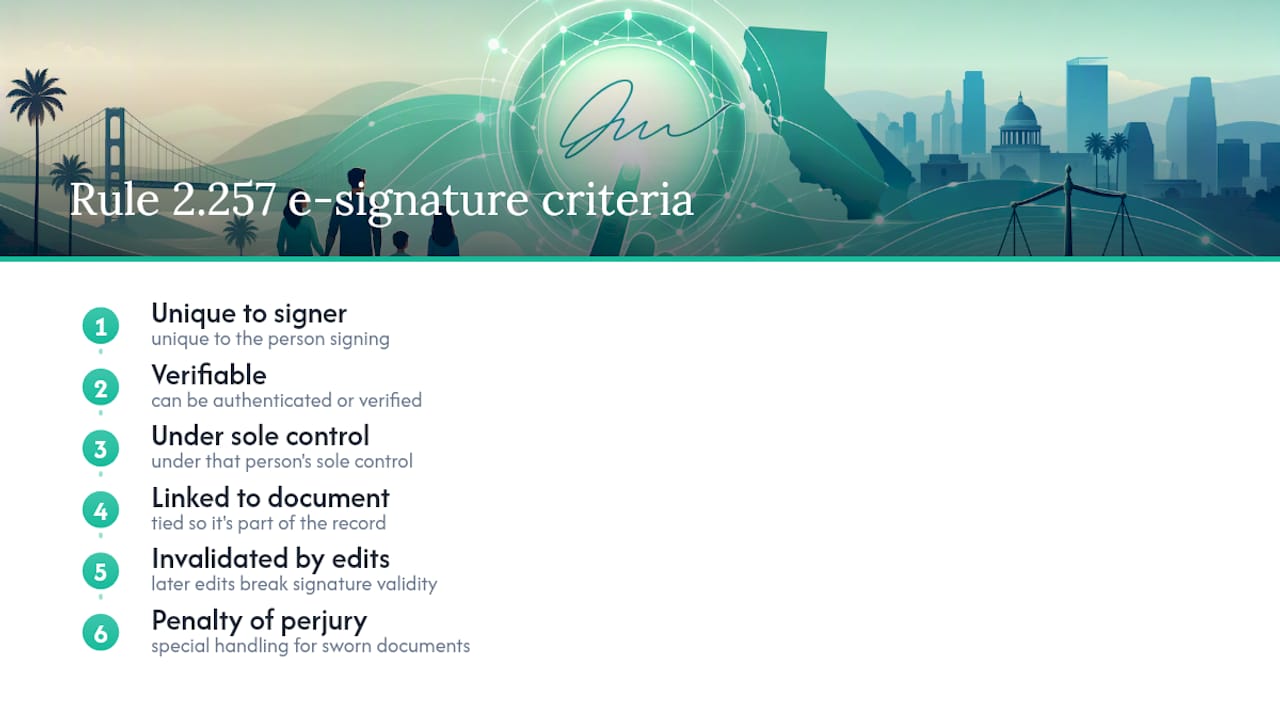
The second layer is procedural. Rule 2.257 of the California Rules of Court sets the bar for what counts as an acceptable e-signature on documents connected to the court system: it has to be unique to the person signing, verifiable, under that person’s sole control, and linked to the document so that any later edit breaks the signature’s validity. Rule 2.257 also spells out special handling for documents signed under penalty of perjury, which matters because some bail paperwork includes sworn statements.
None of this changes who can actually write the bond. The California Department of Insurance still requires bail bonds to be underwritten and issued by a licensed agent. E-signing speeds up the paperwork. It doesn’t replace the license, the underwriting, or the surety relationship behind the bond. If you’re unsure what a bondsman is legally allowed to do in this process, that authority is defined by California licensing law, not by whichever signing method the agent uses.
How Does the Online Bail Signing Process Actually Work?
Here’s the typical sequence once you decide to sign bail bond documents electronically instead of driving to an office at 2 a.m.
- You submit an online application. Expect fields for the defendant’s full name, the jail or facility holding them, the booking number if you have it, and your relationship to the defendant.
- The agent verifies your identity. This usually means uploading a photo ID, a live photo match, and sometimes two-factor authentication through text or email.
- You review and e-sign the indemnity agreement. The platform records a timestamp, your IP address, and an audit trail showing exactly when and how you signed.
- You complete payment. This covers the bail bond fee, not the full bail amount, and many agents offer payment plans for qualifying cases.
- The agent posts the bond with the jail or court. This step depends entirely on the facility’s processing speed, not on how the paperwork got signed.
- The defendant is released, assuming no holds, warrants, or paperwork mismatches are flagged during intake.
Release timelines vary by facility, but agents who handle high volumes of online bail bond requests often move from signed agreement to posted bond in well under an hour when identification checks go smoothly. The biggest delay factor isn’t the e-signature. It’s jail booking backlogs, name mismatches, or the defendant being moved between holding areas during a shift change.
Pro Tip: Have the defendant’s booking number ready before you start the application. It’s the single fastest way to cut down verification time, since it lets the agent confirm custody status immediately instead of searching by name alone.
What Verification Standards Apply to E-Signed Bail Documents?
Rule 2.257 breaks down into three practical requirements: intent, attribution, and verifiability. Intent means you clearly meant to sign, not that you accidentally clicked through a form. Attribution means the signature is tied specifically to you and nobody else. Verifiability means there’s a record proving both of those things if anyone ever questions the agreement later.
In practice, this shows up as a handful of concrete security features:
- Unique login credentials or one-time verification codes sent to your phone or email
- Government-issued ID uploads cross-checked against a live selfie
- Time-stamped audit trails logging every click, view, and signature event
- Encrypted document storage that flags any post-signature edits
Platform providers like DocuSign build these audit trail and identity-verification features specifically so agents can meet Rule 2.257’s evidentiary standards without printing a single page. That said, some situations still call for a notarized signature, particularly on certain sworn declarations. California law does allow electronic notarization to satisfy that requirement when the notary’s own electronic signature and required credentials are attached to the record. If you’re ever unsure whether your agent’s platform actually retains this data, ask directly. A trustworthy agent will show you the audit log or receipt without hesitation, which is one of several signs worth checking before you sign anything.
What Should You Have Ready Before You Sign?
Getting through the process fast means showing up prepared, not scrambling mid-application.
Documents and information to gather:
- A valid photo ID for yourself (driver’s license, passport, or state ID)
- The defendant’s full legal name, date of birth, and booking number if available
- Your relationship to the defendant (spouse, parent, friend, etc.)
- A payment method, since most agents accept cards, bank transfers, or financing for qualifying applicants
Questions worth asking any agent before you commit:
- What verification method do you use, and how long does it usually take?
- What’s the expected time from signature to bond posting at this specific jail?
- What’s the total fee, and is there a payment plan option?
- Will I get a copy of the signed agreement and a receipt I can access later?
Pro Tip: If an agent can’t clearly explain their license number or dodges questions about how they verify signers, treat that as a warning sign. Legitimate agents are required to be licensed by the state and should have no problem sharing that information. Watch out too for agents pushing you toward untraceable payment apps with no receipt trail. If you ever need to confirm that a signed document or payment receipt actually went through, verifying electronic confirmations is a reasonable extra step before you assume the job is done.
An Agent’s View on E-Signing for Fast Release
Electronic signatures have made the worst hours of someone’s life a little less painful. Families used to drive across town at 3 a.m. just to put a pen on paper. Now that same paperwork gets handled from a phone in the parking lot outside the jail. The exceptions are real, though. Court holds, immigration flags, or a name that doesn’t match jail records will stop any bond, e-signed or not, until they’re resolved. What hasn’t changed is the paper trail. A good agent keeps the audit log, the ID verification, and the receipt on file long after the release, so nobody’s left guessing what they agreed to months later.
— Jake
Get Bail Paperwork Signed Fast With Armstrong Bail Bonds
Armstrong Bail Bonds is the option for families who don’t have time to sit in an office or wait on a fax machine. Since 1926, Armstrong has built the local relationships across Los Angeles and San Diego that actually move bonds through jail intake faster, and the online bail bonds system lets you complete the entire application and e-signature from your phone, day or night.
To start, have the defendant’s name, booking number, your relationship to them, and a payment method ready. Armstrong’s staff work in English and Spanish and answer calls around the clock, so there’s no waiting for business hours while someone sits in custody. Payment plans and multiple payment options are available for those who qualify, including reduced-rate bonds for eligible cases. If you’re ready to move, start the online application now or call Armstrong directly to get the signing process underway.
Where to Verify the Rules Yourself
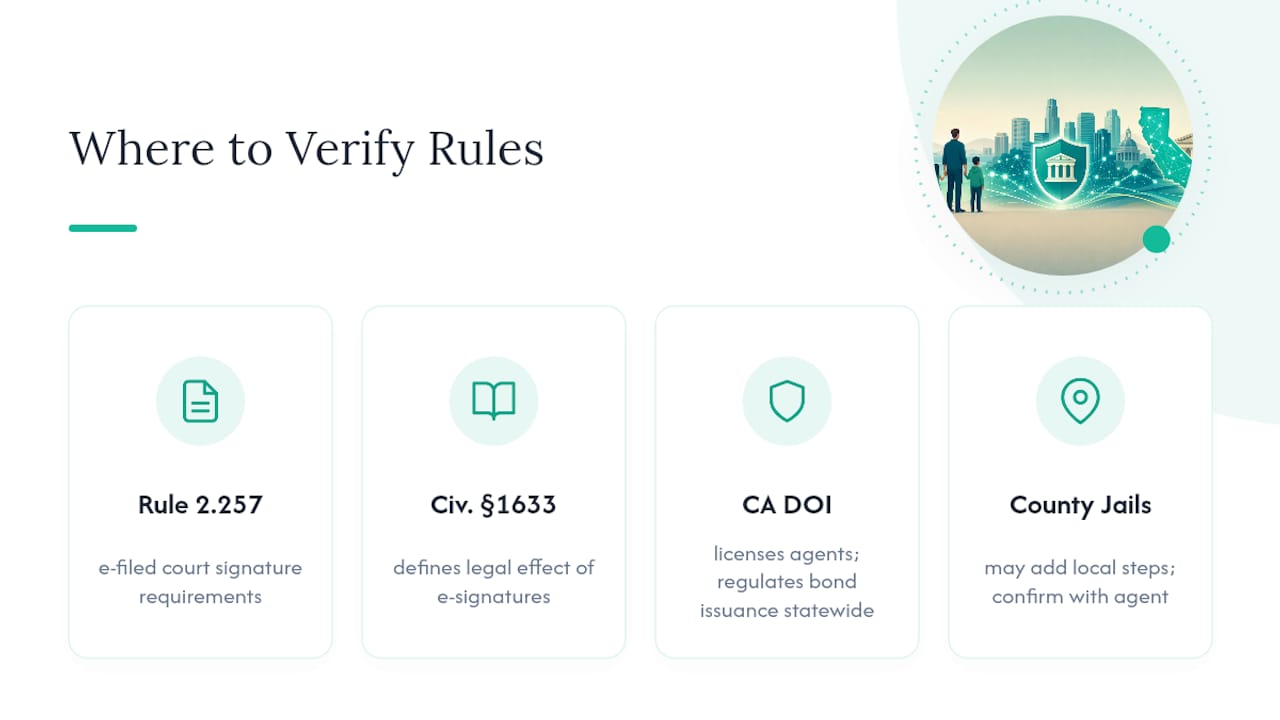
For readers who want the primary sources instead of a summary: Rule 2.257 covers signature requirements for electronically filed court documents. Civil Code §1633 defines the legal effect of an electronic signature generally. The California Department of Insurance regulates bail agent licensing and bond issuance statewide. County jails may add their own operational steps on top of these rules, so it’s worth confirming directly with your agent if you’re posting bail somewhere unfamiliar.
Sources
- California Civil Code §1633
- Rule 2.257. Requirements for signatures on documents | Judicial Branch of California
- Bail Bonds | California Department of Insurance
FAQ
Is an electronic signature bail California agreement as legally binding as a paper one?
Yes. Under Civil Code §1633, an electronic signature carries the same legal force as a handwritten one when intent, consent, and record integrity are all present.
Do all California counties accept e-signed bail bond paperwork?
Most do, but some jails apply extra identity checks or, in rare cases, require an original signature, so confirming with your agent about that specific facility saves time.
What happens if my e-signature isn’t accepted at a particular jail?
The bail agent typically switches to an in-person signing option or arranges a notarized document if the facility requires it, without restarting the entire application.
How fast can I get someone released after signing electronically?
Timelines depend on jail processing speed, but agents handling routine, verified cases through platforms like Armstrong Bail Bonds’ online system often post bonds and secure release in well under an hour.
Do I need to be physically present to e-sign a bail bond?
No. That’s the entire point of an electronic signature bail California workflow: you can complete the application, verification, and signature remotely from a phone or computer.