
California Pretrial Release: $70M Boost, What Families Must Do

Pretrial release in California means getting out of jail while criminal charges are pending, through own recognizance (OR), supervised release, or a bail bond. Judicial officers, guided by county pretrial services and validated risk tools, are required to choose the least restrictive option that still protects public safety and court appearance. Which path applies depends on the charge, the person’s risk score, and often, how fast their family moves.
TL;DR:
- Risk assessment tools and pretrial services are crucial in determining the least restrictive release option tailored to a defendant’s risk level and charge.
- Judges are required to consider a defendant’s ability to pay and less restrictive alternatives before setting bail, especially following the In re Humphrey ruling.
- Supportive services like transportation vouchers and treatment referrals often accompany supervised release but are ineffective if overly restrictive for low-risk defendants.
- Most arrests result in release within 30 minutes after posting bail, with early release possible through prearraignment review or cite-and-release for minor offenses.
- The nonrefundable nature of bail bond premiums remains the same, regardless of case dismissal, emphasizing the importance of understanding the true cost upfront.
Table of Contents
- The Legal Framework Behind Pretrial Release in California
- How Judges Decide: Pretrial Services, Risk Tools, and SB 36
- Own Recognizance, Supervised Release, or Bail: What Are Your Options?
- Ability to Pay: What In re Humphrey Changed for Families
- Common Conditions: Matching Supervision to Actual Risk
- From Arrest to Release: What the Timeline Actually Looks Like
- After Release: Staying Compliant and What Happens If Charges Drop
- What Families Actually Get Wrong About This System
- Need Fast Release? Here’s a Direct Path Forward
- Sources
- FAQ
The Legal Framework Behind Pretrial Release in California
California law starts from a simple premise: liberty is the default, not the exception. A person accused of a crime hasn’t been convicted, and the state’s pretrial system is built around keeping people out of custody unless a judge finds real reasons, tied to flight risk or public safety, to do otherwise.
The California Pretrial Services Program operationalizes this by helping judicial officers apply evidence-based release conditions rather than defaulting to cash bail. That shift didn’t happen by accident. The California Supreme Court’s 2021 ruling in In re Humphrey forced courts to confront a hard truth: setting bail at an amount someone can’t possibly afford functions as detention, not release, and that’s a constitutional problem when the person poses no real danger or flight risk.
Judges document their reasoning on Form CR-104, which requires them to record specific findings on flight risk, danger to the public, and whether less restrictive alternatives were considered before financial conditions are imposed.
A few practical takeaways from the statutory landscape:
- Judges must weigh ability to pay before setting a bail amount, not just consult a bail schedule.
- Detention orders require documented findings, not a rubber stamp.
- Least-restrictive conditions are the legal starting point for every case, misdemeanor or felony.
How Judges Decide: Pretrial Services, Risk Tools, and SB 36
Behind every release decision sits a pretrial services officer and, usually, a risk score. California funds this infrastructure through Senate Bill 129, which the Judicial Council has used to build out risk assessment instruments, supervision programs, and support services in counties statewide.
Those instruments, known as pretrial risk assessment instruments (PRAIs), score a defendant’s likelihood of missing court or reoffending based on factors like criminal history and current charge severity. Senate Bill 36 requires every agency using a PRAI to validate it against local outcomes at least once every three years, with the studies made public. That’s meant to catch tools that systematically overstate risk for certain groups.
The $70 million question: the 2024 Budget Act allocated that amount in ongoing annual funding to expand risk assessment, monitoring, and supportive services across California courts.
Key mechanics worth knowing:
- Risk scores feed into prearraignment reports so judges can act before the formal arraignment hearing.
- Counties vary widely in how automated this process is, and that variation directly affects how long someone sits in custody.
- Supportive services (transportation vouchers, treatment referrals) often accompany a release recommendation, not just a score.
Own Recognizance, Supervised Release, or Bail: What Are Your Options?
Three doors lead out of custody pending trial, and each fits a different situation.
- Own recognizance (OR) release. A judge lets the person go on a written promise to return, typically for lower-risk defendants facing misdemeanor or nonviolent felony charges with minimal criminal history. No money changes hands.
- Supervised release, also called alternatives to detention (ATDs). This adds structure: GPS monitoring, drug or alcohol testing, mandatory check-ins, or treatment referrals. Research from MDRC shows these programs reduce reliance on cash bail while keeping appearance rates steady, particularly for moderate to higher-risk defendants.
- Monetary bail and bail bonds. When a judge sets a dollar amount, families often can’t pay it outright, so they turn to a bail bond. The difference between bail and a bail bond matters here: a bond company posts the full amount for a nonrefundable premium fee.
Ability to Pay: What In re Humphrey Changed for Families
In re Humphrey didn’t abolish cash bail, but it changed the math. Judges now have to actually inquire into what a defendant can afford and consider less restrictive alternatives before locking in a bail figure, according to guidance the California Department of Insurance references alongside its bail agent oversight rules.
That opens a real opportunity for families, if they move fast. Evidence that helps demonstrate ties to the community and ability to pay includes:
- Recent pay stubs or proof of steady employment
- A lease or mortgage statement showing a stable address
- School enrollment records for dependents
- Letters from employers, clergy, or community members willing to vouch
Pro Tip: Gather these documents before the first court appearance, not after. Defense counsel can use them to request OR release or a bail reduction at arraignment, and judges respond better to a folder of proof than a verbal promise. Understanding how bail amounts get calculated in the first place helps families know what they’re pushing back against.
Common Conditions: Matching Supervision to Actual Risk
Courts don’t hand every released defendant the same set of rules. Typical conditions include:
- Stay-away orders from a victim or specific location
- Travel restrictions, often limited to the county or state
- GPS ankle monitoring
- Scheduled drug or alcohol testing
- Regular check-ins with a pretrial officer, by phone or in person
The evidence is fairly consistent: supervised release programs work best for defendants who actually carry elevated risk. Slapping GPS monitoring and daily check-ins on a low-risk defendant doesn’t make anyone safer. It just adds friction that can trigger a technical violation for someone who was never a real flight or safety concern. If your loved one’s bond conditions seem disproportionate to the charge, that’s worth raising with defense counsel before the next hearing.
From Arrest to Release: What the Timeline Actually Looks Like
The clock starts at booking, and California law caps the wait for arraignment at 48 hours (excluding weekends and holidays), per Penal Code timing rules.
- Booking. Minor offenses sometimes end here with cite-and-release, no jail stay at all.
- Prearraignment review. In the 35 of 58 California courts that have implemented this step, a pretrial officer submits a risk report before arraignment, and 29 of those courts allow release before the arraignment hearing itself. Nineteen courts have automated parts of this process for 24/7 review.
- Arraignment. If release wasn’t granted earlier, this is where a judge sets bail, grants OR, or orders detention.
- Posting bail or activating supervision. With a bond company involved, release can happen within roughly 30 minutes of paperwork clearing, though jail processing times vary by county.
After Release: Staying Compliant and What Happens If Charges Drop
Release isn’t the finish line. It comes with obligations, and breaking them has consequences.
- Missing a court date, failing a drug test, or violating a stay-away order can trigger a bench warrant.
- Judges can modify conditions (adding monitoring) or revoke release entirely, sending someone back into custody pending trial.
- If charges are later dropped or dismissed, that doesn’t reverse a bail bond premium. Per California Department of Insurance guidance, the premium is earned once the bond is posted and is generally nonrefundable regardless of case outcome.
What Families Actually Get Wrong About This System
Most people assume pretrial release is a formality, something that happens automatically once bail is “set.” It isn’t. The number that actually matters isn’t the bail schedule figure. It’s whether anyone in the room, a public defender, a pretrial officer, a family member with documents in hand, pushes for the least restrictive option the law already requires judges to consider.
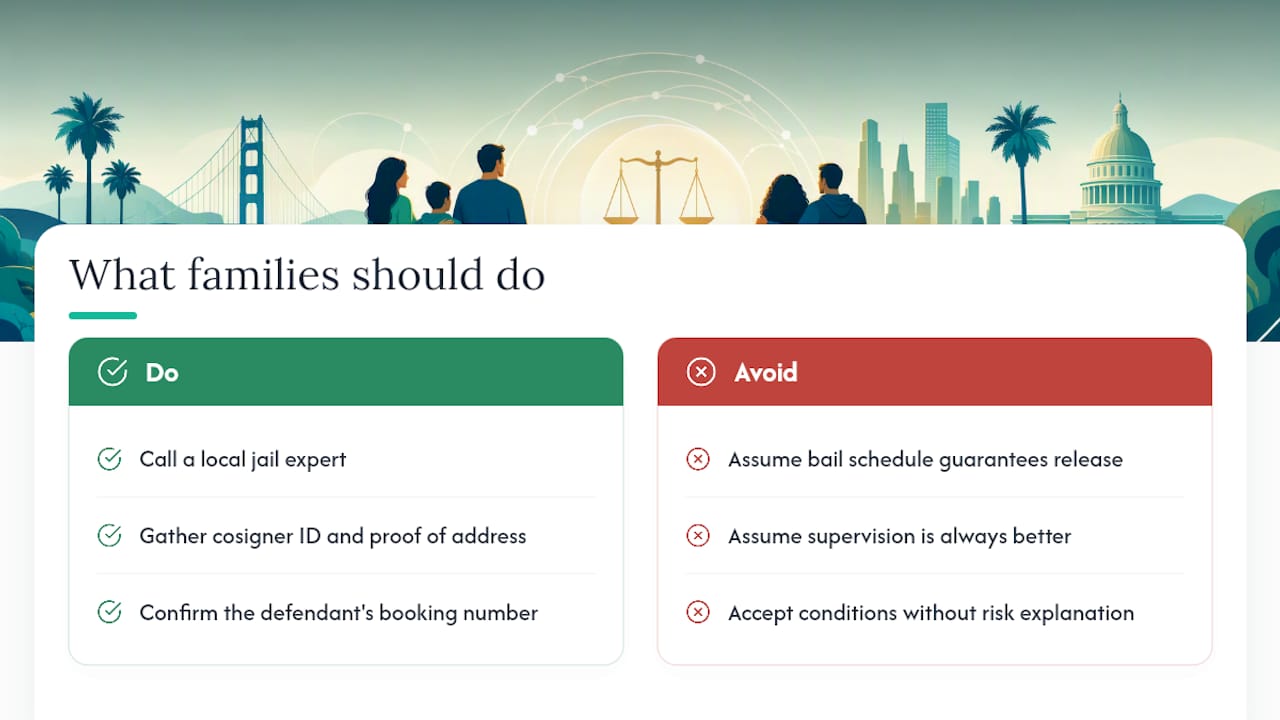
I’d also push back on a common assumption that supervised release is always the “better” option because it sounds less punitive than bail. For a low-risk defendant, daily check-ins and GPS monitoring can create more ways to fail than they prevent. The smarter question isn’t “OR or bail or supervision?” It’s “does the condition actually match this person’s risk?” That’s the whole point of validated risk tools under SB 36, and it’s worth asking your attorney to explain, directly, why a specific condition was attached to a specific case.
Where Armstrong Bail Bonds fits into this from an operational standpoint: nearly a century of working inside Southern California’s court system means knowing which jails move fast on paperwork and which need a phone call first. Families dealing with this for the first time should do three things immediately: call someone who knows the local jail’s process, gather ID and proof of address for the cosigner, and confirm the exact booking number before anything else.
— Jake
Need Fast Release? Here’s a Direct Path Forward
Pretrial services and risk assessments explain the why behind a release decision, but families usually need the how, fast. Armstrong Bail Bonds is the direct route to posting bail once a judge sets an amount: licensed agents answer calls 24/7, not a call center, and the online application lets you start the paperwork before you even reach the jail.

Payment flexibility matters when bail hits five or six figures without warning. Armstrong offers 2% bail bonds and no collateral options for families who qualify, on top of standard payment plans. One thing worth being upfront about: the premium paid on a bail bond is earned once the bond posts, and it stays nonrefundable even if the case is later dismissed, that’s standard under California Department of Insurance rules, not an Armstrong-specific policy. If you need someone out now, call the number on the Armstrong Bail Bonds site or submit the online request, agents are standing by around the clock in both English and Spanish.
This article is general information, not a substitute for advice from a qualified lawyer. Consult a qualified legal professional about your own circumstances before acting on anything here.
Sources
- California Pretrial Services Program | Judicial Branch of California
- California Department of Insurance — Bail Bonds consumer guidance
FAQ
Is pretrial release a good thing?
For most defendants, yes, it preserves employment, housing, and family stability while the case is pending, and California’s evidence-based framework aims to release people without increasing public safety risk. The Judicial Council’s pretrial services program is built specifically around finding that balance rather than defaulting to detention.
Can you go back to jail after pretrial release?
Yes. Violating release conditions, such as missing a court date, failing a drug test, or breaking a stay-away order, can lead a judge to revoke release and order the person back into custody pending trial.
Can a case get dropped at pretrial?
Yes, prosecutors can dismiss charges before trial for insufficient evidence or other reasons, but that doesn’t undo a bail bond premium already paid. Per California Department of Insurance guidance, the premium is earned when the bond is posted and stays nonrefundable regardless of how the case ends.
Do they drug test you on pretrial release?
Only if the court orders it as a condition of release, drug or alcohol testing isn’t automatic for everyone. It’s typically applied when the underlying charge or the defendant’s risk profile suggests substance use is relevant to public safety or appearance risk.
How fast can someone actually get released after arrest?
It depends on the path: cite-and-release can happen at booking for minor offenses, prearraignment review lets some courts release people before formal arraignment, and posting a bail bond through a service like Armstrong Bail Bonds can move release along within about 30 minutes of paperwork clearing, once bail has been set.