
Ventura County Bail Process: From Booking to Release
When someone is arrested in Ventura County, bail is set by a county schedule, you pay it at the jail or through a bail bond, and release usually follows within hours. A bond lets your family post a large bail amount for a fee of 10% of that amount. You also get a licensed agent to walk you through the paperwork. Armstrong Bail Bonds has served Southern California families since 1926, and our agents answer the phone around the clock. Below is how the process works, in order, so you know what to do at each step.
TL;DR
- Bail for a new arrest comes from a countywide schedule set by the Ventura Superior Court, unless a warrant or a judge says otherwise.
- A bail bond lets you post the full bail amount for a premium of 10% of it. On $20,000 bail, that is $2,000.
- Release after bail is posted generally takes 1 to 4 hours, and the jail does not release people between midnight and 6:00 a.m. unless they are bailing out.
- Some charges, such as serious or violent felonies and domestic violence, cannot be released before arraignment on a different amount than the schedule sets.
- Start by finding the booking record on the Sheriff’s inmate search, then call a bondsman with the booking number.
Table of Contents
- Step 1: Find the person and their bail amount
- Step 2: Understand where the bail amount comes from
- Step 3: Know what a judge considers
- Step 4: Choose how to pay
- Step 5: Release, and how long it takes
- If nobody posts bail
- Promo: getting a bond started
- Our perspective
- FAQ
- Sources
Step 1: Find the person and their bail amount
Before you can pay anything, you need to know where the person is held and what bail is set at. The Ventura County District Attorney directs the public to the Sheriff’s website and its inmate list for anyone in the county jail. Someone in state prison is looked up through the state corrections department instead.
Search by first and last name or by booking number. The Sheriff’s Inmate Information page explains how to run the search and check the record. The Sheriff’s office at 800 S. Victoria Ave in Ventura keeps weekday hours of 8:00 am to 5:00 pm and is closed weekends, so a record can be easier to find online than by phone at night.
Write down three things: the full legal name, the booking number and the bail amount. A bondsman needs all three. If the person was only just arrested, the record may take a while to appear. Early in the process they may be at a police station rather than the main jail.
Step 2: Understand where the bail amount comes from
In California, a person arrested without having seen a judge is held at a preset amount. Under Penal Code §1269b, that is the amount written on the arrest warrant. If there is no warrant, it is the countywide bail schedule. The superior court judges in each county must adopt and revise that schedule every year.
The Ventura Superior Court bail schedule lists amounts by charge. A few examples from the 2024 edition:
| Charge | Scheduled bail |
|---|---|
| Murder | $500,000 |
| Carjacking | $100,000 |
| Escape from county jail | $50,000 |
| Felony corporal injury to a spouse (PC 273.5) | $20,000 |
| Unlisted felony | $10,000 |
| Other unlisted misdemeanor | $2,500 |
Murder with special circumstances carries no bail. The schedule also states that listed section numbers include their unlisted subdivisions.
Rules that raise the number
The schedule has add-ons. Under its rules, a crime committed while on bail or probation adds $5,000 for each misdemeanor probation or diversion and $10,000 for each felony one. New offenses during release double the standard bail. Felony enhancements are added to the base offense: second-degree robbery with a personal firearm is $300,000, which is $50,000 plus $250,000. Attempts, conspiracies and similar charges take the target offense’s bail, but not less than the amount listed for that charge.
An out-of-county hold with no amount on a warrant is treated under the felony schedule, with a minimum of $10,000. A warrant-only arrest is set at the warrant amount unless a judge orders otherwise.
If your loved one is on probation, the added amounts can change the total quickly. Our page on probation violation bail bonds covers how those cases are handled. Release conditions can also include testing, and a guide to probation drug testing schedules explains what panels and windows look like.
When the schedule does not apply
The schedule is only a starting point. A peace officer can ask a judge for higher bail by declaration under Penal Code §1269c. If no order changes bail within eight hours of booking, the person is entitled to release on posting the schedule amount.
For offenses in Penal Code §1270.1(a), which covers serious and violent felonies, stalking and misdemeanor domestic violence, the schedule says release before arraignment must be at the scheduled amount, not more or less. If a judge raises the bail or grants own-recognizance release, the person cannot go home before arraignment even if bail is posted. In those cases, a family should expect to wait for the first court appearance.
Step 3: Know what a judge considers
At arraignment, the first court appearance, a judge can set, reduce or deny bail. Under Penal Code §1275, the judge weighs:
- public safety, the primary consideration
- seriousness of the offense
- previous criminal record
- the probability the person will appear
Seriousness includes injury or threats to a victim or witness, use of a firearm or deadly weapon, and use or possession of controlled substances.
The rules also moved in 2026. In In re Kowalczyk, decided April 30, 2026, the California Supreme Court held that in noncapital cases courts may deny bail only for the offenses named in the state constitution. Otherwise they generally must set monetary bail at a reasonably attainable amount, based on an individual assessment that includes the person’s finances. So the number at the first hearing can differ from the schedule, and a bondsman can help you plan around whichever amount is set.
Step 4: Choose how to pay
The Sheriff’s Posting Bail page lists the ways to post at the Pre-Trial Detention facility:
- Exact-amount cash.
- A cashier’s check payable to the Ventura County Superior Court (or the relevant out-of-county jurisdiction).
- A bail bond.
- A credit or debit card, online through GovPayNet or by phone at 1-888-604-7888 using PLC #6404.
State law allows bail in cash or in a surety bond issued by a certified insurer, and the person is discharged from custody on that offense once bail is posted. That is the point of a bond: you do not need the whole bail amount on hand.
What a bond costs
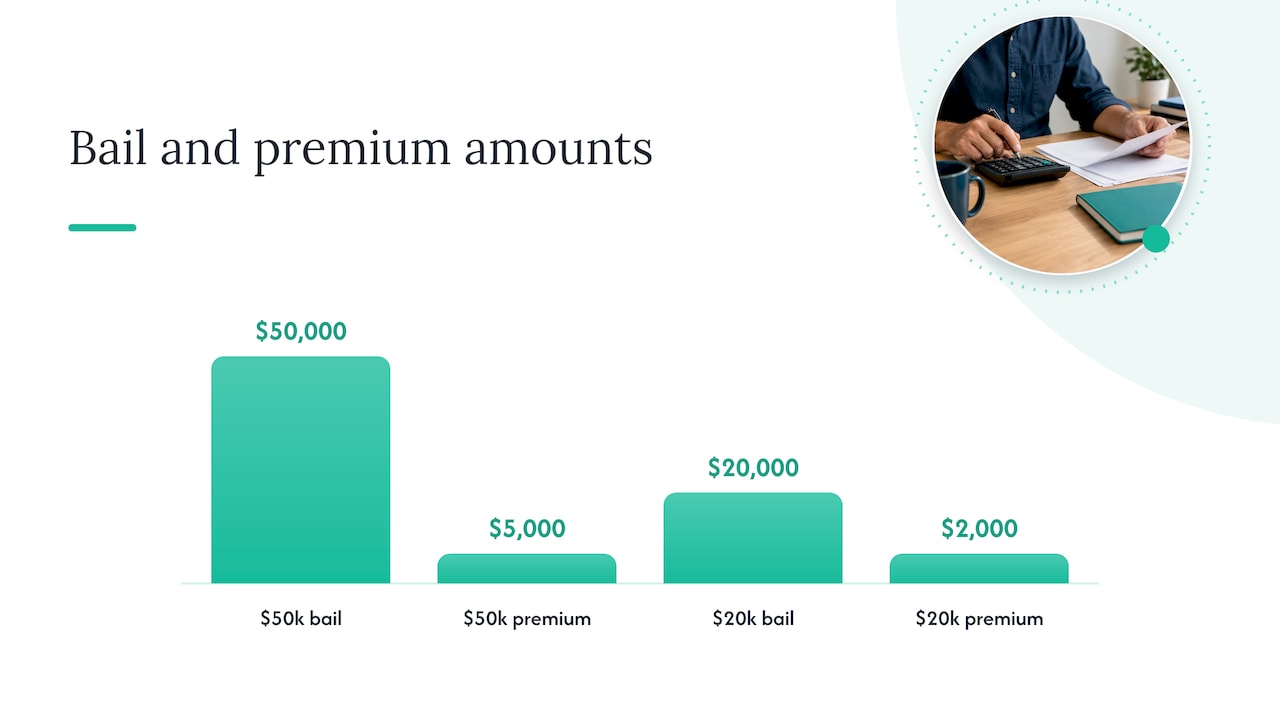
A bail bond premium is a percentage of the bail amount. Ours is 10%. On a $50,000 bail, the premium is $5,000. On the $20,000 scheduled for felony spousal injury, it is $2,000. The premium is the fee for the service, and the full bail amount stays with the court.
We also offer payment plans and financing for qualifying customers, including 2% bail bonds and 1% bail bonds. If cost is the main worry, our guide on what to do if you can’t afford bail in California lays out the options. We also offer no collateral bail bonds, so many families never have to put up property.
The person who signs
Whoever signs the bond, the cosigner, is legally responsible for the payment and for making sure the defendant goes to every court date. Choose that person carefully, and make sure they have the court dates written down. Our explainer on what a bail bond is and how to get one goes through the signing.
A note on the source of bail money
A peace officer or prosecutor may challenge where bail money came from. Under the schedule’s Rule 11, if facts suggest the money came from a felony, bail is not accepted until a magistrate is contacted, and a legitimate source must be shown if probable cause is found (Penal Code §1275.1). Using your own legitimately earned funds, or a bond, keeps this from becoming an issue.
Step 5: Release, and how long it takes
After bail is posted, the jail still has to process the release. The Sheriff’s April 2026 inmate orientation brochure says release is completed as soon as practicable, generally within 1 to 4 hours. That covers records review, returning clothing and property, notice of future legal obligations and fingerprinting. The county grand jury’s June 2026 inquiry into detention facilities notes that processing can run six to 10 hours after bail is posted, so plan for a longer wait on a busy day.
Two timing facts matter to families:
- For safety, people are not released between midnight and 6:00 a.m. unless they are bailing out or have a forthwith release from the court. A bail release can happen overnight.
- People preparing for release may make up to three free phone calls from the Property/Release area to arrange a ride.
Our pages on how long after bail is posted someone is released and bail release time cover what speeds up or slows down the wait. Our own process often leads to release within about 30 minutes of paperwork being finished at our end, though jail processing sets the final timing.
Once your loved one is out, the Sheriff says inmates are told their court date at booking. Confirm it, put it in every cosigner’s calendar, and plan how they will get to court. Missing a court date puts the bond and the cosigner at risk.
If nobody posts bail
Bail is not the only path to release. For a misdemeanor, Penal Code §1270 entitles a person in custody at arraignment to own-recognizance release, meaning release on a promise to appear, unless the court finds that release would endanger public safety or would not reasonably assure appearance. Then the court sets bail and conditions.
Before arraignment, a request for own-recognizance release or bail below schedule goes to the on-call magistrate on Superior Court Form 3000, submitted through the classification deputy at the jail. That form is typically handled by the defense side.
Some people need a hearing in open court first. Under Penal Code §1319.5, anyone on felony probation or parole, and anyone with three or more failure-to-appear warrants in the past three years who is arrested for listed offenses, must have that hearing. The same Sheriff brochure also describes a county parole program that eligible inmates can apply to for early release, and the Public Defender can help with the application.
Promo: getting a bond started
If you are ready to post bail, we can start with your loved one’s name and booking number. You can apply through our online bail bonds page or reach a licensed agent at any hour through our 24-hour bail bonds line. Our staff are bilingual in English and Spanish, and the bond premium is 10%, with payment plans for qualifying customers. You can see everything we offer on our main page.
A free inmate search is available as well, so you can confirm the booking before you call.
Our perspective
Families usually reach us on the worst night of their year. They have a booking number, a dollar figure they were not prepared for, and a clock running in their heads. What helps most is a straight answer: what the bail is, what the fee is, what happens next.
We have been doing this since 1926, and four generations of our family have worked in California’s bail system. You speak with a licensed agent, not a call center, at any hour. We can start the process by phone, online or in person, and we explain costs, timing and eligibility before you sign.
The 2026 Kowalczyk ruling means bail amounts will be looked at more closely for what a person can reasonably pay. Whatever number is set, a bond lets a family put the defendant at home with them while the case goes forward, and payment plans can spread the cost.
Jake
FAQ
How much do you pay for bail in California?
If you use a bond, you pay a premium of a percentage of the bail amount. At Armstrong Bail Bonds the premium is 10%, so $10,000 bail costs $1,000. If you post cash instead, you pay the full amount to the court.
What does $50,000 bail mean?
It means the court needs $50,000 in cash or a surety bond to release the person. With a bond at a 10% premium, the fee is $5,000. The full amount is a guarantee that the person returns for every court date.
What if no one posts bail?
The person stays in custody until a judge reviews the case at arraignment. The judge may order own-recognizance release, lower the bail, or keep it. Families who want the person home sooner can contact us about a bond at any hour.
Can I start the bond from outside the county?
Yes. We can begin the process remotely through our online application or by phone, and an agent will explain what is needed. You will need the person’s full name, the booking number and the bail amount.
Sources
- How can I find out where someone is incarcerated? (Ventura County District Attorney)
- Inmate Information (Ventura County Sheriff)
- California Penal Code §1269b
- Ventura Superior Court 2024 Bail Schedule
- Ventura Superior Court 2024 Bail Schedule rules
- California Penal Code, Part 2 (§§1269c, 1275)
- In re Kowalczyk, California Supreme Court, April 30, 2026
- Posting Bail (Ventura County Sheriff)
- Ventura County Jails orientation brochure, April 2026
- Annual Inquiry of Detention Facilities, Ventura County Grand Jury
- California Penal Code §1270
- California Penal Code, Part 2 (§1319.5)
- Probation Drug Testing: Panels, Windows & Schedules