

27 Mar Can Hit and Run Charges Be Dropped? Strategies for Dismissal & Getting Out of Jail
If you are wondering if hit and run charges can be dropped, the answer is yes, but the outcome depends heavily on the specific facts of your case and how quickly you take action. Facing these charges in California is overwhelming, but understanding the legal pathways to a dismissal can help you regain control of your future. Armstrong Bail Bonds is here to provide the support and information you need to navigate the jail system and start building a strong defense.
Understanding Hit and Run Charges in California (CVC 20002 & 20001)
In California, a hit and run occurs any time a driver leaves the scene of an accident without identifying themselves to the other parties involved. It does not matter who caused the accident; the crime is the act of leaving.
Misdemeanor vs. Felony: When is a Hit and Run a Serious Crime?
The severity of the charge is determined by the outcome of the crash:
Misdemeanor (CVC 20002): This applies when there is only property damage. This includes hitting a parked car, a fence, or even a mailbox.
Felony (CVC 20001): This is a much more serious “wobbler” offense that applies if someone other than the driver was injured or killed.
The Legal Duty: What You Were Required to Do at the Scene
To avoid a hit and run charge, the law requires you to stop immediately. You must provide your name, current address, and registration information. If the owner of the property isn’t there, you are legally required to leave a visible note and notify the local police or the California Highway Patrol (CHP).
Common Reasons for Arrest and Booking in Southern California
Most arrests occur after a witness records a license plate number or a doorbell camera captures the incident. In Southern California cities like Los Angeles, San Diego, and Riverside, police often follow up at the registered owner’s home. If they find a damaged vehicle matching the description, an arrest usually follows.
How to Get Hit and Run Charges Dropped or Reduced
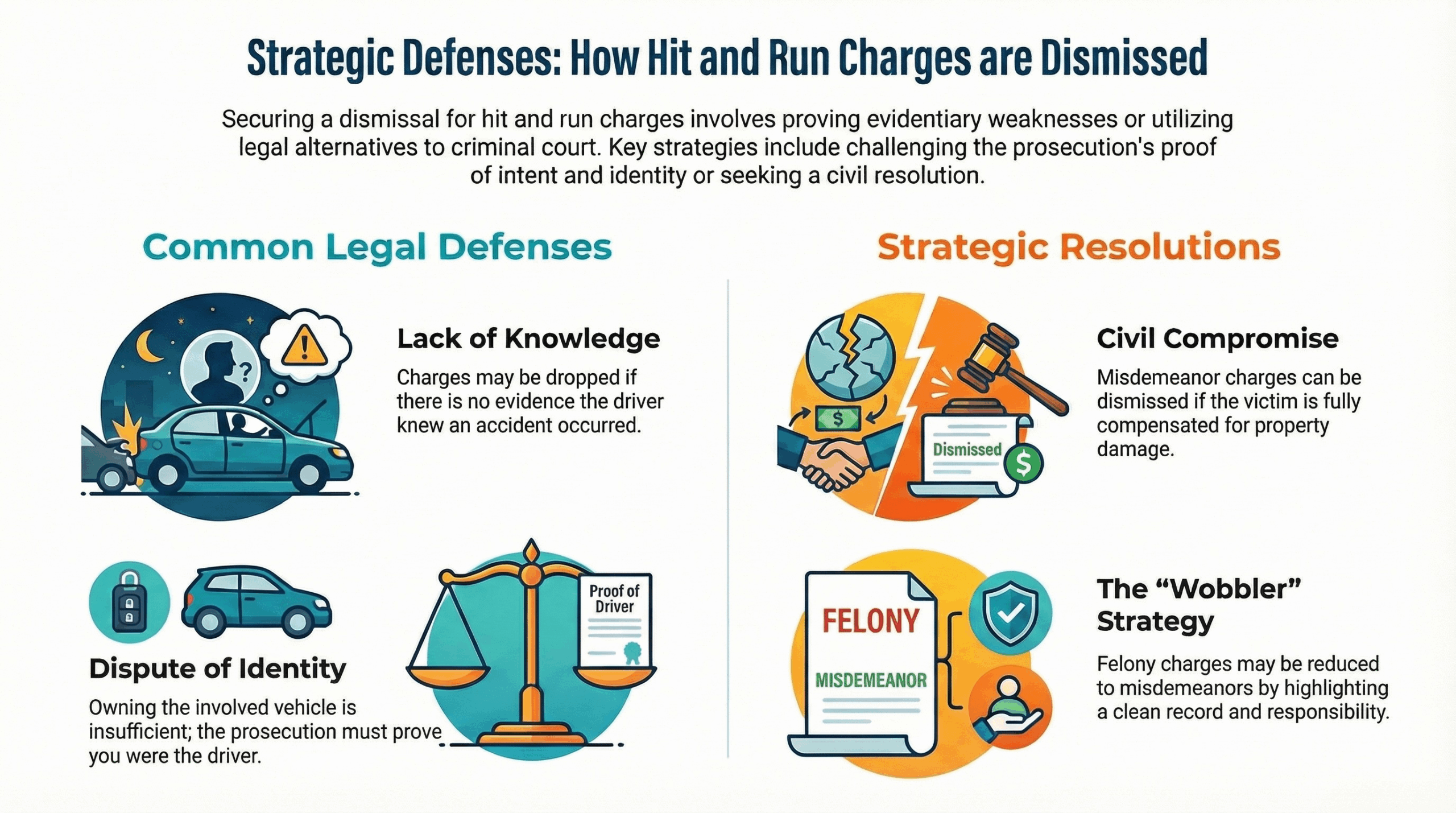
Getting a case dismissed requires proving that the prosecution’s evidence is weak or that a legal alternative exists to resolve the matter outside of criminal court.
Lack of Knowledge: “I Didn’t Know I Hit Anything”
One of the most common defenses is a “lack of knowledge.” If you hit a small object at night or were driving a large truck and didn’t feel the impact, you cannot be “willfully” guilty of leaving the scene. If there is no evidence that you knew an accident occurred, the charges may be dropped.
Dispute of Identity: Can They Prove You Were the Driver?
The prosecution must prove that you were the one behind the wheel. Simply owning the car involved in the accident isn’t enough for a conviction. If you weren’t driving—perhaps a friend or family member was—your attorney can use this to have the charges dismissed against you.
Civil Compromise: Using Restitution to Dismiss Misdemeanor Charges
In California, Penal Code sections 1377 and 1378 allow for a Civil Compromise. This is a powerful tool for misdemeanor hit and run cases. If the victim agrees that they have been fully compensated for their property damage, a judge has the discretion to dismiss the criminal charges entirely. This turns a criminal matter into a private insurance or cash settlement.
Reducing Felonies to Misdemeanors (The “Wobbler” Strategy)
If you are charged with a felony because of a minor injury, an attorney can argue to have it reduced to a misdemeanor. This is often called a “wobbler” strategy. By highlighting a clean driving record and showing that you have taken responsibility, you can avoid the long-term consequences of a felony conviction.
The Role of Bail in Hit and Run Cases
When an arrest is made, the first priority is getting out of jail. Staying in a cell makes it nearly impossible to coordinate with a lawyer or gather evidence for your defense.
How Bail is Determined for Hit and Run
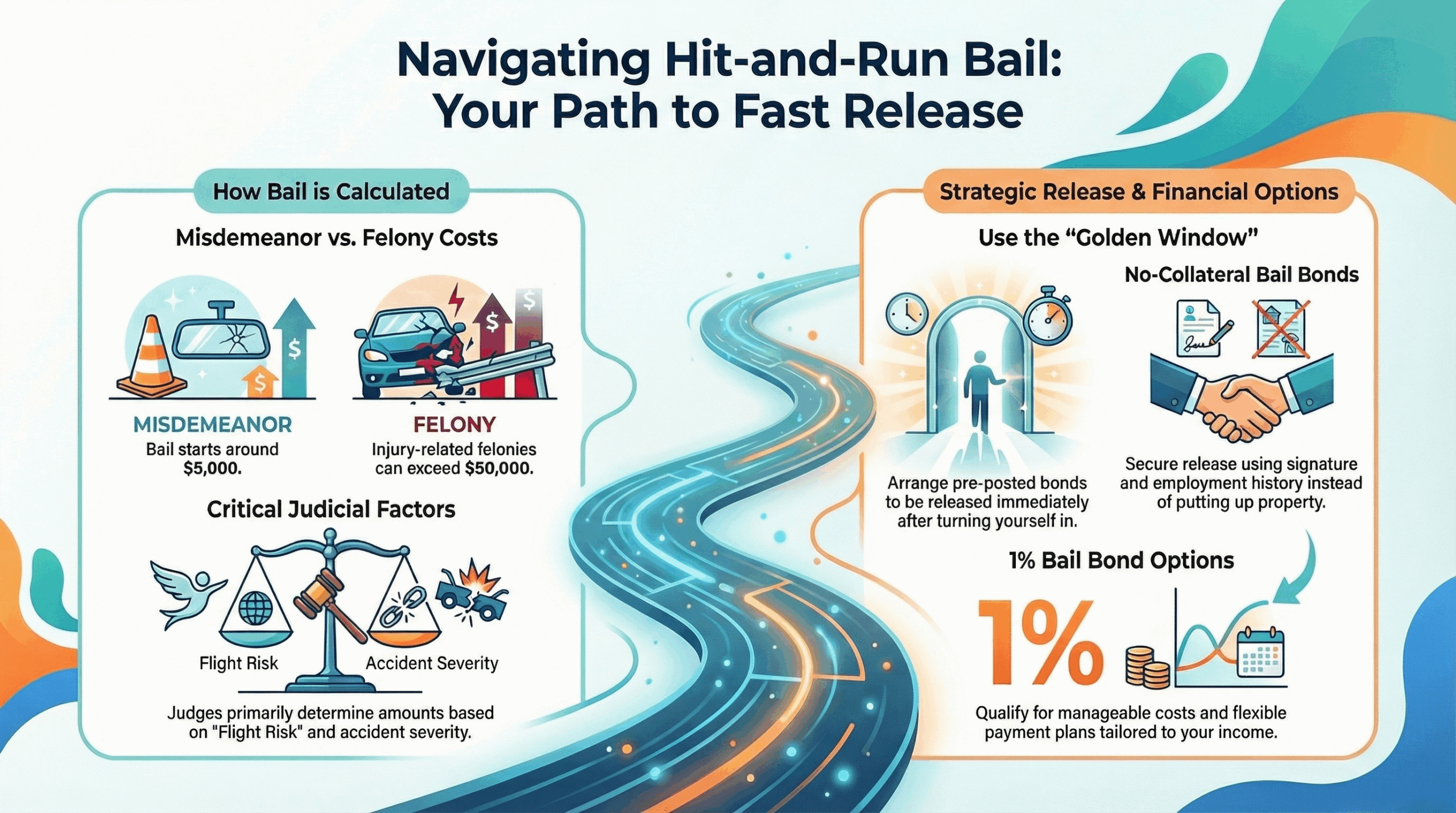
Bail amounts are set by a “Bail Schedule” which varies by county. For a misdemeanor hit and run, bail might be relatively low (around $5,000), but for a felony involving injury, it can skyrocket to $50,000 or more. Factors like “Flight Risk” and the severity of the accident play a huge role in what the judge decides.
The “Golden Window”: Posting Bail Before Your First Court Date
There is a “Golden Window” between the time of the accident and your first court appearance. If you know a warrant is out for your arrest, you can work with Armstrong Bail Bonds to arrange a “pre-posted” bond. This allows you to turn yourself in, get processed, and be released immediately without spending a night in a cell.
No-Collateral Bail Bonds: Securing Release Without Risk
Many people fear they will lose their home if they post bail. Armstrong Bail Bonds offers no-collateral options for qualified clients. This means you can secure a bond based on your signature and your employment history rather than putting up your property as a guarantee.
Flexible Payment Plans and 1% Bail Bonds
Legal fees are expensive, and an unexpected arrest can break the budget. We provide flexible payment plans tailored to your income. For those who qualify (OAC), we offer 1% bail bond options, making the cost of freedom much more manageable.
Factors That Make Dismissal More Difficult
While many cases are eligible for dismissal, certain “aggravating factors” make prosecutors less likely to drop charges:
Bodily Injury: If someone was hospitalized, the state has a high interest in prosecution.
DUI Involvement: If the police suspect you left the scene because you were intoxicated, they will fight harder to keep the charges.
Prior Record: A history of reckless driving or a Failure to Appear (FTA) in court suggests a pattern of ignoring the law.
What to Do If You Are Currently Under Investigation
If you suspect the police are looking for you, your actions in the next 24 hours are critical.
Why You Should Never Contact the Other Party Directly
It is tempting to call the person you hit to apologize and offer money. Do not do this. Anything you say can be used as an admission of guilt in court. Let your attorney or your bail agent handle the logistics of communication.
Handling the “Police Call”
If a detective calls you, politely decline to answer questions until you have a lawyer. You are not required to incriminate yourself.
How Turning Yourself In Voluntarily Can Lower Your Bail
Judges look favorably on “voluntary surrenders.” If you walk into the station with your bail bond already arranged through Armstrong Bail Bonds, it shows you are taking the matter seriously and are not a flight risk. This often results in lower bail amounts and a faster release.
Navigating Local Southern California Courthouses
Dealing with the court system is confusing. Whether your case is being handled at the Van Nuys Courthouse, Glendale City Jail, or the San Diego Central Jail, each location has its own rules. Armstrong Bail Bonds has deep roots in these communities. We know the local procedures and can speed up the release process because we understand exactly how each facility operates.
Why Immediate Action is Critical for Your Defense
The faster you get out of jail, the faster you can preserve evidence. Skid marks fade, weather changes, and witnesses forget details. By securing your release quickly, you give your legal team the best chance to prove your innocence or negotiate a dismissal. Armstrong Bail Bonds provides 24/7 rapid response to ensure you aren’t stuck behind bars a minute longer than necessary.
People Also Ask (FAQ)
1. Will I lose my license for a hit and run in California? Yes, a conviction for a hit and run can lead to a mandatory driver’s license suspension by the DMV, usually for six months to a year, depending on the severity of the accident.
2. Can a hit and run be a felony if no one was hurt? No. In California, if there is only property damage, it is charged as a misdemeanor. It only becomes a felony if there is an injury or death involved.
3. What is the penalty for a first-time hit and run? For a misdemeanor, penalties can include up to six months in jail, a $1,000 fine, and three years of informal probation. For a felony, you could face up to four years in state prison.
4. How does a bail bond work? A bail bond is a guarantee provided by a company like Armstrong Bail Bonds to the court. You pay a small percentage of the total bail (usually 10% or less), and we post the full amount so you can go home.
5. Can I get a hit and run expunged later? Yes. If you successfully complete your probation and do not have other pending charges, you can petition the court to have a misdemeanor or felony hit and run expunged from your record.
6. Do I still need a lawyer if I post bail? Yes. Bail only gets you out of jail. You still need an attorney to fight the charges in court and attempt to get the case dropped.
Contact Armstrong Bail Bonds Today
If you or a loved one has been arrested for a hit and run, time is of the essence. Don’t wait in a cell while your future hangs in the balance. Armstrong Bail Bonds offers fast, professional, and empathetic service 24 hours a day, 7 days a week. We provide flexible payment plans, no-collateral bonds, and the local expertise needed to get you home fast.
Call Armstrong Bail Bonds now at (800) 414-2245 or visit our website at www.armstrongbailbonds.net to start the release process immediately.