


02 Apr The Most Common Crimes in California (2026 Edition)
Understanding the most common crimes in California is essential for anyone navigating the state’s complex legal landscape or concerned about public safety. While California has seen significant shifts in criminal justice reform over the last decade, recent data shows that certain offenses remain far more prevalent than others. This guide explores the current trends, the impact of new laws, and how to find help if you or a loved one is facing charges.
Overview of California Crime Trends: 2024–2026
The last few years have marked a “post-pandemic pivot” for California. Between 2021 and 2023, the state experienced a sharp rise in specific offenses, particularly motor vehicle thefts and homicides. However, as we move through 2026, the data indicates a stabilization.
Violent crime rates, while still a concern in major metropolitan areas, have begun to plateau or drop in many counties. Conversely, property crime remains the most significant challenge for law enforcement. One of the biggest shifts has been in how these crimes are reported. With the rise of digital reporting tools, more citizens are reporting “cold” property crimes (like package theft), which has contributed to higher recorded numbers even if the severity of the crimes has changed.
Despite these fluctuations, the “clearance rate”—the rate at which police solve crimes—remains a hurdle. This makes it more important than ever for individuals to understand their rights and the legal protections available to them.
Most Common Property Crimes in California
Property crime is statistically the most frequent type of criminal activity in the Golden State. These crimes involve the taking of money or property but do not involve force or threat of force against a victim.
Larceny-Theft: This is consistently the #1 most reported crime. It includes everything from pocket-picking and bicycle theft to shoplifting. It is essentially the unlawful taking of property belonging to another.
Motor Vehicle Theft: California has long struggled with high rates of auto theft. While the “Kia/Hyundai” social media theft trends of previous years have slowed due to software patches, catalytic converter thefts remain a frequent issue for California drivers.
Burglary: Burglary is defined as entering a structure with the intent to commit a theft or felony. In California, this is split into “First Degree” (residential) and “Second Degree” (commercial). Recently, there has been a significant focus on commercial burglaries involving retail “smash-and-grabs.”
Shoplifting and Retail Theft: Unlike other property crimes that leveled off, shoplifting rates saw a spike through 2025. This led to a major outcry from business owners and eventually influenced new statewide legislation to increase penalties for repeat offenders.
Most Common Violent Crimes in California
Violent crimes involve the use of force, or the threat of force, against a person. These charges carry much heavier penalties and often result in significant prison time.
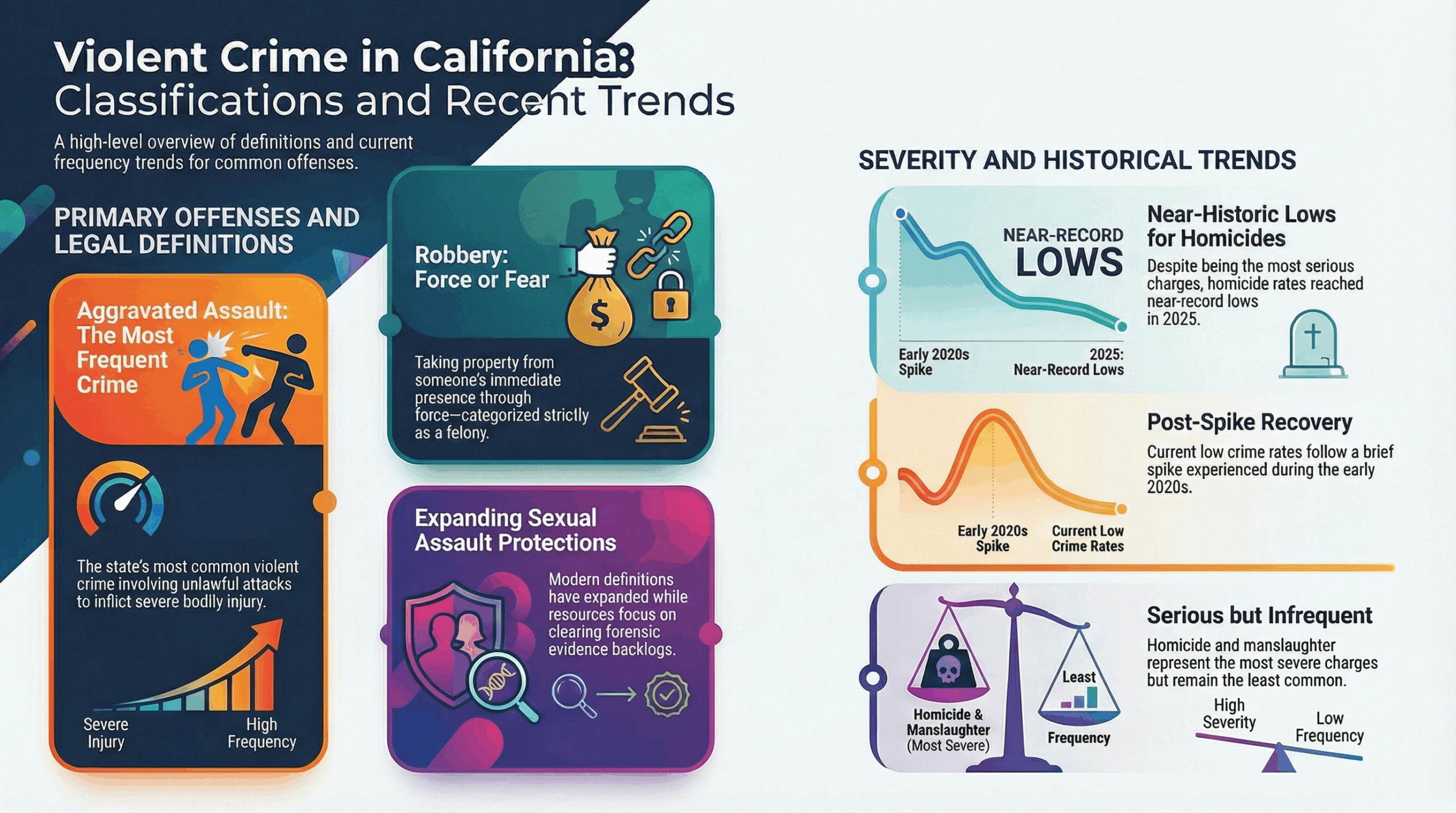
Aggravated Assault: This is the most frequent violent crime in the state. It involves an unlawful attack by one person upon another for the purpose of inflicting severe bodily injury. It often involves the use of a weapon.
Robbery: Many people confuse theft with robbery. In California, robbery is taking property from someone’s “immediate presence” through force or fear. Because it involves a victim’s safety, it is always a felony.
Homicide and Manslaughter: While these are the most serious charges, they are the least common. California’s homicide rates reached near-historic lows in 2025, following a brief spike during the early 2020s.
Rape and Sexual Assault: These crimes remain a priority for California prosecutors. Modern legal definitions have expanded to ensure more comprehensive protection for victims, and the state has put significant resources into clearing backlogs of forensic evidence.
Public Safety, Drug Offenses, and Traffic Crimes
Beyond property and violence, several other categories of crime make up a large portion of California’s court dockets.
DUI (Driving Under the Influence): California has some of the strictest DUI laws in the country. This includes not just alcohol, but also impairment by marijuana or prescription drugs.
Drug Possession and Sales: The Fentanyl crisis has changed how drug crimes are prosecuted. While possession of small amounts of some drugs is a misdemeanor, the sale or transport of Fentanyl is now being met with much harsher “aggravating factors” in court.
Domestic Violence: These calls are among the most common for police. California law requires officers to make an arrest if they have probable cause to believe domestic abuse occurred, regardless of whether the victim wants to press charges.
Weapon Offenses: The state has intensified its crackdown on “ghost guns”—unserialized firearms made from kits. Charges for carrying a concealed weapon without a permit have also seen an uptick in enforcement following recent Supreme Court rulings and subsequent state-level legislative responses.
The “Prop 47” vs. “Prop 36” Era: How Laws Impact Crime
To understand California crime, you must understand how the law has changed. For a decade, Proposition 47 was the dominant force. Passed in 2014, it reclassified many “non-serious, non-violent” property and drug crimes from felonies to misdemeanors (specifically those involving values under $950).
However, in late 2024, California voters passed Proposition 36, marking a major shift in the legal landscape.
The “Treatment-Mandated Felony: Prop 36 created a new category of crime. For certain drug possession charges, defendants are now required to complete treatment. If they fail, they face felony jail time.
Repeat Offender Penalties: Under the new rules, if a person has two prior convictions for theft, the third theft can be charged as a felony, even if the value of the stolen goods is low.
Fentanyl Warnings: Courts are now required to warn people convicted of selling or providing illegal drugs that they could be charged with murder if they continue to sell drugs and someone dies as a result.
Regional Crime Hotspots: Where You Live Matters
Crime in California is not spread evenly. Depending on where you are, the “most common” crime might look very different.
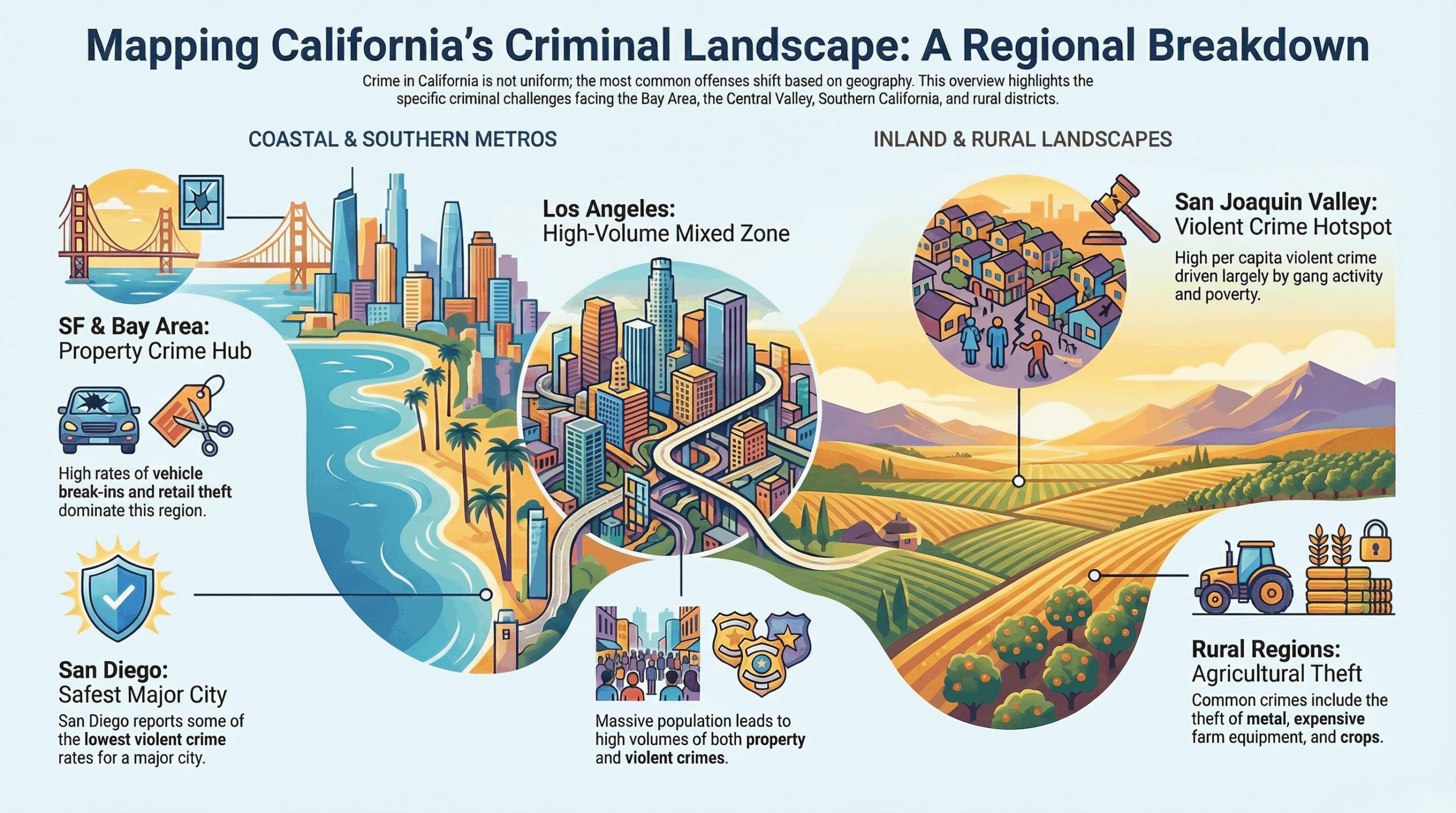
San Francisco & The Bay Area: This region currently sees some of the highest property crime rates in the state, particularly related to vehicle break-ins and retail theft.
The San Joaquin Valley: Cities in the Central Valley often see higher rates of violent crime per capita than the coastal metros, largely driven by gang activity and higher poverty levels.
Southern California (Los Angeles & San Diego): Surprisingly, despite its size, San Diego often reports some of the lowest violent crime rates for a major city. Los Angeles remains a “mixed” zone, with high volumes of both property and violent crime simply due to its massive population.
Urban vs. Rural: In rural California, property crimes like agricultural theft (stealing equipment or crops) and metal theft are much more common than in the cities.
What to Do if You are Charged with a Common Crime
Facing a criminal charge in California is overwhelming. The legal system moves quickly, and a conviction can follow you for a lifetime, affecting your ability to get a job or find housing.
Navigating the Legal System
The first step is determining if the charge is a misdemeanor (up to one year in county jail) or a felony (state prison time). Because of Prop 36, even a minor theft charge can now escalate into a felony if you have a prior record.
How a Defense Attorney and Bail Agent Help
A defense attorney will look for “procedural errors.” Did the police have a warrant? Did they read you your rights? In many cases, an attorney can negotiate for Alternative Sentencing. This might include “Diversion” programs where you perform community service or attend counseling in exchange for having the charges dismissed.
If you or a loved one is arrested, the first priority is getting out of custody so you can prepare your defense. This is where Armstrong Bail Bonds comes in. Staying in jail makes it harder to meet with lawyers and keep your job. A bail bond allows you to return home quickly while your case moves through the court system.
People Also Ask (FAQ)
What is the most common crime in California?
Larceny-theft is the most common crime. This includes shoplifting, bicycle theft, and any taking of property that does not involve force.
Is shoplifting a felony in California now?
Under Proposition 36, shoplifting can be charged as a felony if the defendant has two or more prior convictions for certain theft-related or drug-related crimes.
What is the $950 rule in California?
This refers to Proposition 47, which stated that many thefts under $950 must be charged as misdemeanors. However, new laws have added “aggravating” factors that allow for felony charges in repeat cases.
Can I get a bail bond for a domestic violence charge?
Yes. Domestic violence is a “bondable” offense. Armstrong Bail Bonds specializes in helping families navigate these sensitive situations to get their loved ones home.
How long does a misdemeanor stay on your record in California?
A conviction stays on your record permanently unless you successfully petition for an “expungement” (dismissal) after completing your probation.
Does California have a “Three Strikes” law?
Yes. California still has a Three Strikes law for serious or violent felonies, which can lead to a sentence of 25 years to life for a third strike.
Secure Your Freedom with Armstrong Bail Bonds
A criminal charge doesn’t have to define your future, but how you react in the first 24 hours matters. If someone you love has been arrested for a property crime, DUI, or any other offense in California, don’t wait. You need an advocate who understands the system and can provide a fast, professional path to freedom.
Armstrong Bail Bonds provides 24/7 service across California. We offer flexible payment plans and empathetic support during one of the most stressful times of your life.
Contact Armstrong Bail Bonds today to get help now. Your defense starts with your release.