

16 May DUI with Injury: Why This Charge Changes Your Bail Eligibility
Facing a charge of DUI with injury is a life-altering event that fundamentally changes your bail eligibility and legal standing. Unlike a standard DUI, where bail is often a predictable, flat fee, an injury-related charge moves you into a high-stakes legal category. Understanding these shifts is the first step toward regaining your freedom and preparing your defense.
The Fundamental Shift: Standard DUI vs. DUI with Injury
In most jurisdictions, a “simple” DUI is treated as a misdemeanor. You are typically booked, a standard bail amount is set according to a fixed schedule, and you can be home within hours. However, once an injury is involved, the legal landscape shifts from a traffic-related offense to a violent or “person-related” crime.
Defining “DUI with Injury” (VC 23153)
Under California Vehicle Code 23153, it is illegal to drive under the influence and, while doing so, perform any act forbidden by law that causes bodily injury to another person. This isn’t just about your blood alcohol content (BAC); it is about the physical consequences of the incident.
Felony vs. Misdemeanor “Wobblers”
A DUI with injury is often considered a “wobbler.” This means the prosecutor has the discretion to charge it as a misdemeanor or a felony. Because injuries are involved, prosecutors almost always lean toward a felony charge. A felony designation automatically triggers a much higher bail schedule, often jumping from a few thousand dollars to $50,000 or $100,000 instantly.
The Impact of “Great Bodily Injury” (GBI)
If the victim suffers “Great Bodily Injury”—defined as significant or substantial physical injury—prosecutors may add a GBI enhancement (Penal Code 12022.7). This isn’t just a legal footnote; it is a “strike” under the Three Strikes Law. For bail eligibility, a GBI enhancement often means the judge will view you as a significant threat to public safety, leading to much higher bail or even a “no-bail” hold.
Why Your Bail Eligibility Changes After an Injury
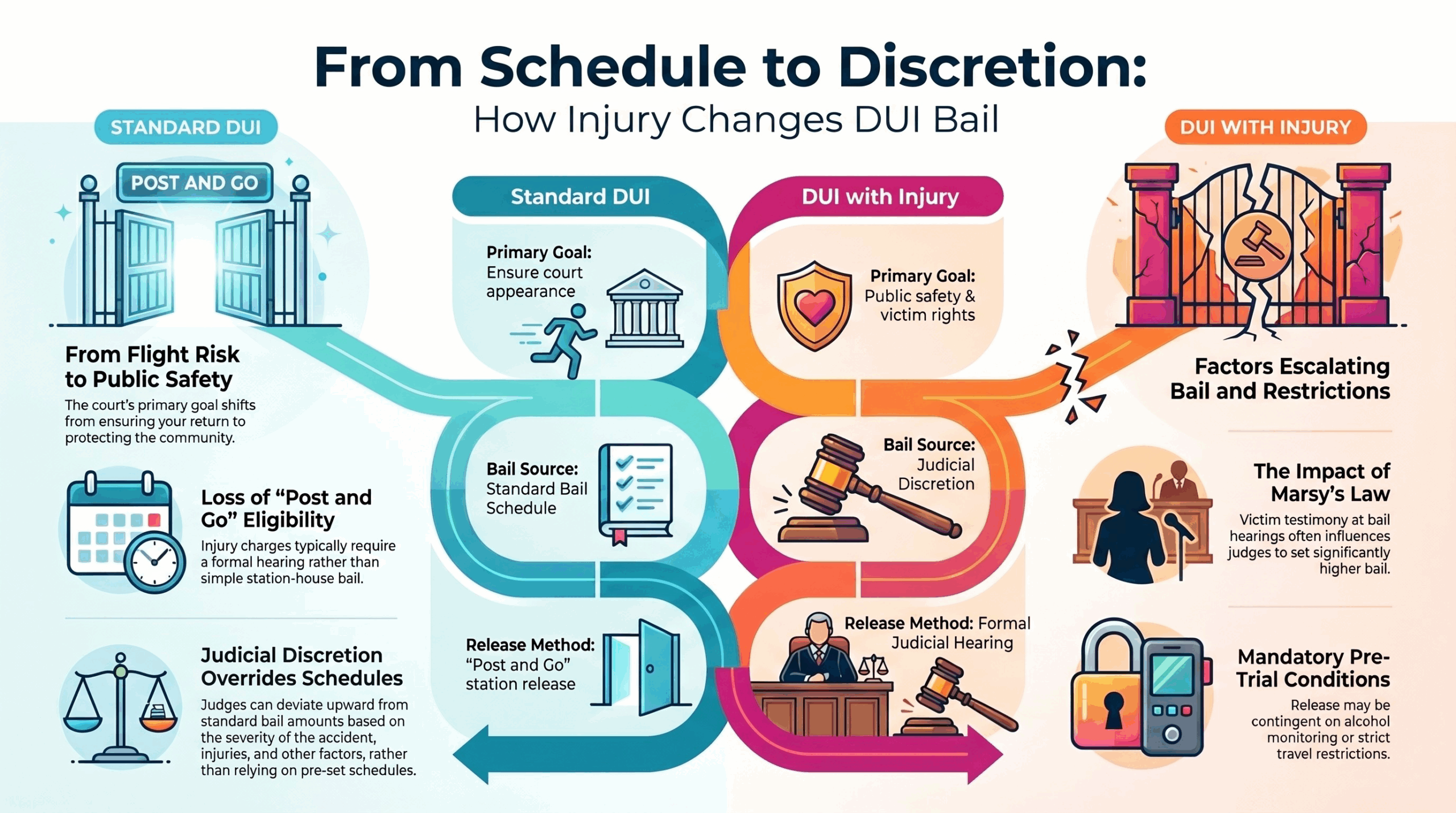
The presence of an injured victim changes the court’s primary goal. In a standard DUI, the court focuses on whether you will show up for your next date. In a DUI with injury, the court focuses on public safety and victim rights.
From “Standard Schedule” to “Judicial Discretion”
For a standard DUI, you can often “post and go” from the police station. With an injury charge, you will likely be held until you can see a judge for a formal bail hearing. The “Bail Schedule” acts only as a starting point; the judge has the final say and can deviate upward based on the severity of the accident.
Public Safety vs. Flight Risk
When an injury occurs, the court assumes a higher level of negligence. Judges are often hesitant to release an individual quickly if they believe the person poses a continuing danger to the community. This often results in “pre-trial conditions,” such as mandatory alcohol monitoring, even if you post bail.
The Role of Marsy’s Law and Victim Rights
Under Marsy’s Law, victims have a constitutional right to be notified of and present at bail hearings. The victim or their family can stand before the judge and describe the impact of their injuries. This emotional testimony often influences a judge to set bail at a much higher amount than the standard schedule suggests, or to impose stricter travel restrictions.
Factors That Determine Your Bail Amount in Injury Cases
Severity of Injuries & Aggravating Factors
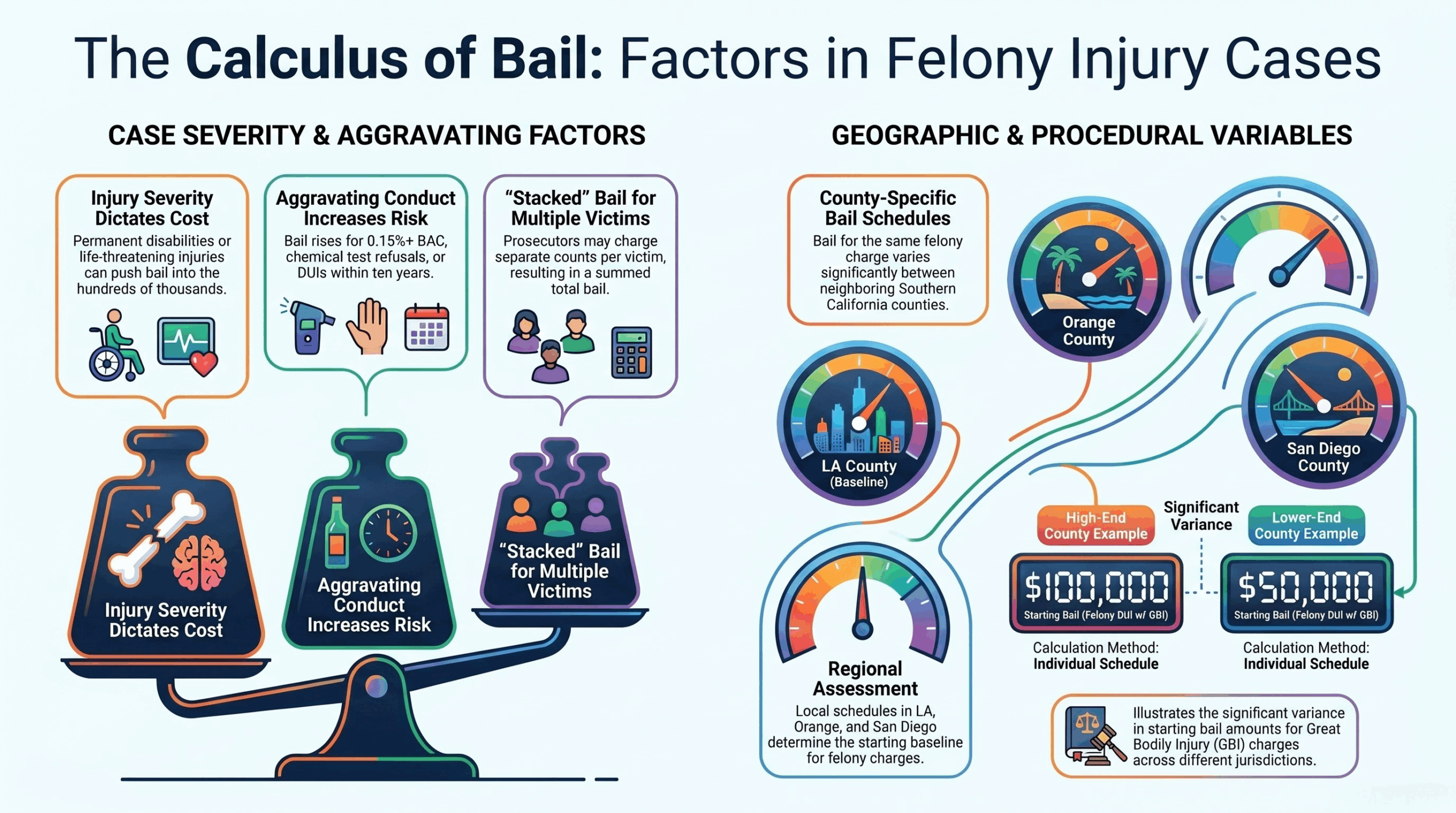
The court looks at the “degree” of injury. A broken bone will result in higher bail than a bruise, and a life-threatening injury or permanent disability can push bail into the hundreds of thousands of dollars. Other factors include:
High BAC: A blood alcohol level of 0.15% or higher.
Refusal: Refusing a chemical test.
Prior Convictions: Any DUI on your record within the last ten years.
Number of Victims
Bail is not always a “flat fee” per incident. If multiple people were in the other vehicle or on the sidewalk, prosecutors may charge a separate count of DUI with injury for each person. This can lead to “stacked” bail, where the total amount is a sum of the bail for each victim involved.
County-Specific Bail Schedules
Bail isn’t uniform across the state. In Southern California, the bail schedule for a felony DUI with injury can vary significantly between Los Angeles, Orange, and San Diego counties. For example, a “felony DUI with GBI” in one county might start at $100,000, while a neighboring county might start at $50,000. Armstrong Bail Bonds maintains deep knowledge of these local variations to give you the most accurate expectations.
Navigating the Bail Process for Injury Charges
The Formal Bail Hearing (The “Humphrey” Analysis)
In California, the Humphrey decision requires judges to consider a defendant’s ability to pay when setting bail. However, in injury cases, the “seriousness of the offense” often outweighs the “ability to pay.” Your attorney and your bail bondsman must work together to present you as a stable member of the community to keep bail at a manageable level.
The “Source of Funds” Inquiry (PC 1275.1)
In high-bail felony cases, the prosecution may request a “1275 hold.” This means you cannot be released—even if you have the money—until you prove that the funds used for bail were not obtained through criminal activity. This is common in high-stakes cases to ensure that the “premium” paid to a bondsman is legitimate. Armstrong Bail Bonds is experienced in helping families gather the necessary documentation (bank statements, pay stubs, etc.) to clear these holds quickly.
Immediate Assistance: 24/7 Inmate Locating
The hours following an arrest for a DUI with injury are chaotic. You may not know which jail your loved one is being held in. Armstrong Bail Bonds provides a free, 24/7 inmate locator service. Whether they are in the Los Angeles County Jail system or a smaller city facility, Armstrong can find them and begin the paperwork before they even see a judge.
Armstrong Bail Bonds: Affordable Solutions for High-Bail Cases
When bail is set at $50,000 or $100,000, the standard 10% fee ($5,000–$10,000) can be impossible for most families to pay upfront. This is where Armstrong Bail Bonds provides a lifeline.
1% Down Bail Bonds
Armstrong understands that an injury charge is an unexpected financial crisis. They offer 1% down payment options on approved credit. This allows you to secure a loved one’s release for a fraction of the cost, ensuring they can return home to keep their job and prepare their legal defense.
Interest-Free Financing & Payment Plans
To make the remaining balance manageable, Armstrong offers interest-free financing. Like a standard credit check for a car loan, they look at your employment history and residency. Once approved, you can pay the bond premium in monthly installments that fit your budget, with no hidden fees or “gotcha” interest rates.
88 Years of Local Expertise
Since 1926, Armstrong Bail Bonds has been a fixture in the Southern California legal community. They have established relationships with jailers and court clerks in Los Angeles, Santa Clara, and San Diego. This history means they know exactly who to call to speed up the release process, often shaving hours off the time a defendant spends behind bars.
Protecting Your Rights After Posting Bail
Compliance with Protective Orders
In a DUI with injury case, the judge will almost certainly issue a “Criminal Protective Order.” This requires you to have “no contact” with the victims. Violating this order can result in your bail being revoked and you being sent back to jail without a second chance. Armstrong Bail Bonds works with you to ensure you understand all the conditions of your release so you stay out of trouble.
Bilingual Support (English/Spanish)
Legal jargon is confusing enough in your native language. Armstrong provides full support in both English and Spanish, ensuring that every family member understands the contract, the court dates, and the bail conditions.
People Also Ask (FAQs)
1. Can I be denied bail entirely for a DUI with injury? While most DUI with injury charges are bailable, a judge can deny bail if they believe there is “clear and convincing evidence” that your release would result in great bodily harm to others, especially if there were prior violent offenses.
2. How long does it take for Armstrong to post bail? Once the paperwork is signed and the down payment is made, Armstrong can post bail immediately. However, the release time depends on the jail’s processing speed, which typically ranges from 2 to 6 hours.
3. Does a “Strike” offense affect my bail? Yes. If the DUI with injury is charged with a GBI enhancement, it may count as a “strike.” Under California law, having a prior strike or being charged with a new one can double the bail amount on the schedule.
4. What happens if I can’t afford the full 10% premium? Armstrong Bail Bonds specializes in payment plans. With as little as 1% down and a qualified co-signer or collateral, they can work out a monthly payment schedule that makes the premium affordable.
5. Will I get my bail money back? If you pay the full amount to the court, you get it back (minus court fees) once the case is over. If you use a bail bondsman, the 10% (or lower) premium is the fee for their service and is non-refundable, as it allowed you to stay out of jail during the trial.
6. Do I need a lawyer before I can post bail? No, you can post bail as soon as a bail amount is set. However, it is highly recommended to contact an attorney immediately after your release to handle the complexities of an injury charge.
Secure Your Freedom Today
A DUI with injury charge is a heavy burden, but you don’t have to carry it alone. Every hour spent in jail is an hour lost from your job and your family. Armstrong Bail Bonds has the experience, the local connections, and the flexible financing to get you or your loved one home today.
Don’t wait for the court to decide your future. Call Armstrong Bail Bonds at (800) 224-5266 or visit www.armstrongbailbonds.net for a free consultation and immediate inmate locating. We are open 24/7 to help you through this.