

22 Jun Can You Post Bail for an Out-of-County Warrant in Southern California?
Discovering that you or a loved one has an out-of-county warrant in Southern California can be a confusing and terrifying experience. The good news is that you do not necessarily have to travel to the county where the warrant was issued just to resolve your bail. By working with a knowledgeable local professional, you can safely navigate the system and secure a quick release right from your home county.
Understanding Out-of-County Warrants in California
What is an Out-of-County Warrant?
An out-of-county warrant is an arrest warrant issued by a judge in one California county, but executed or discovered when the individual is located in a completely different county. For example, if a judge in Orange County issues a warrant for your arrest, but a police officer pulls you over in Los Angeles, you are being held on an out-of-county warrant.
Common Reasons for Facing a Warrant Outside Your Home County
People frequently travel across county lines in Southern California for work, family, and entertainment. It is incredibly common to face a warrant outside your home county due to:
Unresolved traffic violations or unpaid tickets received while traveling.
Missing a mandatory court date in a neighboring county.
Failing to complete court-ordered community service or probation terms assigned by a distant court.
Unbeknownst to the individual, a misdemeanor or felony charge being filed against them in a jurisdiction they previously visited.
How Southern California Counties Handle External Warrants (LA, Orange, San Diego, Riverside, San Bernardino)
Southern California is a massive, interconnected region. Police departments across Los Angeles, Orange, San Diego, Riverside, and San Bernardino counties utilize shared digital databases.
When a local law enforcement officer runs your name during a routine encounter, an out-of-county warrant will pop up immediately. How they handle it depends heavily on the distance between the counties and the severity of the alleged offense. If you are picked up in Los Angeles on a minor warrant from San Diego, local authorities may contact the issuing county to see if they want to pay the money and logistical costs to transport you. For major charges, they will book you into the local jail immediately and prepare you for an inter-county transfer.
Your Legal Rights Under California Penal Code 822

Misdemeanor Arrest Rights When Custody is Outside the Issuing County
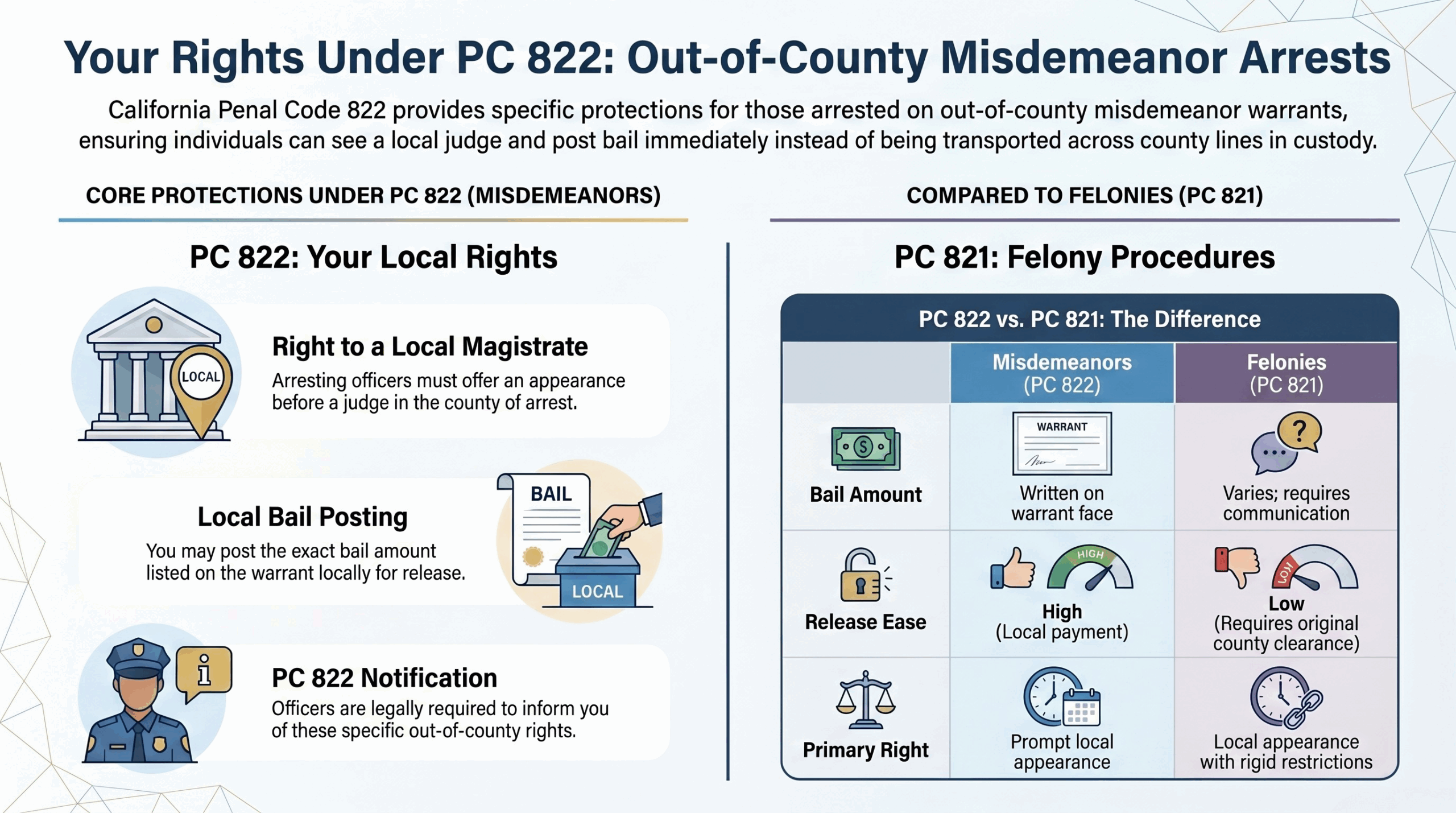
If you are arrested on a misdemeanor out-of-county warrant, California Penal Code 822 grants you very specific protections. Under this law, the arresting officer must inform you of your right to be taken before a local judge or magistrate right there in the county where you were arrested. You do not have to be immediately thrown into a transport van and shipped across county lines.
How Misdemeanor Procedures Differ from Felony Warrant Arrests
The legal treatment changes drastically depending on the classification of the crime:
Misdemeanors: The bail amount is almost always written directly on the face of the warrant. Because of PC 822, you have a legal right to post that exact bail amount locally, obtain your freedom, and receive a new court date for the issuing county.
Felonies: If the warrant is for a felony, Penal Code 821 applies instead. While you still have a right to see a local magistrate, the process is much more rigid. Local jails are far less likely to release you easily without direct communication and clearance from the county that holds the original case.
Your Right to Appear Before a Local Magistrate in the Arresting County
You have the right to request a prompt appearance before a local judge rather than waiting in a cell for weeks. The local magistrate has the legal authority to read the bail terms set by the origin county, accept your bail payment or bond, and release you with strict instructions on when and where you must show up to face the original charges.
How to Post Bail for an Out-of-County Warrant
The Jail Officer’s Authority to Accept Bail Locally
Many people do not realize that you do not always have to wait to see a judge to secure your release. The jail booking officer holding you has the legal authority to look at the warrant, verify the exact bail amount required by the issuing county, and accept valid bail on their behalf. Once the jail accepts the bail, they will process your release paperwork and send the funds or bond directly to the originating court.
Cash Bail (Paying the Full Amount to the Court or Jail)
Cash bail requires you to pay 100% of the warrant’s total bail amount upfront to the jail or court. If the out-of-county warrant dictates a $20,000 bail, you must hand over $20,000 in cash, a cashier’s check, or an approved money order.
While this money is eventually returned to you at the very end of the criminal case (minus minor court administrative fees), it ties up massive amounts of personal capital that most families simply do not have on hand during an emergency.
Utilizing a California Bail Bond (The 10% Premium)
The most common and affordable method is hiring a licensed bail bondsman. In California, standard bail bond premiums are set by state law at a maximum of 10% of the total bail amount.
Instead of paying $20,000 in cash out-of-pocket, you pay a non-refundable fee of $2,000 to a bail bondsman. The bondsman then acts as a financial guarantor to the court, securing your immediate release from jail while keeping your personal savings intact.
Post and Forfeit Warrants (Resolving the Matter Remotely)
For certain minor offenses or old traffic tickets, some jurisdictions allow a “post and forfeit” process. This means you pay the bail amount with the explicit understanding that you are forfeiting the money to the court in exchange for closing the case completely. This allows you to resolve the out-of-county legal issue entirely from afar, eliminating the need to ever travel back to that county for a physical court appearance.
How Bail Schedules and Amounts are Determined Between Counties
Every single county in California creates and updates its own official “Bail Schedule” every year. A misdemeanor DUI in Los Angeles County might carry a completely different standard bail amount than the exact same charge in Riverside County. When dealing with an out-of-county warrant, the jail and court must strictly follow the financial schedule of the issuing county, not the county where you are currently sitting in jail.
Step-by-Step Guide: Transfer Bail Bonds and Co-Bailing
When you need to clear a warrant issued in a different county, you cannot simply walk into any random local bail office and expect a standard contract. The process requires a highly specialized financial tool known as a transfer bond.
[Local Family Member] ---> [Local Bail Agent] ---> [Network Partner Agent] ---> [Out-of-County Jail]
   (Provides Co-Signing)       (Arranges Bond)        (Physically Posts Bond)       (Releases Defendant)
What is a Transfer Bond and How Does It Work?
A transfer bond is a specific type of bail bond used when a defendant is locked up in one county but the bail must be executed or coordinated through a bondsman located elsewhere.
The Outreach: A worried family member contacts a trusted bail agency in their own home neighborhood.
The Verification: The local bail agent contacts the jail holding the defendant and looks up the out-of-county warrant details.
The Partnership: The local agency writes the contract and uses their licensed network to coordinate with an agent near the physical jail to hand-deliver the bond paperwork.
The Release: The local jail processes the paperwork, allows the defendant to walk free, and issues a receipt detailing the future court requirements.
The Role of a Co-Signer When Dealing Across County Lines
Because the defendant is being released to face charges in a different county, bail agencies look closely at the financial stability of the co-signer (also called an indemnitor). The co-signer must undergo a basic credit check to prove financial responsibility.
The credit check acts as a screening tool to ensure the co-signer can handle the financial burden if the defendant flees. The co-signer signs a legally binding contract promising that the defendant will travel to the issuing county and appear for every single scheduled court date. If the defendant skips court, the co-signer becomes personally liable for paying the full face value of the bail to the court.
What Happens Next? Jail Transfers and Extradition
Failing to act quickly when an out-of-county warrant is discovered can result in severe logistical penalties. Jails will not hold a defendant indefinitely; instead, they will initiate physical transit.
The 5-Day Rule: How Long Can an Arresting County Hold You?
Under California law, if you are arrested on an out-of-county warrant and cannot post bail immediately, the arresting county cannot hold you in their local jail forever. They are bound by a strict statutory timeline.
Generally, the arresting county must notify the issuing county of your detention. The issuing county then has a maximum of five days to send their own sheriffs or transit officers to physically pick you up. If they do not come to claim you within this legal window, a local judge may be forced to order your immediate release.
The Reality of County-to-County Extradition in SoCal
Do not make the mistake of assuming a county will refuse to extradite you over a long distance. In Southern California, county-to-county extradition happens every single day.
Sheriff departments run regular prisoner transport buses between Los Angeles, Orange, and San Diego counties. If you are held on a felony warrant or a serious domestic violence misdemeanor, the issuing county will almost certainly choose to extradite you. Being moved in a county transport van is a slow, miserable, and stressful experience that can keep you trapped inside the jail system for days on end.
What Happens When You Do Not Exercise Your Rights or Post Bail Timely
If you sit in jail and fail to arrange a bail bond quickly, you will eventually be transferred directly into the custody of the issuing county’s jail system. Once you are transferred, your family will have to deal with a completely new set of jail systems, booking numbers, and visiting schedules, making the process of securing your freedom twice as difficult and time-consuming.
The Financial Reality of Out-of-County Bail
Financial Considerations and Bail Planning
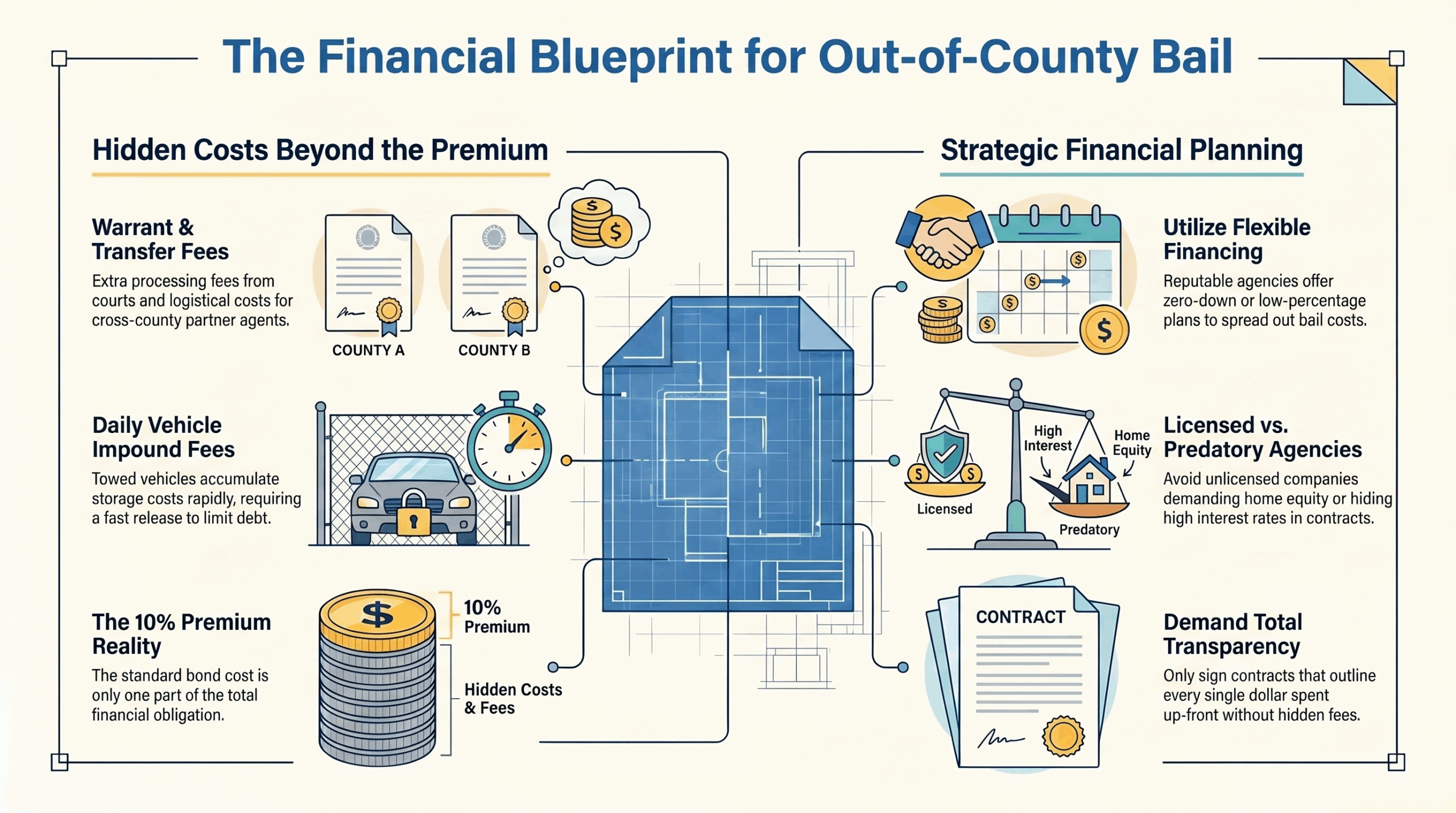
Navigating a cross-county arrest requires careful financial planning. Families must look closely at their budgets to determine if they can qualify for flexible payment plans. Reputable bail agencies understand that unexpected legal trouble can devastate a household’s monthly finances, which is why they often offer zero-down or low-percentage financing options to help spread out the cost of the 10% premium.
Hidden Costs: Warrant Fees, Transfer Fees, and Impound Costs
The face value of the bail bond is rarely the only expense you will face. When dealing with an out-of-county warrant arrest, you must also prepare for several hidden costs:
Warrant Administrative Fees: Extra processing fees tacked on by the court that issued the original warrant.
Bail Transfer Fees: Small, standard processing fees charged by agencies to cover the logistics of utilizing cross-county partner agents.
Vehicle Impound Fees: If you were pulled over and arrested during a traffic stop, your car will be towed to a local impound lot. Daily storage fees accumulate rapidly, meaning you need to get out of jail quickly to retrieve your vehicle before the bill spirals out of control.
Common Financial Mistakes Defendants and Families Make
The absolute biggest financial mistake a family can make is panicking and rushing to use an unlicenced, predatory bail company that charges hidden interest rates or demands equity in a home without explaining the terms. Always ensure you are working with an established, fully transparent provider who outlines every single dollar spent on your contract up-front.
How a Southern California Criminal Defense Attorney Can Intervene
Requesting a Court Surrender or New Calendar Date to Recall the Warrant
If you know you have an active out-of-county warrant but have not yet been handcuffed by the police, a criminal defense lawyer can save you from ever stepping foot inside a jail cell. Your attorney can file a motion to place your case back on the court’s calendar. By arranging a formal, voluntary court surrender, your attorney can ask the judge to safely “recall and quash” the warrant in exchange for your promise to face the charges voluntarily.
The Role of the Attorney in Out-of-County Bail Hearings
If you are already in custody, your attorney can argue aggressively for a significant bail reduction during your initial hearings. They can present mitigating evidence to a local or originating judge, showing that you are not a flight risk and that you have deep ties to the Southern California community.
How An Attorney Can Block Unnecessary Extradition Transfers
A skilled lawyer knows how to file emergency motions to halt or delay an impending physical transfer between counties. By showing the court that valid bail arrangements are currently being processed locally through a licensed bond agency, your attorney can convince a judge to hold the transport orders, saving you from the pain and trauma of a long-distance sheriff’s transfer.
Out-of-County Warrant FAQs
Can I clear a SoCal warrant if I live out of state?
Yes. If you have an active warrant in a Southern California county but now live in another state, you can often retain a local California criminal defense attorney to appear in court on your behalf for misdemeanor offenses. For felonies, your attorney and a local Southern California bail bondsman can coordinate to arrange your safe return and a voluntary surrender, ensuring you do not get arrested unexpectedly at an airport or during a routine out-of-state check.
Will an out-of-county warrant show up during a routine traffic stop?
Yes, absolutely. Police cruisers across California are equipped with advanced mobile computers linked directly to the California Law Enforcement Telecommunications System (CLETS). If a local police officer or California Highway Patrol agent pulls you over for a minor issue like a broken taillight or speeding, your active out-of-county warrant will show up on their screen within seconds, giving them the legal authority to place you in handcuffs immediately.
Can I use a local LA bondsman for an Orange County warrant?
Yes. An established, highly experienced bail agency based in Los Angeles can easily write and execute bonds for active warrants originating in Orange County, San Diego, Riverside, or any other region in California. They utilize a large network of licensed agents to ensure your bond is hand-delivered to the proper jurisdiction without delay.
What is the difference between a bench warrant and an arrest warrant?
An arrest warrant is typically issued by a judge after law enforcement presents evidence that you committed a crime. A bench warrant is issued directly from the judge’s “bench” because you failed to follow a direct court order, such as missing a mandatory court hearing, failing to pay a fine, or violating probation. Both give police the immediate authority to take you into custody.
Can a bail bond premium fee be refunded if the case is dropped?
No. The 10% premium fee paid to a bail bond agency is completely non-refundable. This money is the fee earned by the bail agency for taking on the massive financial risk of guaranteeing your total bail amount to the court system and securing your immediate freedom. It cannot be returned, even if the prosecutor decides to drop all of your charges the very next day.
The Solution: Contact Armstrong Bail Bonds
When a cross-county warrant threatens your freedom, your family cannot afford to waste time waiting on an inexperienced agency. You need an established, highly professional team that knows every corner of the Southern California legal landscape inside and out.
Armstrong Bail Bonds has been family-owned and operated since 1926. For nearly a century, their compassionate, licensed agents have proudly served communities across Los Angeles County, Orange County, and San Diego County. They operate 24 hours a day, 7 days a week, providing the fastest, most reliable transfer bonds and affordable financing solutions to bring your loved ones home safely.
Do not let an out-of-county warrant turn into a logistical nightmare. Contact the dedicated team at Armstrong Bail Bonds right now to secure your fast, friendly, and confidential consultation.