

23 Jun Is Boating Under the Influence (BUI) in California a Felony? What You Need to Know
Spending a day on California’s beautiful waterways is a favorite pastime for many, but mixing alcohol or drugs with boating can lead to severe legal trouble. If you or a loved one were recently arrested for Boating Under the Influence (BUI), you are likely wondering about the severity of the charges. A primary concern for most people facing this situation is whether a California BUI is automatically considered a felony.
The answer is not a simple yes or no, as California law treats BUI offenses with varying degrees of severity based on the specific details of the incident. This comprehensive guide breaks down how California law handles BUI charges, when they cross the line into felonies, and what steps you need to take to protect your future.
The Short Answer: Misdemeanor vs. Felony BUI in California
In California, a standard Boating Under the Influence charge is not automatically a felony. In fact, the vast majority of first-time BUI arrests are handled as misdemeanors. However, the state takes maritime safety very seriously, and certain circumstances will instantly elevate a BUI to a felony charge.
When a California BUI Is Charged as a Misdemeanor
If you are operating a boat while intoxicated but do not cause an accident, property damage, or injury, the state will typically charge you with a misdemeanor. This applies even if your blood alcohol concentration (BAC) is well over the legal limit. While a misdemeanor is less severe than a felony, it still results in a permanent criminal record, expensive fines, and potential jail time.
The Exact Thresholds That Trigger a Felony BUI Charge
A BUI escalates from a misdemeanor to a felony under very specific conditions. The state will file felony charges if:
Injury or Death Occurs: If you operate a vessel under the influence and cause bodily injury or death to any person other than yourself.
Multiple Priors: You have a history of multiple prior BUI or Driving Under the Influence (DUI) convictions within a ten-year window.
Gross Negligence: Your behavior behind the wheel of the watercraft was so reckless that it showed a complete disregard for human life.
Understanding California BUI Laws (Harbors and Navigation Code 655)
The state of California enforces its maritime intoxication rules through the Harbors and Navigation Code (HNC) Section 655. This law mirrors the state’s vehicle DUI laws but is specifically tailored to the unique environment of the water.
Legal Limits for Recreational Vessel Operators (BAC of 0.08% or Higher)
For the average person enjoying a day on a recreational boat, the legal limit for alcohol consumption matches the road. Under HNC 655(c), it is illegal to operate any motorized or non-motorized vessel with a blood alcohol concentration (BAC) of 0.08% or higher.
Legal Limits for Commercial Boaters (BAC of 0.04% or Higher)
If you operate a commercial vessel—such as a charter boat, a fishing vessel, or a water taxi—the state holds you to a much stricter standard. Under HNC 655(d), a commercial operator can be charged with a BUI if their BAC reaches 0.04% or higher.
BUI Involving Marijuana, Prescription Medication, and Illegal Drugs
Many people mistakenly believe that BUI laws only apply to alcohol. In reality, HNC 655(b) explicitly prohibits operating a vessel while under the influence of any drug, or the combined influence of alcohol and drugs. This includes legal medicinal or recreational marijuana, illegal substances, and even legal prescription medications if they impair your physical or mental ability to safely control the vessel.
What Constitutes “Operating a Vessel” Under HNC 655?
A common area of confusion is what actually counts as a “vessel” and what counts as “operating” it. Under California law, a vessel is broadly defined as almost anything used for transportation on the water.
Jet Skis and Motorboats: Clearly fall under the law.
Kayaks, Canoes, and Sailboats: Even without a motor, you can still be cited for a BUI if you are paddling or sailing while intoxicated.
Anchored or Moored Boats: If your boat is securely anchored and the engine is completely turned off, you are generally not considered to be “operating” the vessel. However, if you are drifting or if the engine is idling, law enforcement can argue that you are actively operating the craft.
Penalties and Consequences of a California BUI Conviction
The consequences of a BUI conviction can disrupt your life, your finances, and your freedom. The exact penalties depend entirely on whether you are facing a misdemeanor or a felony.
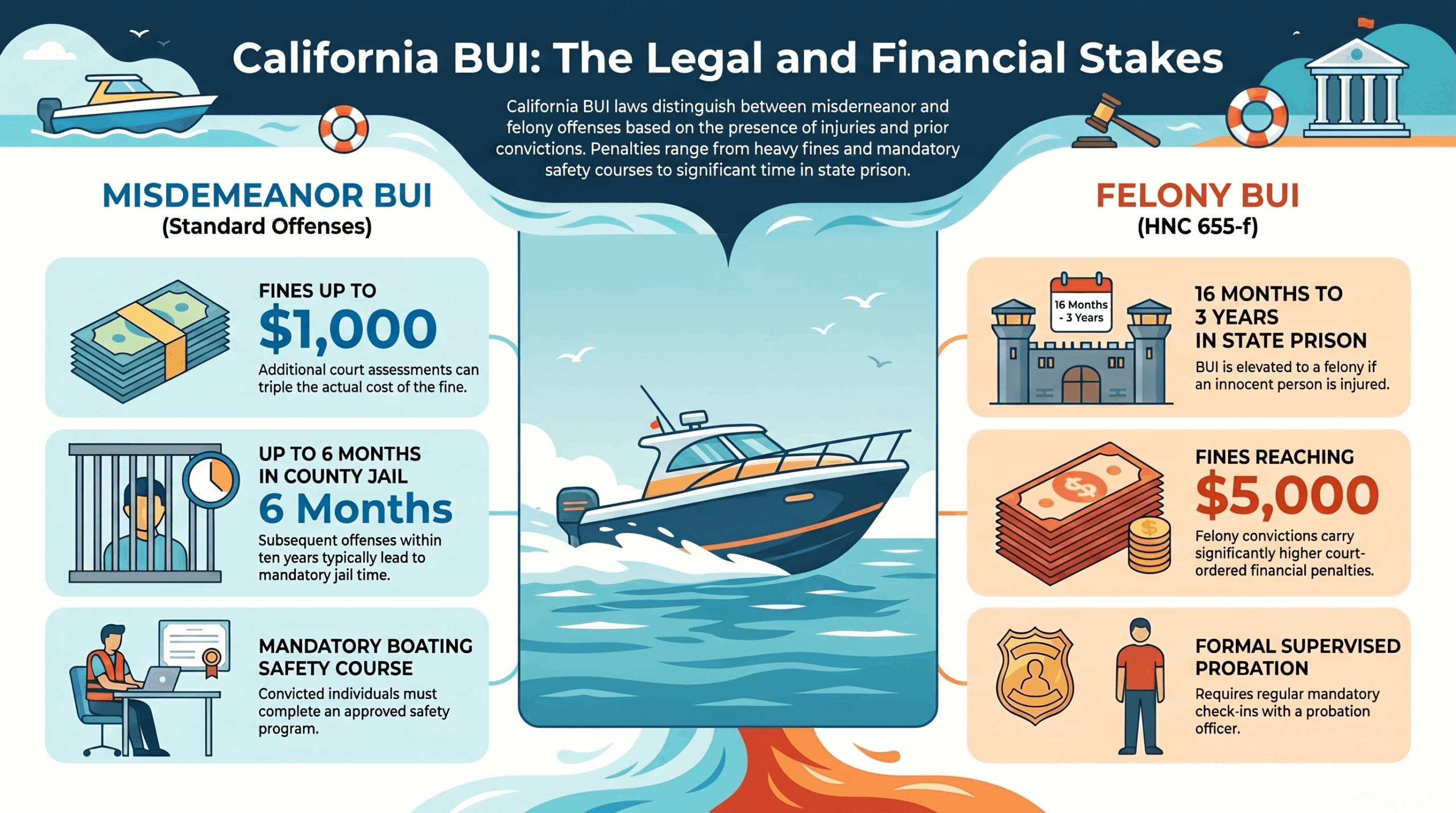
Misdemeanor BUI Penalties: First Offense vs. Subsequent Offenses
A first-time misdemeanor BUI conviction carries standard penalties that include:
Up to $1,000 in court fines (plus additional court assessments that can triple the actual cost).
Up to 6 months in a county jail.
Completion of a mandatory boating safety course.
If you receive a second or subsequent misdemeanor BUI conviction within a ten-year period, the court will typically enforce mandatory jail time, longer probationary periods, and higher fines.
Felony BUI Penalties: State Prison, Formal Probation, and High Fines
If your BUI is elevated to a felony because an innocent person was injured, the penalties become extraordinarily severe. A felony BUI conviction under HNC 655(f) can result in:
State Prison: A sentence of 16 months, 2 years, or 3 years in California state prison.
High Fines: Court-ordered fines reaching up to $5,000.
Formal Probation: Stricter supervised probation that requires regular check-ins with a probation officer.
The Consequences of Chemical Test Refusal for Motorized Watercraft
If a law enforcement officer has reasonable suspicion that you are operating a motorized vessel under the influence, they will ask you to submit to a chemical breath or blood test.
While you have the physical power to refuse, California law imposes separate penalties for a chemical test refusal. A refusal can be used as consciousness of guilt by the prosecution in court, and it often leads to enhanced sentencing penalties if you are ultimately convicted of the BUI.
Alternative Sentencing Options: Rehabilitation and Counseling
In some misdemeanor cases, an experienced defense attorney can negotiate alternative sentencing options with the judge. Instead of serving time in a county jail, a defendant might be allowed to complete an alcohol or drug rehabilitation program, attend counseling, or perform community service. This approach focuses on rehabilitation rather than pure punishment.
Critical Differences: How a BUI Affects Your Driver’s License vs. a DUI
One of the most surprising aspects of California BUI law is how it interacts with your everyday driver’s license. Because boating laws and driving laws are governed by different codes, the consequences vary in unexpected ways.
Why a BUI Arrest Does Not Trigger an Automatic DMV License Suspension
When you are arrested for a standard DUI on land, the police officer will confiscate your driver’s license and the DMV will automatically initiate an administrative suspension of your driving privileges.
However, a BUI arrest does not trigger an automatic administrative suspension of your California driver’s license. The DMV does not have the immediate authority to take away your driving privileges for a standard BUI arrest because your driving privilege applies to public roadways, not waterways.
The “Priorable” Trap: How a BUI Conviction Acts as a Prior Offense on a Future DUI Ticket
While a BUI arrest won’t take away your driver’s license right away, you must be aware of the “priorable” trap. Under California law, a BUI conviction counts as a prior offense if you are arrested for a vehicle DUI in the future.
If you have a BUI conviction on your record and get pulled over in a car five years later, the state will charge you with a second-offense DUI. This means you will face the mandatory driver’s license suspensions, increased jail time, and massive fines associated with a repeat DUI offense.
Severe Aggravating Factors: When BUI Escalates Beyond HNC 655
When a boating accident results in severe harm, the state drops standard BUI charges and pursues aggressive felony prosecutions under completely different sections of the California Penal Code.
BUI Causing Injury: The “Wobbler” Charge (HNC 655(f))
When a BUI causes an injury to another person, it is classified as a “wobbler.” This means the prosecution has the discretion to charge the crime as either a misdemeanor or a felony. They will make this decision based on your past criminal record and the severity of the victim’s injuries. If charged as a felony, prison time is highly likely.
Boating Manslaughter While Intoxicated (Penal Code 192.5)
The absolute worst-case scenario on the water is an accident that results in a fatality. If a person dies as a result of your intoxicated boating operation, the state will charge you with Boating Manslaughter While Intoxicated under Penal Code 192.5.
| Charge Type | Legal Code | Maximum Prison Sentence |
| Vehicular/Boating Manslaughter (Without Gross Negligence) | Penal Code 192.5(b) | Up to 4 years in state prison |
| Gross Boating Manslaughter While Intoxicated | Penal Code 192.5(a) | Up to 10 years in state prison |
A conviction under Penal Code 192.5 will completely alter your life, resulting in a permanent felony strike on your record and a lengthy prison sentence.
Federal vs. State Jurisdiction: Coast Guard vs. Local Law Enforcement
Boating law enforcement is unique because jurisdiction on the water is often shared between multiple local, state, and federal agencies. Who arrests you can change how your case is handled.
Who Has the Authority to Stop and Board Your Boat?
On California lakes, rivers, and coastal waters, several agencies have the right to stop and board your vessel to perform safety checks. These include:
Local County Sheriff’s Departments (Harbor Patrol)
California Department of Parks and Recreation (Lifeguards and Rangers)
The United States Coast Guard
Unlike driving a car, where an officer needs reasonable suspicion of a traffic violation to pull you over, maritime law enforcement officers are legally permitted to stop and board your vessel simply to conduct a routine safety equipment inspection.
What Happens If You Are Arrested by the U.S. Coast Guard on Federal Waters?
If you are operating your boat in ocean waters or large bays under federal jurisdiction, the U.S. Coast Guard may arrest you. The Coast Guard enforces federal maritime laws under 33 CFR Directives.
If arrested by federal authorities, your case will be prosecuted by a federal prosecutor in a United States District Court, rather than a local California county courthouse. Federal BUI convictions carry their own set of strict fines and federal prison sentences.
Legal Defenses: How to Fight a California BUI Charge
Receiving a BUI charge can feel overwhelming, but it is important to remember that an arrest is not the same thing as a conviction. Defending a BUI charge requires specialized knowledge because the environment on the water introduces variables that do not exist on land.
Challenging the Legality of the Watercraft Stop
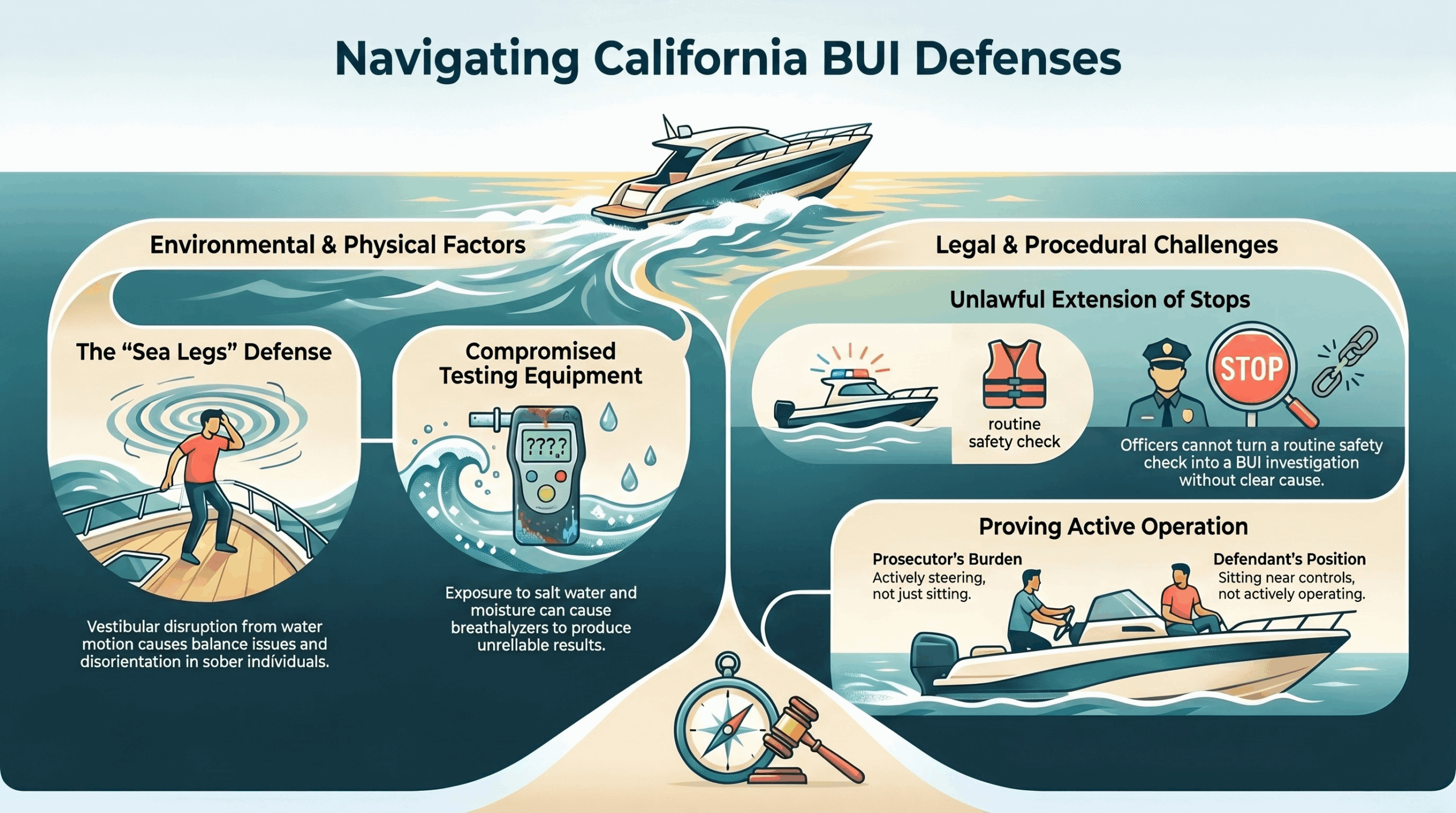
While officers can board your boat for a safety check, they cannot use the safety check as a blank check to conduct a prolonged criminal investigation without reason. If the officer extended the stop into a BUI investigation without clear signs of intoxication, your defense attorney can challenge the legality of the stop and attempt to get the evidence thrown out of court.
Unreliability of Maritime Field Sobriety Tests (FSTs) Due to “Sea Legs”
On land, police officers ask you to walk a straight line or stand on one foot. Performing these same tests on a moving boat, a swaying dock, or even on solid ground immediately after spending hours on the water is fundamentally flawed.
A natural condition known as vestibular disruption—commonly called “sea legs”—causes balance issues, inner-ear disorientation, and fatigue in perfectly sober individuals. A skilled defense lawyer will argue that your poor performance on a Field Sobriety Test was caused by the natural motion of the water and sun exposure, not alcohol consumption.
Inaccuracies in Breathalyzer and Blood Testing Equipment
Breath testing devices used on the water are exposed to harsh conditions, including moisture, salt water, and constant movement. If the law enforcement agency failed to properly calibrate, clean, or maintain the breathalyzer equipment according to strict state guidelines, the test results can be deemed unreliable and excluded from your trial.
Proving You Were Not the Person “Operating” the Vessel
To secure a BUI conviction, the prosecutor must prove beyond a reasonable doubt that you were the person actively operating the vessel while intoxicated. If multiple people were on board and you were simply sitting near the controls or relaxing while someone else steered, the state’s case can fall apart.
What to Do If You Are Facing BUI Charges in California
If you or a family member find yourself under arrest for a BUI in California, the choices you make in the first 24 to 48 hours are absolutely critical. If the court sets a high bail amount, remaining in a county jail while trying to build a legal defense can place an immense emotional and financial strain on your family.
The Importance of Immediate Legal Representation
Securing an experienced defense attorney right away gives you the best chance of reducing a felony charge to a misdemeanor, or getting a misdemeanor charge dismissed entirely. Your attorney will immediately look to preserve evidence, interview witnesses, and analyze police reports for errors.
Securing Fast Release with Armstrong Bail Bonds
If a loved one is currently detained following a BUI arrest in Southern California, getting them out of jail quickly is the top priority. Armstrong Bail Bonds is here to provide the immediate solution you need.
As a trusted, family-owned business serving Los Angeles, Orange County, and San Diego since 1926, Armstrong Bail Bonds understands the complexities of the California legal system. Their licensed agents operate 24 hours a day, 7 days a week, to post bail quickly and securely, often securing a release in as little as 30 minutes.
Frequently Asked Questions (People Also Ask)
Can a BUI take away your driver’s license in California?
No, a standard misdemeanor BUI arrest will not result in an immediate or automatic administrative suspension of your California driver’s license by the DMV. However, a BUI conviction remains on your record and will act as a prior offense if you are arrested for a vehicle DUI within the next ten years.
Is a first-time BUI in California a felony?
A first-time BUI in California is typically charged as a misdemeanor. It will only be charged as a felony if your actions caused bodily injury or death to another person, or if you have a prior history of multiple BUI or DUI convictions within a ten-year timeframe.
What happens if you get a BUI on a jet ski in California?
California law defines a jet ski as a motorized vessel. Operating a jet ski with a BAC of 0.08% or higher carries the exact same HNC 655 penalties as operating a large motorboat, including potential jail time, expensive fines, and a permanent criminal record.
Can you drink alcohol as a passenger on a boat in California?
Yes, passengers on a recreational boat in California are legally permitted to consume alcohol. The state’s open container laws apply strictly to motor vehicles on public roadways, not to recreational boats. However, the designated operator of the boat must remain sober and below the legal limit at all times.
What is the difference between a DUI and a BUI in California?
While both charges involve operating a vehicle under the influence, a DUI applies to motor vehicles driven on public roads and involves automatic DMV driver’s license suspensions. A BUI applies to watercraft under the Harbors and Navigation Code and does not trigger an immediate driver’s license suspension upon arrest.
Can the Coast Guard pull you over for no reason?
Yes. Under federal law, the United States Coast Guard has the unique authority to stop and board any vessel on federal or coastal waters at any time to perform a routine safety and document inspection. They do not need to observe a traffic violation or have reasonable suspicion of criminal activity to initiate the stop.
Need Help Resolving a BUI Arrest? Contact Armstrong Bail Bonds Today
An arrest on the water does not have to ruin your future. If your friend or family member is currently held in custody on a BUI charge, do not wait through stressful delays in the county jail system.
Contact Armstrong Bail Bonds immediately to speak with a professional, compassionate agent who can walk you through the process step-by-step. With flexible payment options and around-the-clock availability, Armstrong Bail Bonds will help bring your loved one home safely and quickly. Call their team today at 818-241-2171 or connect with them online to get the bail bond process started right away.