

02 Jul What Happens When You Violate Probation?
Learning that you or a loved one is facing a probation violation can be an overwhelming and terrifying experience. Under California Penal Code 1203.2, violating the terms of your release can result in immediate arrest, a return to court, or even the activation of a suspended jail sentence. If you are dealing with this high-stress situation, knowing how the legal system works and learning your options for a fast release can make a massive difference in your case.
Understanding California Probation Basics (PC 1203.2)
Probation is an alternative to serving time in jail or prison. Instead of being locked behind bars, the court allows an individual to live and work in the community under strict supervision. However, this freedom is a privilege, not a right, and it comes with explicit legal boundaries.
Summary (Informal) Probation vs. Formal Probation in SoCal
In Southern California, courts generally issue two main types of probation:
Summary Probation (Informal): This is typically handed down for misdemeanor offenses (such as a first-time DUI). You do not have a designated probation officer. Instead, you are monitored directly by the court and must simply stay out of legal trouble and complete your court orders.
Formal Probation: Reserved for felony offenses. You are assigned a specific probation officer (PO) whom you must visit regularly. You must also ask permission before changing addresses or traveling outside your county.
Standard Terms and Conditions
Every probation agreement includes rules that you must follow exactly. Common conditions include:
Paying court-ordered fines and victim restitution.
Submitting to random drug and alcohol testing.
Completing community service or mandatory counseling programs.
Maintaining steady employment or schooling.
Avoiding specific people or places (such as staying away from a co-defendant).
Technical vs. Substantive Probation Violations
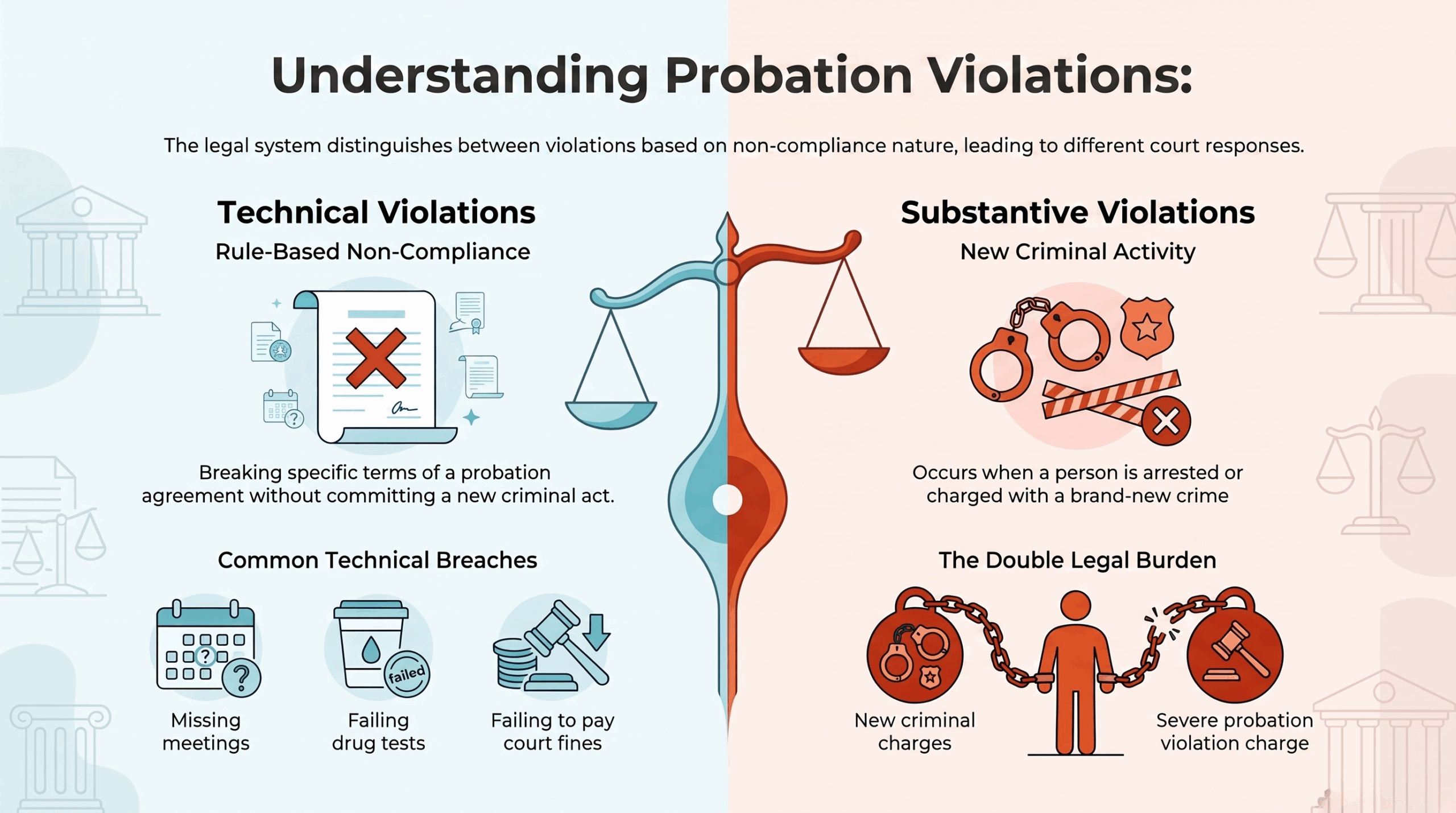
Not all probation violations look the same. The legal system splits violations into two distinct categories, and the courts treat them very differently.
What Qualifies as a Technical Violation?
A technical violation occurs when you break one of the specific rules of your probation agreement, but you did not commit a new crime. For example:
Missing a scheduled meeting with your probation officer.
Moving to a new apartment without updating your address.
Testing positive for substances during a random drug screen.
Failing to pay your monthly court fines on time.
While these are not new criminal acts, they still prove to the court that you are failing to comply with your supervision rules.
What Qualifies as a Substantive Violation?
A substantive violation occurs if you are arrested or charged with a brand-new crime while still serving probation for an older offense. For example, if you are on probation for theft and get arrested for assault, you face a substantive violation.
In this scenario, you must deal with two separate issues: the new criminal charges themselves, and a severe probation violation for failing to “obey all laws.”
The Arrest Process: Probation Violation Warrants & Jail Holds
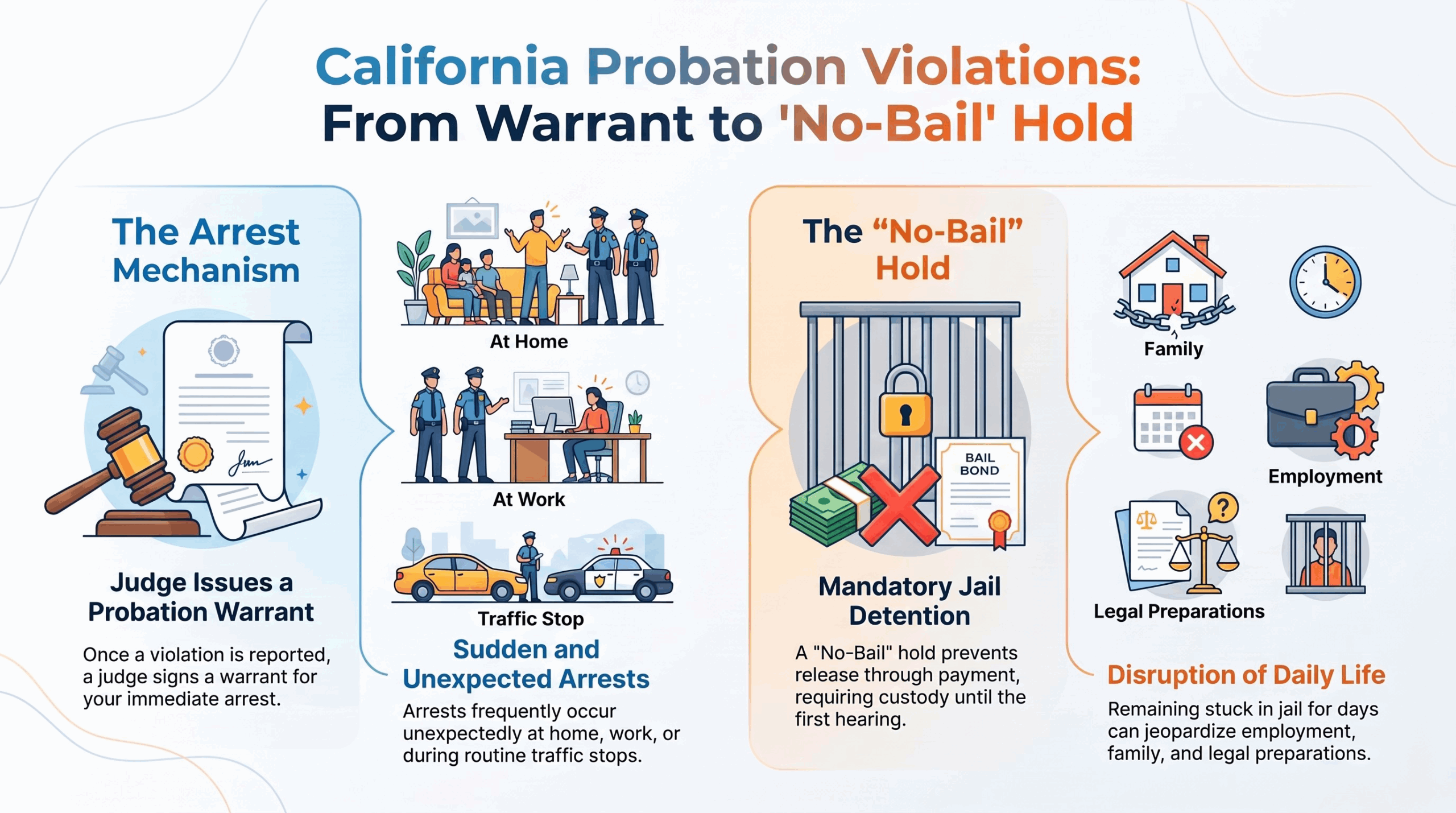
If your probation officer or the court believes you broke your rules, the legal machinery starts moving quickly.
How California Judges Handle Probation Warrants
When a violation is reported, a judge will typically sign a probation violation warrant. Law enforcement officers can use this warrant to arrest you at home, at work, or during a routine traffic stop. Unlike typical criminal warrants where you might receive a polite notice to appear in court, probation warrants frequently lead to unexpected, stressful arrests.
The Dreaded “No-Bail” Hold
When you are booked into a Southern California jail on a probation warrant, the judge will often apply a “No-Bail” hold.
A “No-Bail” hold means that the jail staff cannot let you pay money to walk out of jail right away. Instead, you are legally required to remain in custody until you can stand before a judge at your initial hearing. This hold can keep you stuck in a local holding facility for days, which can disrupt your job, family life, and legal preparations.
Can You Post Bail for a Probation Violation in Southern California?
One of the biggest areas of confusion for families is whether a loved one can get out of jail after a probation violation arrest. The answer depends heavily on the specific situation and how the judge structures the warrant.
When is Bail Allowed for a Probation Violation?
If the judge does not issue a “No-Bail” hold, or if your defense attorney successfully convinces the judge to lift the hold during your first court appearance, a specific bail amount will be set. Once a monetary bail amount is on the books, you are legally allowed to post bail and secure your freedom while your violation case moves forward.
How Bail Amounts are Determined
If you face a substantive violation (a new crime), the judge will look at the local county bail schedule to determine the bail amount for the new charge. Then, they will add an additional bail amount—or keep a temporary hold—for the probation violation itself. Because you broke the court’s trust by violating your initial terms, the bail amounts for probation issues are often set much higher than standard rates.
Working with a Local Bondsman for a Fast Release
If the court sets a clear bail amount, trying to pay the full cash sum directly to the court can be financially devastating. That is where working with a licensed bondsman is essential.
By paying a small, legally regulated premium (typically 10% or less under certain conditions), a trusted agency like Armstrong Bail Bonds can post the full bond amount with the jail. This secures a rapid release from major Southern California facilities, such as the Twin Towers Correctional Facility in Los Angeles, or local jails in Orange County and San Diego.
What to Expect at a California Probation Revocation Hearing (PRH)
You have a constitutional right to a hearing before a judge can officially punish you for a probation violation. This process is called a Probation Revocation Hearing (PRH).
The Lower Standard of Proof: Preponderance of the Evidence
It is vital to understand that a probation hearing is not a standard criminal trial. In a regular trial, the prosecutor must prove you are guilty “beyond a reasonable doubt.”
At a probation violation hearing, the standard drops significantly to a “preponderance of the evidence.” This simply means the prosecutor only has to convince the judge that it is more likely than not (51% certainty) that you violated your terms. Furthermore, there is no jury; the judge alone decides your fate.
Potential Court Outcomes
If the judge decides you did violate your probation, they have three main choices:
Reinstatement: The judge gives you a warning, releases you, and lets you continue your original probation terms.
Modification: The judge allows you to stay on probation, but adds harsher terms. This can include extending your probation time, adding more community service hours, or requiring stricter counseling.
Revocation: The judge cancels your probation entirely. They can sentence you to serve the full, suspended jail or prison sentence that was held over your head when your initial case concluded.
How to Handle a First-Time Probation Violation
If this is your first time facing an alleged violation, taking the correct steps immediately can keep a minor mistake from turning into a life-altering jail sentence.
Immediate Steps to Minimize Consequences
Do Not Run: Avoiding your probation officer or evading a warrant will only make the judge view you as a flight risk, ensuring you face maximum jail time later.
Gather Your Proof: If your violation was a technicality—like missing a meeting because you were hospitalized—gather your medical records, employer notes, or program completion certificates immediately to show your officer.
Stay Respectful: Keep open, polite lines of communication with your probation officer. A cooperative attitude can lead them to recommend a lighter penalty to the judge.
Why Coordinating Legal Defense and Bail Matters
Do not wait until your court date to build a game plan. You need to coordinate your defense steps and your bail options at the exact same time. Having a professional bail agency ready to act the moment a judge sets a bail amount means your time spent behind bars is cut down to the absolute minimum.
Need Help Getting a Loved One Out of Jail? Contact Armstrong Bail Bonds
When an unexpected probation warrant throws your life into chaos, you do not have to handle the complex Southern California jail system alone. Armstrong Bail Bonds has been helping local families navigate arrests, warrants, and jail releases for nearly a century.
Over 88 Years of Trusted Bail Experience
Founded in Glendale in 1926 by Cecil Armstrong, our family-owned and operated business is one of Southern California’s oldest and most respected bail institutions. Today, CEO Bill Armstrong leads a third generation of dedicated bail professionals who understand the inner workings of municipal and county courts across Los Angeles, San Diego, and Orange County.
24/7 Rapid Release and Flexible Financing
Jail holds do not wait for business hours, and neither do we. Our team is available 24 hours a day, 7 days a week to guide you through the application process and arrange rapid jail releases—sometimes in as little as 30 minutes depending on the facility. We offer convenient online application forms and flexible financing options to make securing your loved one’s freedom affordable and stress-free.
People Also Ask (FAQ)
Can you get bail for a probation violation in California?
Yes, you can get bail, but it depends on the judge. If the court places a “No-Bail” hold on your warrant, you must remain in custody until your first hearing. At that hearing, a judge can choose to lift the hold and set a financial bail amount.
How long can they hold you in jail for a probation violation?
If you are held without bail, California law generally requires that you are brought before a judge for an arraignment within a few business days of your arrest. The final revocation hearing must usually take place within a reasonable timeframe, often within 30 days of your initial appearance.
What is the most common probation violation?
The most common technical violations include missing scheduled check-ins with a probation officer, failing a random drug or alcohol screening, and failing to pay court fines or victim restitution.
Will I go to jail for my first probation violation?
Not necessarily. For a first-time, minor technical violation, a judge may choose to reinstate your probation with a warning or modify your terms to include extra community service or classes. However, jail time is always a legal possibility.
What happens if you commit a new crime while on probation?
This is considered a substantive violation. You will face brand-new criminal charges for the recent act, alongside a formal probation violation case for the original offense. This significantly increases your chances of serving jail time.
Can a probation officer drop a violation?
A probation officer has some discretion, especially for minor first-time technical issues. They may choose to give you an official warning instead of filing a formal violation with the court. However, once they file the paperwork with a judge, only the judge can dismiss it.
Secure an Immediate Release Today
If a friend or family member has been detained on a probation warrant anywhere in Southern California, fast action is vital. Call Armstrong Bail Bonds right now at (818) 241-2171 for free, confidential guidance and immediate 24/7 bail assistance.