

29 Jul If You Bail Someone Out of Jail, Are You Responsible for Them in California?
If you bail someone out of jail, are you responsible for them in California? Yes, you are financially responsible for ensuring they appear in court, but you are not legally liable for their personal behavior. To protect your financial security and secure your loved one’s release without delay, partner with the experienced team at Armstrong Bail Bonds.
Quick Answer: What Are You Actually Responsible For?
When a friend or family member is arrested in California, getting them home is your top priority. However, signing a bail contract raises serious questions about your personal exposure. Understanding the exact scope of your commitment protects both your wallet and your peace of mind.
Financial Responsibility vs. Personal/Legal Liability
The biggest misconception about bailing someone out of jail is that you become responsible for their personal actions. You are NOT criminally or civilly liable for crimes, traffic accidents, or civil wrongdoings the defendant commits after release.
If the person you bail out gets arrested again, you do not go to jail for their new charge. Your legal obligation is strictly financial and tied exclusively to one requirement: ensuring the defendant attends every scheduled court date.
What Does It Mean to Be an “Indemnitor” (Co-Signer) in California?
When you sign a bail bond agreement, you become the indemnitor. In legal terms, an indemnification agreement means you promise to hold the bail bond company harmless. If the defendant misses court and the bond is forfeited, you agree to repay the bail agency for the full penal amount of the bond, plus any costs incurred to locate and return the defendant to custody.
The 3 Primary Responsibilities of a Bail Bond Co-Signer
Before co-signing a bond, you must understand the three core obligations you undertake under California law.
Guaranteeing Court Appearances (California Penal Code Requirements)
Your primary responsibility as an indemnitor is to ensure the defendant appears for every required court hearing—from arraignment to final sentencing. You must maintain open communication with the defendant, remind them of court dates, and ensure they have reliable transportation.
Paying the Non-Refundable Premium Fee
Under California law, the fee charged by a bail bond company is called a “premium.” This fee is non-refundable because it represents the service charge for taking on the risk of posting the full bail amount with the court.
Standard Rates: The standard bail bond premium in California is 10% of the total bail set by the court (for example, a $50,000 bail equals a $5,000 premium).
Legal Discounts: Under California Insurance Code guidelines, Armstrong Bail Bonds offers discounted premium rates (such as 7% or 8%) for qualified clients, including union members, military personnel, homeowners, or defendants who have retained private defense counsel.
Covering the Full Bail Amount If the Defendant Flees
If the defendant deliberate skips court and vanishes, the court forfeits the bail. As the co-signer, you become legally responsible for paying 100% of the full bail amount to the bail bond company, as well as any fees required to apprehend the fugitive.
Ways to Post Bail in California (And How Liability Differs)
How you choose to post bail dictates your financial exposure and how quickly your assets are tied up.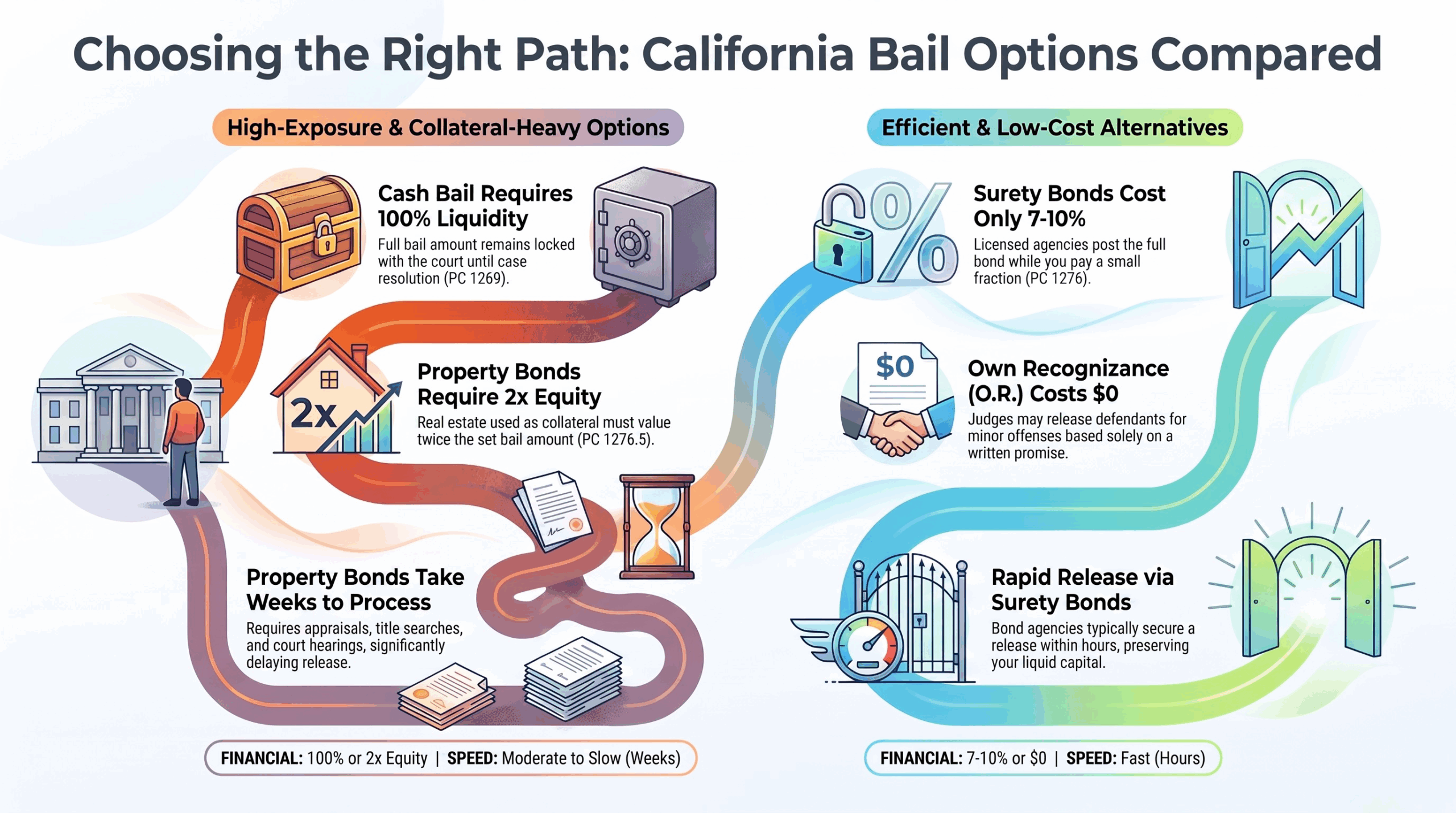
Cash Bail (California Penal Code 1269)
Posting cash bail under PC 1269 requires paying 100% of the full bail amount directly to the jail or court cashier.
Risk Factor: If bail is set at $100,000, you must deposit $100,000 in liquid cash. That money remains locked up with the court system for months—or even years—until the case fully resolves.
Surety Bail Bonds (California Penal Code 1276)
A surety bond under PC 1276 is the most common, cost-effective way to secure release. You work with a licensed agency like Armstrong Bail Bonds, paying only a small fraction (typically 7% to 10%) of the total bail. Armstrong posts the full bond with the court, allowing you to keep your capital liquid while getting your loved one out in hours.
Property Bonds (California Penal Code 1276.5)
Under PC 1276.5, you can put up real estate as collateral to post bail. However, California law requires that the equity in the property equal at least two times (2x) the set bail amount. Processing a property bond requires property appraisals, title searches, and court hearings, often keeping the defendant in jail for weeks.
Own Recognizance (O.R.) Release (CA Constitution Art. 1 § 12c)
In select cases involving minor, non-violent offenses, a judge may release a defendant on their Own Recognizance (O.R.). This requires no cash or bond, relying solely on the defendant’s written promise to appear.
What Happens If the Defendant Skips Town or Misses Court?
Missing a court appearance triggers a swift legal sequence in California. However, a single missed court date does not mean immediate financial ruin if you act quickly.
[Defendant Misses Court] ➔ [Court Issues Bench Warrant & Forfeits Bond] ➔ [180-Day Grace Period Begins] ➔ [Fugitive Recovery or Re-Arraignment] ➔ [Bond Exonerated OR Full Forfeiture]
California’s 180-Day Forfeiture Period (PC 1305 Explained)
When a defendant misses court, the judge issues a bench warrant and declares the bond conditionally forfeited under California Penal Code Section 1305.
The court grants a mandatory 180-day grace period (which can sometimes be extended by an additional 180 days). During this window, the bail bond agency and the co-signer have time to locate the defendant, bring them back to court, or show a valid legal excuse (such as hospitalization or arrest in another jurisdiction) to vacate the forfeiture and reinstate the bond.
The Role of Fugitive Recovery Agents (Bounty Hunters under CA PC 1299)
If the defendant goes into hiding, the bail agency dispatches licensed Fugitive Recovery Agents operating under the California Bail Fugitive Recovery Persons Act (PC 1299). These agents have the legal authority to locate and arrest the fugitive. The costs incurred by recovery agents are billed to the co-signer as outlined in the indemnity agreement.
Asset Seizure, Wage Garnishment, and Collateral Loss
If the 180-day window expires and the defendant is not returned to custody, the court executes a final summary judgment. The bail agency must pay the full bail amount to the court, and will subsequently sell pledged collateral, garnish wages, or file civil suits against the indemnitor to recover the full debt.
Can You Take Back a Bail Bond in California? (The Exit Strategy)
If you signed as a co-signer and later discover the defendant plans to flee, stop attending court, or engage in dangerous behavior, you are not trapped.
How to Request Bond Revocation and Surrender the Defendant
As an indemnitor, you have the legal right to revoke your sponsorship at any time. You can contact Armstrong Bail Bonds and request a “surrender of defendant.”
Our licensed bail agents can initiate the process to return the defendant to jail custody. Once the defendant is surrendered back to the court, your financial liability for future court appearances is legally terminated.
Adding Mandatory Conditions Before You Agree to Co-Sign
You hold the leverage before signing the paperwork. You can require the defendant to meet specific conditions as a requirement for your co-signature, such as:
Enrolling in an outpatient drug or alcohol rehabilitation program.
Checking in weekly with both you and Armstrong Bail Bonds.
Surrendering their passport and agreeing to travel limitations.
What Are the Qualifications to Co-Sign a Bail Bond in California?
Bail bond agencies evaluate co-signers much like financial institutions evaluate loan applicants, focusing on stability and reliability.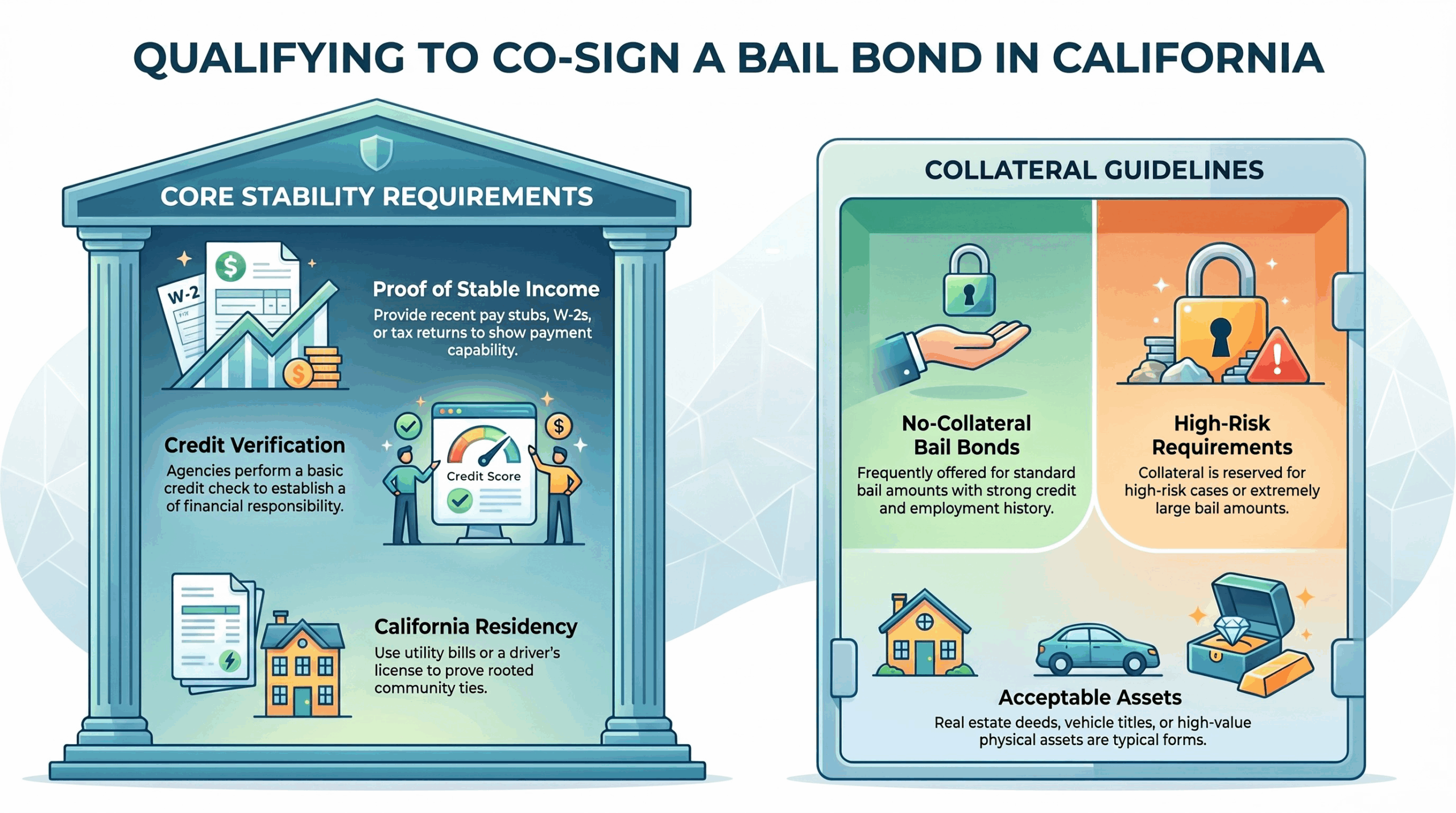
Credit, Proof of Income, and California Residency Requirements
To qualify as an indemnitor with Armstrong Bail Bonds, you generally need to meet basic stability metrics:
Proof of Stable Income: Recent pay stubs, W-2s, or tax returns showing you can cover potential fees or payment arrangements.
Credit Verification: A basic credit check to establish financial responsibility.
California Residency: Proof of local address (utility bills or driver’s license) showing rooted ties to the community.
When Is Collateral (House, Car, Assets) Required?
Collateral is not required for every bond. For standard bail amounts where the co-signer has strong credit and employment history, Armstrong Bail Bonds frequently offers no-collateral bail bonds. Collateral (such as real estate deeds, vehicle titles, or high-value physical assets) is typically reserved for high-risk cases or extremely large bail amounts.
How Long Are You On the Hook? (Bail Exoneration)
Your financial liability does not last forever. It ends through a formal legal declaration known as exoneration.
Case Resolution (Verdict, Dismissal, or Sentencing) ➔ Court Issues Order of Exoneration ➔ Liability Terminates ➔ Collateral Returned (within 30 days)
What Is “Bail Exoneration” and When Does Your Contract End?
Bail exoneration is the official court order declaring that the bail bond obligation is complete. Exoneration occurs when the criminal case reaches its final conclusion—regardless of whether the defendant is found guilty, acquitted, or if charges are dropped entirely. Once the judge exonerates the bond, your financial liability for the total bail amount instantly ends.
What Happens to Your Money/Collateral If the Defendant Is Found Guilty or Charges Are Dropped?
Bail Premium: The 7%-10% premium paid to Armstrong Bail Bonds is a fee for professional service rendered and is non-refundable, regardless of the case outcome.
Collateral: Any property, car titles, or cash collateral held by the agency must be returned to you in full once the court issues an order of exoneration and all outstanding administrative fees are settled.
How Long Does It Take to Get Cash Bail or Collateral Back in California?
Cash Bail Posted Directly with the Court: Courts are notoriously slow. Getting cash bail refunded directly from a California court clerk can take anywhere from 6 to 12 weeks after case exoneration, minus administrative processing fees.
Collateral Returned by Armstrong Bail Bonds: Once we receive written proof of exoneration from the court, Armstrong Bail Bonds returns pledged collateral to you promptly, typically within 10 to 30 days.
Checklist: Questions to Ask Yourself Before Bailing Someone Out
Do not let emotions dictate a major financial commitment. Run through this checklist before signing as an indemnitor:
How well do I know this person? (Do they have a history of honesty and keeping promises?)
Do they have deep roots in the community? (Local job, family, local home, or school obligations?)
Have they ever missed a court date before?
Can I afford the non-refundable premium? (Am I comfortable with the down payment and monthly plan?)
Am I prepared to pay the full bail amount if they skip court?
Will they stay in close contact with me until the entire case is closed?
If you answer “no” or feel uncertain about several of these points, speak with an agent at Armstrong Bail Bonds at (818) 241-2171 to explore protective co-signing arrangements.
Frequently Asked Questions (FAQ)
Can I go to jail if the person I bailed out commits another crime?
No. You are only responsible for ensuring their appearance in court for the specific charge associated with the bail bond. You carry zero criminal liability for new crimes or personal offenses they commit while out on bail.
Do I get the 10% bail bond fee back if the charges are dismissed?
No. The premium paid to a bail bond company is a non-refundable service fee. It compensates the bail agency for putting up the full bail amount on the defendant’s behalf and securing their immediate release from custody.
Can a co-signer force a defendant back into jail?
Yes. As an indemnitor, if you believe the defendant is planning to flee or violating bond conditions, you have the legal right to request that the bail bond agency revoke the bond and surrender the defendant back into court custody.
What happens if the defendant misses court due to a medical emergency?
If a defendant misses court due to a verifiable emergency (such as emergency hospitalization or severe illness), the attorney or bail agency can present medical proof to the judge under California Penal Code 1305 to vacate the bond forfeiture and reinstate the bail without penalty.
Do all bail bond companies charge the same 10% rate in California?
While 10% is the standard maximum rate regulated by the California Department of Insurance, licensed agencies like Armstrong Bail Bonds can offer legally approved discounted rates (such as 7% or 8%) for qualified individuals, union members, veterans, or clients represented by private defense attorneys.
Secure Your Loved One’s Freedom with Southern California’s Most Trusted Team
Navigating the California bail process can feel overwhelming, but you do not have to do it alone. Since 1926, Armstrong Bail Bonds has helped thousands of families secure fast, affordable release while protecting co-signers every step of the way.
As a family-owned, 3rd-generation business serving Los Angeles County, Orange County, San Diego County, and surrounding areas, our licensed bondsmen are available 24 hours a day, 7 days a week. We offer flexible payment plans, low rates, and complete transparency so you are never left in the dark about your co-signing obligations.
Don’t leave your loved one in jail another hour. Call Armstrong Bail Bonds right now at (818) 241-2171 or contact us online for immediate, confidential assistance.