

11 Aug What Collateral Do Bondsmen Accept? (And How Bail Collateral Works)
If you need to know what collateral bondsmen accept to secure a loved one’s fast release from jail, most licensed agencies accept real estate, motor vehicles, bank accounts, precious metals, and high-value personal property. Finding out someone you care about has been arrested is overwhelming, but you do not have to navigate the bail process alone. Armstrong Bail Bonds is available 24/7 to help walk you through your options and secure a rapid release.
What Is Bail Bond Collateral and When Is It Required?
Bail collateral is a financial guarantee or physical asset pledged to a bail bond agency to secure a defendant’s release from custody. When a court sets bail at an amount higher than what a family can pay out-of-pocket in cash, a bail bondsman can post the full bond on the defendant’s behalf. Collateral acts as insurance to ensure the defendant returns to court for all scheduled hearings.
The Role of Collateral in Securing Pretrial Release
When a bond agency posts bail for a defendant, it takes on financial liability for the full bail amount set by the court. If the defendant skips court, the bail agency must pay that full amount to the court. Collateral protects the bondsman against this risk, ensuring the agency can recover the financial loss if the defendant fails to appear.
Bail Premium (Fee) vs. Collateral: Understanding the Difference
It is essential to distinguish between the bail premium and collateral:
Bail Premium (Fee): This is the non-refundable service fee charged by the bail bond agency (typically 10% of the total bail amount in states like California). This fee is payment for the agency’s services and risk.
Bail Collateral: This is valuable property or money pledged as security. Unlike the premium, collateral is fully refundable once the defendant’s court case concludes, provided all court appearances are met.
Factors That Determine If a Bondsman Will Require Collateral
Not every bail bond requires collateral. A licensed bail bondsman evaluates several risk factors before deciding whether collateral is necessary:
The Bail Amount: Higher bail amounts carry greater financial risk, making collateral more likely.
Flight Risk: Defendants with out-of-state ties or past failures to appear are higher risks.
Criminal History: Serious charges or extensive records often mandate collateral.
Employment and Community Ties: Steady employment and local family ties reduce the need for collateral.
Cosigner Credit Rating: A cosigner with exceptional credit and proof of income may qualify for an unsecured bond.
The Most Common Types of Collateral Accepted by Bail Bondsmen
Bail agencies look for assets that possess measurable, verifiable value and clear ownership.
┌─────────────────────────────────────────────────────────────────┐
│                 ACCEPTED COLLATERAL AT A GLANCE                 │
├───────────────────┬─────────────────────────────────────────────┤
│ Real Estate       │ Single-family homes, land, commercial unit  │
│ Motor Vehicles    │ Cars, trucks, motorcycles, RVs, boats       │
│ Financial Assets  │ Cash, savings accounts, CDs, stocks, bonds  │
│ Precious Metals   │ Gold/silver bullion, high-end timepieces    │
│ Firearms & Assets │ Legal firearms, electronics, valuable items │
└───────────────────┴─────────────────────────────────────────────┘
Real Estate (Homes, Land, Commercial Property)
Real estate is the most commonly used form of collateral for large bail amounts. Bondsmen accept residential homes, commercial buildings, multi-family units, and vacant land. The property must have sufficient equity to cover the bond liability.
Motor Vehicles (Cars, Trucks, RVs, Boats, Motorcycles)
Vehicles are widely accepted because their market values are easily established using trade standards like Kelley Blue Book (KBB). Cars, commercial trucks, trailers, recreational vehicles, jet skis, and boats can all be used if they carry enough equity.
Financial Assets (Savings Accounts, Certificates of Deposit, Stocks, Bonds)
Liquid financial assets provide immediate security. Bondsmen accept cash deposits, Certificates of Deposit (CDs), mutual funds, stocks, and bonds. These assets are usually held in an escrow account until the court case resolves.
Jewelry and Precious Metals (Gold, Silver, High-End Timepieces)
Gold and silver bullion, fine diamond jewelry, and luxury watches (such as Rolex or Patek Philippe) are strong physical collateral options. An independent professional appraisal is typically performed to establish their fair market value.
Firearms and Pawn-able High-Value Personal Property
In many jurisdictions, legal firearms, musical instruments, high-end electronics, heavy machinery, and collectible items can serve as collateral. The item must be legally owned and easily storable by the agency.
What Makes an Asset Acceptable as Collateral? (Qualifying Criteria)
Not every valuable item automatically qualifies. Bondsmen apply specific criteria to determine if an asset can be used.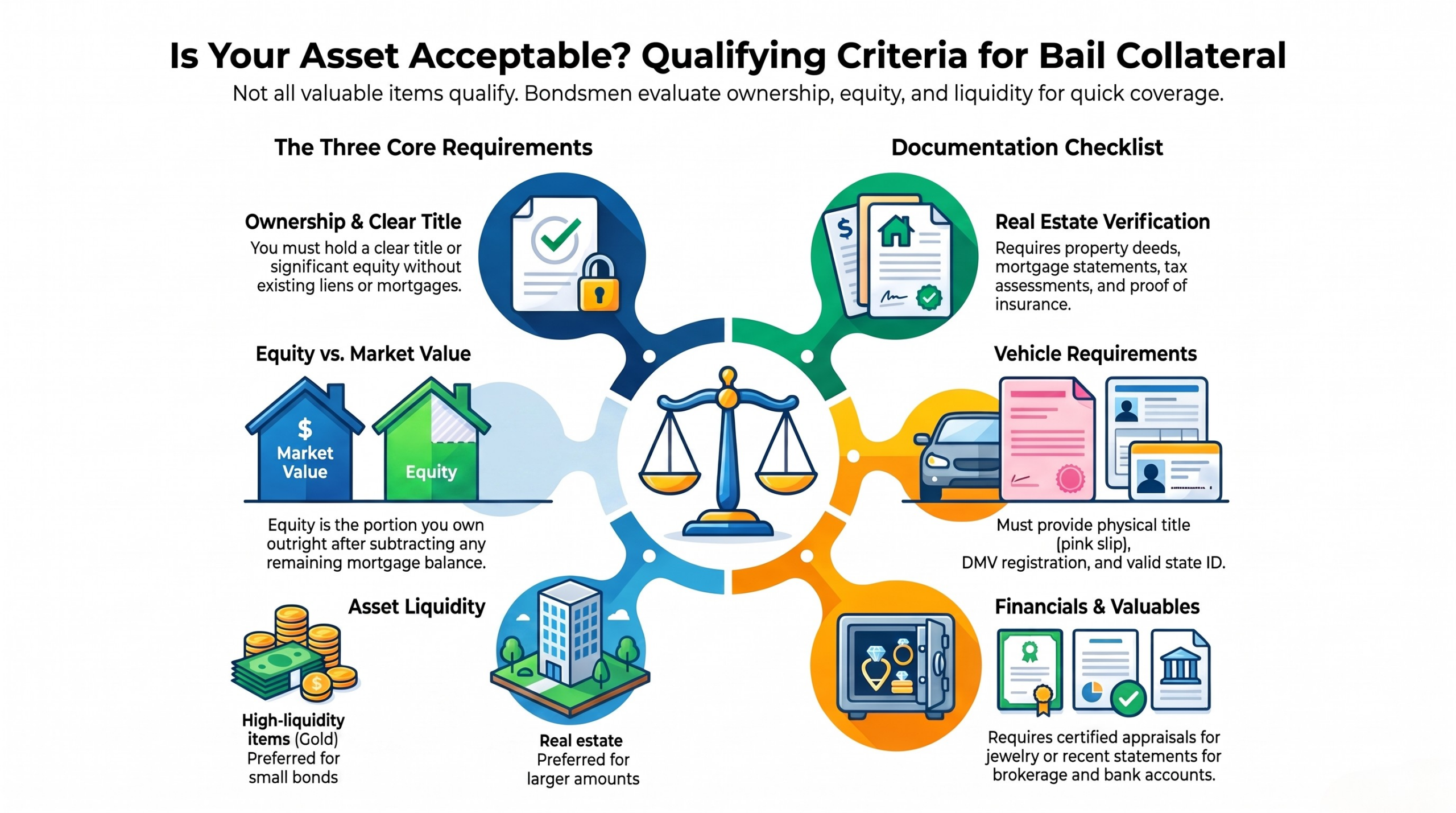
Ownership and Clear Title (No Existing Liens or Mortgages)
To pledge property, you must hold a clear title or have significant equity. If a car title has multiple lienholders or if a home is encumbered by mortgages exceeding its market value, it cannot serve as collateral.
Equity vs. Market Value: How Much Equity Is Needed?
Market value is what an item sells for; equity is the portion you actually own outright.
Example: If a home is worth $400,000 but has a remaining mortgage balance of $370,000, it only holds $30,000 in equity. If your required bail collateral is $50,000, this property alone will not suffice.
Asset Liquidity: How Easily Can the Item Be Converted to Cash?
Liquidity refers to how fast an asset can be sold to cover a debt. Real estate takes longer to sell than liquid cash or gold bullion. High-liquidity items are preferred for smaller bonds, while real estate is reserved for substantial bail amounts.
Proof of Ownership & Required Documentation Checklist
When bringing collateral to a bail agency, you must provide proper verification:
Real Estate: Property deed, recent mortgage statement, tax assessment, and proof of property insurance.
Vehicles: Physical title (pink slip) with no active liens, current DMV registration, and valid state ID.
Financial Accounts: Recent bank statement, CD documentation, or brokerage statements.
Jewelry or Valuables: Certified appraisals or original purchase receipts.
Physical Possession vs. Legal Liens: What Happens to Your Property?
Depending on the type of collateral, the bail bond agency will either take physical custody of the item or record a legal lien against it.
Physical Custody Assets (Jewelry, Firearms, Cash, Pink Slips)
For smaller, highly portable assets—such as gold, jewelry, legal firearms, or vehicle titles—the bail agency takes physical possession. Items are stored securely in safes or insured storage facilities. You retain ownership, but the agency holds the asset or title document until the case is over.
Lien-Based Assets (Deeds of Trust and Property Mortgages)
For real estate, you do not hand over your home or move out. Instead, the bail agency files a legal document (such as a Deed of Trust or mortgage lien) with the county recorder’s office. This places a temporary cloud on the title, preventing you from selling or refinancing the property until the bail bond is exonerated.
Using Third-Party Collateral: Can Someone Else Post Collateral for You?
Yes, a friend, relative, or employer can post collateral on behalf of a defendant. The person providing the collateral becomes a third-party indemnitor (commonly known as a cosigner).
┌─────────────────────────────────────────────────────────────────┐
│                INDEMNITOR (COSIGNER) FLOW CHART                 │
├─────────────────────────────────────────────────────────────────┤
│ 1. Indemnitor Signs Agreement & Offers Collateral               │
│ 2. Defendant Is Released from Custody                           │
│ 3. Defendant Attends All Court Dates ───► Collateral Released   │
│ 4. Defendant Skips Court             ───► Collateral Liquidated │
└─────────────────────────────────────────────────────────────────┘
Rights and Responsibilities of an Indemnitor (Co-Signer)
An indemnitor assumes full financial responsibility for the bond. By signing the agreement, the cosigner agrees that their collateral will be used to pay court forfeitures or recovery costs if the defendant fails to follow court rules.
Risks Involved for Friends and Family Members
Pledging property for someone else carries real risks. If the defendant flees or fails to report to court, your property can be foreclosed on or liquidated to cover the bail amount. Before signing, ensure you trust the defendant to attend every single court appearance.
How Collateral Value Is Evaluated and Appraised
Bail bondsmen must accurately assess collateral to ensure it covers the bond balance in the event of default.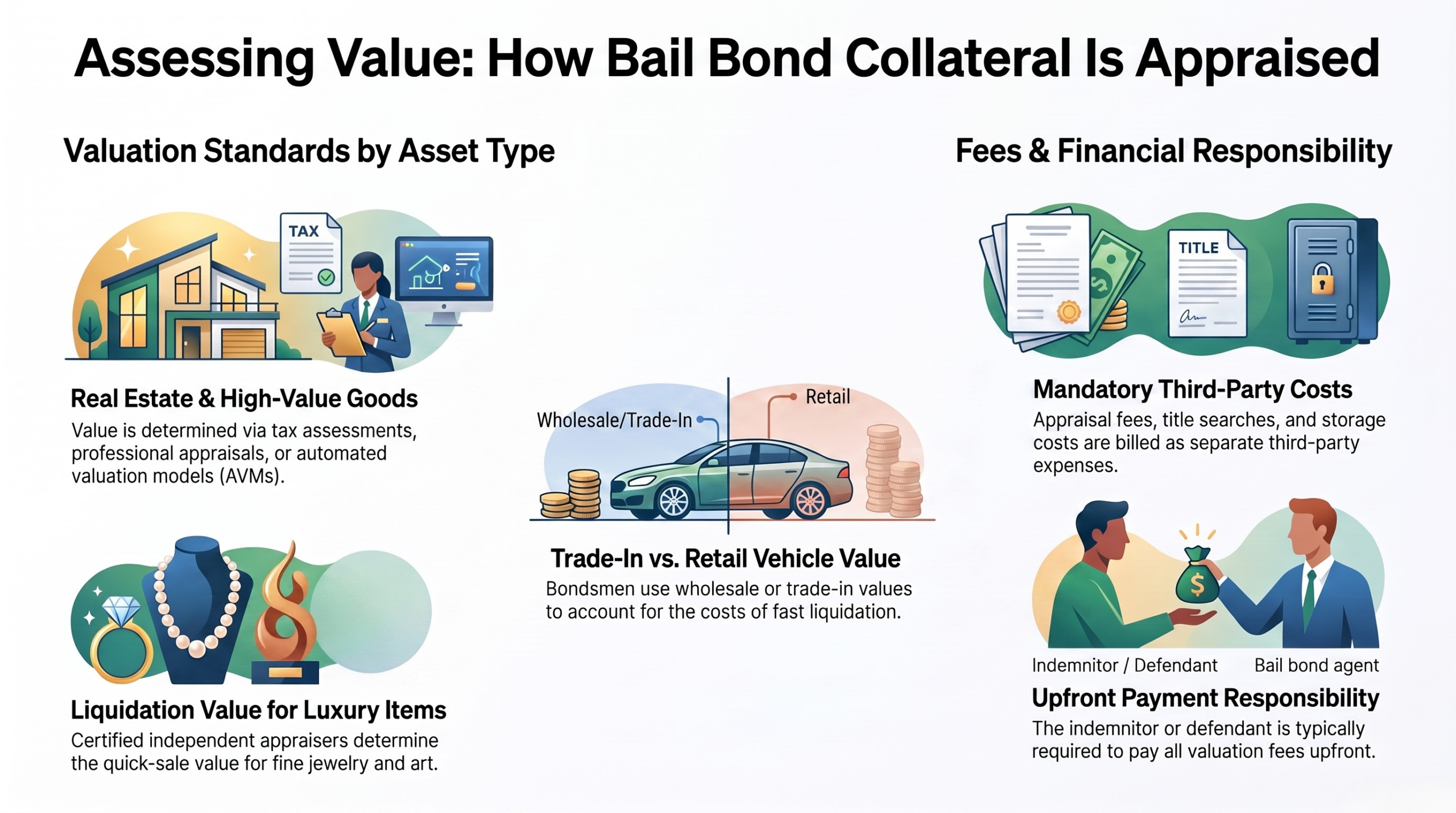
Appraisal Processes for Real Estate and High-Value Goods
For real property, agencies look at recent county tax assessments, professional real estate appraisals, or automated valuation models (AVMs). For fine jewelry or art, a certified independent appraiser determines the liquidation value.
Vehicle Valuation Standards (Trade-In vs. Fair Market Value)
Vehicles are evaluated based on wholesale or trade-in value rather than retail market value. Bondsmen use trade-in values because fast liquidation yields lower prices than private retail sales.
Who Pays for Appraisal and Storage Fees?
If an asset requires a formal appraisal, title search, recording fee, or secure physical storage (such as a vehicle impound lot), these third-party costs are typically paid by the indemnitor or defendant upfront.
The Collateral Release Process: How and When You Get Your Property Back
Getting your collateral returned is straightforward once the defendant fulfills their obligations to the court.
┌─────────────────────────────────────────────────────────────────┐
│                    COLLATERAL RELEASE STEPS                     │
├─────────────────────────────────────────────────────────────────┤
│ Step 1: Court issues official Certificate of Exoneration.      │
│ Step 2: Provide exoneration document to Armstrong Bail Bonds.   │
│ Step 3: Agency processes release paperwork (typically 5-10 days)│
│ Step 4: Physical items returned; legal property liens removed.  │
└─────────────────────────────────────────────────────────────────┘
Conditions Required for Collateral Release (Case Disposition & Exoneration)
Collateral is returned only when the court formally exonerates the bond. Bond exoneration happens when the criminal case finishes, regardless of whether the defendant is found guilty, acquitted, or if charges are dismissed. The outcome of the trial does not affect the return of collateral—only attendance does.
Step-by-Step Timeline to Reclaim Cash or Property Documents
Obtain an official copy of the Bond Exoneration document or Minute Order from the court clerk.
Deliver the court document to your bail agent.
The agency verifies the court record.
Physical collateral (cash, jewelry, pink slips) is returned, or legal liens (Deeds of Trust) are formally released. This process typically takes between 5 to 21 business days.
What to Do If a Bondsman Refuses or Delays Returning Your Collateral
Licensed bail bond agencies are legally required to return collateral promptly once a bond is exonerated and all outstanding contractual fees are paid. If an agency intentionally delays returning property, you can file a formal complaint with your State Department of Insurance. At Armstrong Bail Bonds, prompt collateral return is guaranteed by transparent, ethical business practices.
What Happens to Collateral If the Defendant Misses Court?
If a defendant misses a scheduled court date, the court issues a bench warrant and declares the bond in forfeiture.
Forfeiture Proceedings and Grace Periods
Courts provide a legal grace period (often 180 days, depending on state law) before demanding full payment from the bail bond agency. During this window, the bail bondsman and cosigner can work together to locate the defendant and return them to court.
Property Liquidation and Foreclosure Mechanics
If the defendant cannot be returned to court and the grace period expires, the bail agency must pay the full bail amount to the court. The agency will then liquidate the pledged collateral—selling physical items or foreclosing on property liens—to cover the loss.
Reinstating the Bond to Protect Your Collateral
If a missed court date was an honest mistake (such as illness or transportation trouble), an experienced agent can help set a new court date and issue a Motion to Vacate Forfeiture or a Consent of Surety. This reinstates the bond and protects your pledged collateral from seizure.
Alternatives to Posting Collateral for a Bail Bond
Not everyone owns high-value property or real estate, but that should not prevent your loved one from getting released.
Signature Bonds (Unsecured / No-Collateral Bail Bonds)
Many bail bonds can be approved on a “signature only” basis. If the cosigner has stable employment, proof of steady income, good credit, and deep community roots, Armstrong Bail Bonds can post bail without requiring physical collateral.
Payment Plans and Financing Options
For families needing help covering the standard 10% bail fee, flexible payment arrangements are available. Weekly or monthly installment plans can break up the premium into manageable payments tailored to your budget.
Release on Own Recognizance (ROR) and Pretrial Diversion Programs
In minor offenses or for first-time offenders, defense attorneys can request an O.R. release (Own Recognizance). This allows defendants to be released based on a written promise to return to court, bypassing bail altogether.
Frequently Asked Questions (FAQ)
Can I use a car as collateral if I am still making payments on it?
Yes, but only if the vehicle has sufficient equity. The market value of the car must be substantially higher than the remaining balance on your auto loan.
Will I lose my collateral if the defendant is found guilty?
No. Collateral guarantees court attendance, not innocence. As long as the defendant attends all required court dates, your collateral will be returned in full regardless of the verdict.
Does the bail bond fee (10%) come out of my collateral?
No. The bail bond fee is a separate payment for the agent’s services. Collateral is held purely as security for the total bail bond amount and is returned once the case is closed.
How quickly can Armstrong Bail Bonds process my collateral and release my loved one?
Paperwork can be completed in minutes over the phone or in person. Once collateral terms are finalized, an agent is immediately dispatched to post bail at the jail.
What happens if the property owner cannot physically visit the bail office?
Armstrong Bail Bonds offers convenient mobile bail services, online document signing, and remote payment options so you can complete the process from home.
Get Fast, Compassionate Bail Help Right Now
When a loved one is in custody, every minute matters. You do not have to figure out collateral or bail mechanics on your own. Armstrong Bail Bonds brings decades of professional experience, flexible payment options, and low-to-no collateral solutions to help secure a fast release.
Contact Armstrong Bail Bonds right now to speak directly with a licensed bail agent available 24 hours a day, 7 days a week. We are ready to help bring your family member home today.