

03 Apr Bail for Repeat Offenders: How California’s 2026 Rules Impact Your Release
Navigating the legal system regarding bail for repeat offenders can feel like moving through a maze, especially with California’s strict 2026 rules now in full effect. These new regulations significantly change how the courts view recidivism, making it more difficult—but not impossible—to secure a release. Understanding these shifts is the first step in protecting your rights and bringing your loved one home.
Understanding the Shift: California’s 2026 Bail Landscape
For several years, California experimented with “Zero Bail” policies to reduce jail overcrowding. However, as of 2026, the pendulum has swung back toward public safety and accountability.
The End of “Zero Bail” for Repeaters The days of automatic release for “non-violent” offenses are largely over for those with a criminal history. Under the 2026 framework, if an individual is arrested while already on probation or parole, or if they have a history of failing to appear in court, they are no longer eligible for the $0 bail schedules that were common during the early 2020s.
Proposition 36 & The “Three Strikes” Resurgence Proposition 36 has fundamentally changed the landscape. While California’s original “Three Strikes” law was softened in previous years, the 2024 ballot measure (which reached full implementation in 2026) reintroduced stricter penalties for repeat drug and theft offenses. Judges now have more leverage to treat “petty” crimes as felonies if the defendant has two or more prior convictions, directly impacting bail eligibility and amounts.
The 2026 Felony Bail Schedule Every county in California now follows a revised 2026 Felony Bail Schedule. These schedules have been adjusted upward for repeat offenders. A crime that might have carried a $20,000 bail for a first-time offender can now see a “multiplier” effect, doubling or tripling the required amount if the defendant has a prior “strike” or a recent felony conviction on their record.
How Repeat Offender Status Changes Your Bail Hearing
If you are a repeat offender, your bail hearing will not be a standard “check-the-box” procedure. It is a high-stakes legal battle.
The “Reverse Onus” Shift In a standard bail hearing, the prosecution must prove why a defendant should stay in jail. Under the 2026 rules for repeat offenders, the burden often shifts to the defendant. This is known as “Reverse Onus.” The defendant must now prove to the judge why they are not a danger to the community and why they should be granted bail at all.
Statutory Grounds for Denial Under the current California Penal Code, judges are mandated to deny bail entirely if there is “clear and convincing evidence” that the defendant’s release would result in great bodily harm to others. For repeat offenders, the prosecution uses past records as evidence of this “clear and convincing” risk.
The 10-Year “Look Back” Rule A common misconception is that old crimes don’t count. The 2026 rules utilize a 10-year “look back” period. If you committed a qualifying offense within the last decade, the court views your current arrest through the lens of a “pattern of criminal behavior,” which can lead to higher bail or total denial of release.
High-Risk Categories Under 2026 Rules
Certain crimes have been singled out for the strictest bail requirements in 2026.
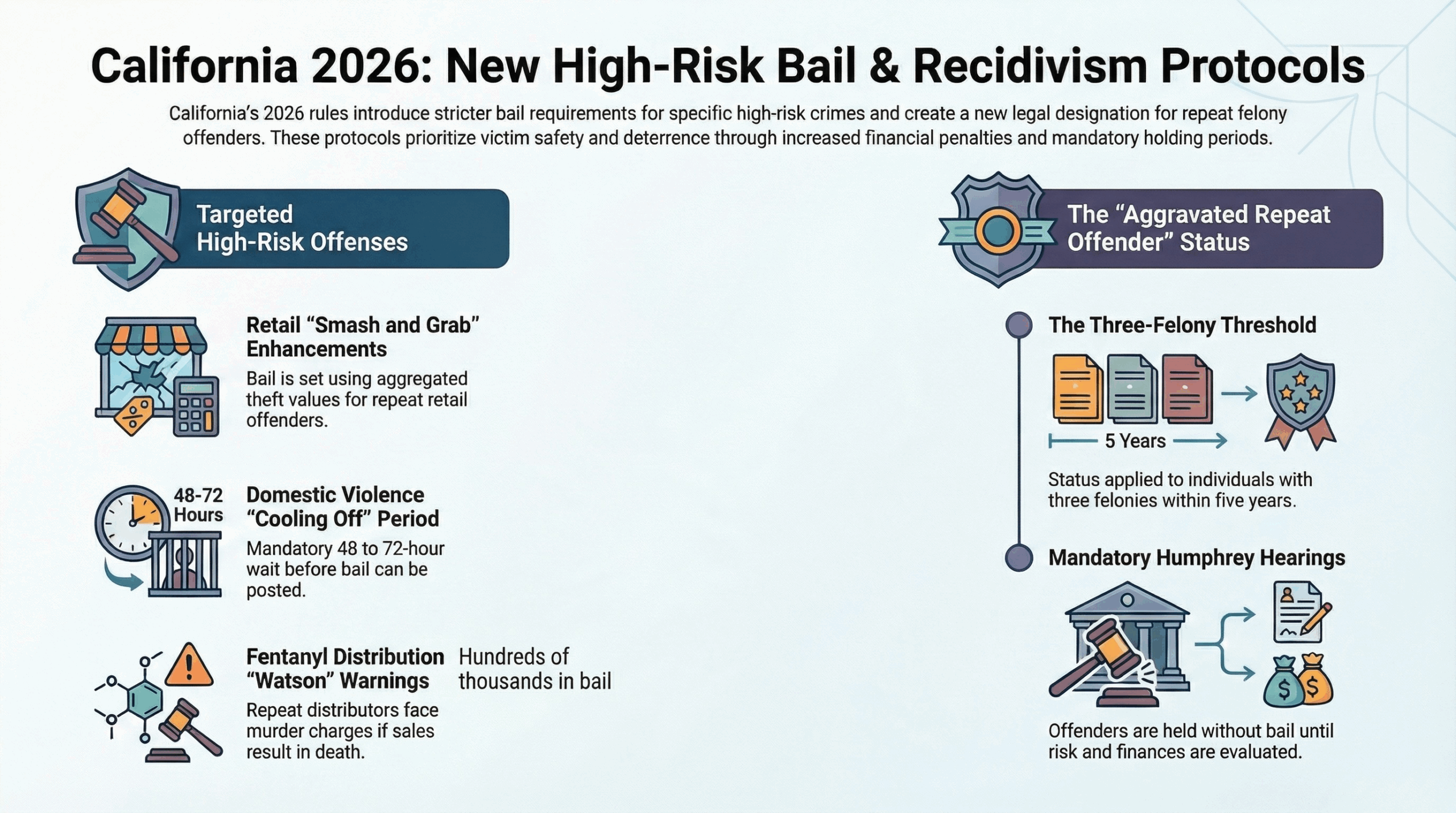
Retail Theft & “Smash and Grab” Enhancements To combat organized retail theft, California now allows for “aggregation.” If a repeat offender is caught stealing, the value of their past thefts can be added to the current charge. Under 2026 rules, repeat retail theft offenders face mandatory high-bail amounts to deter further “smash and grab” activity.
Fentanyl & Hard Drug Distribution Drug charges for repeat offenders are now handled with extreme severity. If a defendant has a prior conviction for distribution and is arrested again, they may receive a “Watson-style” warning. This warns the defendant that if they continue to sell and someone dies, they can be charged with murder. Consequently, bail for repeat drug offenders is often set in the hundreds of thousands of dollars.
Domestic Violence Recidivism California 2026 laws prioritize victim safety above all else. For repeat domestic violence offenders, there is now a mandatory “cooling off” period where bail cannot be posted for the first 48 to 72 hours, and the minimum bail amounts have been raised significantly to ensure the victim has time to seek a restraining order.
The “Aggravated Repeat Offender” Designation A new legal designation in 2026 is the “Aggravated Repeat Offender.” This applies to individuals who are arrested for a third felony within a five-year window. These individuals are often held without bail until a formal “Humphrey Hearing” can be conducted to evaluate their financial ability to pay and their risk to society.
Navigating the 2026 Bail Process: A Step-by-Step Guide
Securing a release requires a strategic approach.
The First 48 Hours: Once booked, the defendant will see a judge for an arraignment. For repeat offenders, the prosecutor will almost always ask for “No Bail” or an “Increase in Bail.”
The Bail Review Hearing: If bail is set too high, your attorney can request a review. At this stage, you must provide evidence of community ties, employment, and a stable residence to counter the “repeat offender” stigma.
The “Treatment-Mandated Felony” Alternative: Under Prop 36, some repeat drug offenders can opt into “Treatment-Mandated” tracks. If a defendant agrees to go directly into a locked residential treatment facility, a judge may grant a “Release on Own Recognizance” (OR) or a significantly lower bail amount.
Strategies for Families and Defendants
When the court sees a “repeat offender,” they see a statistic. You need to make them see a person.
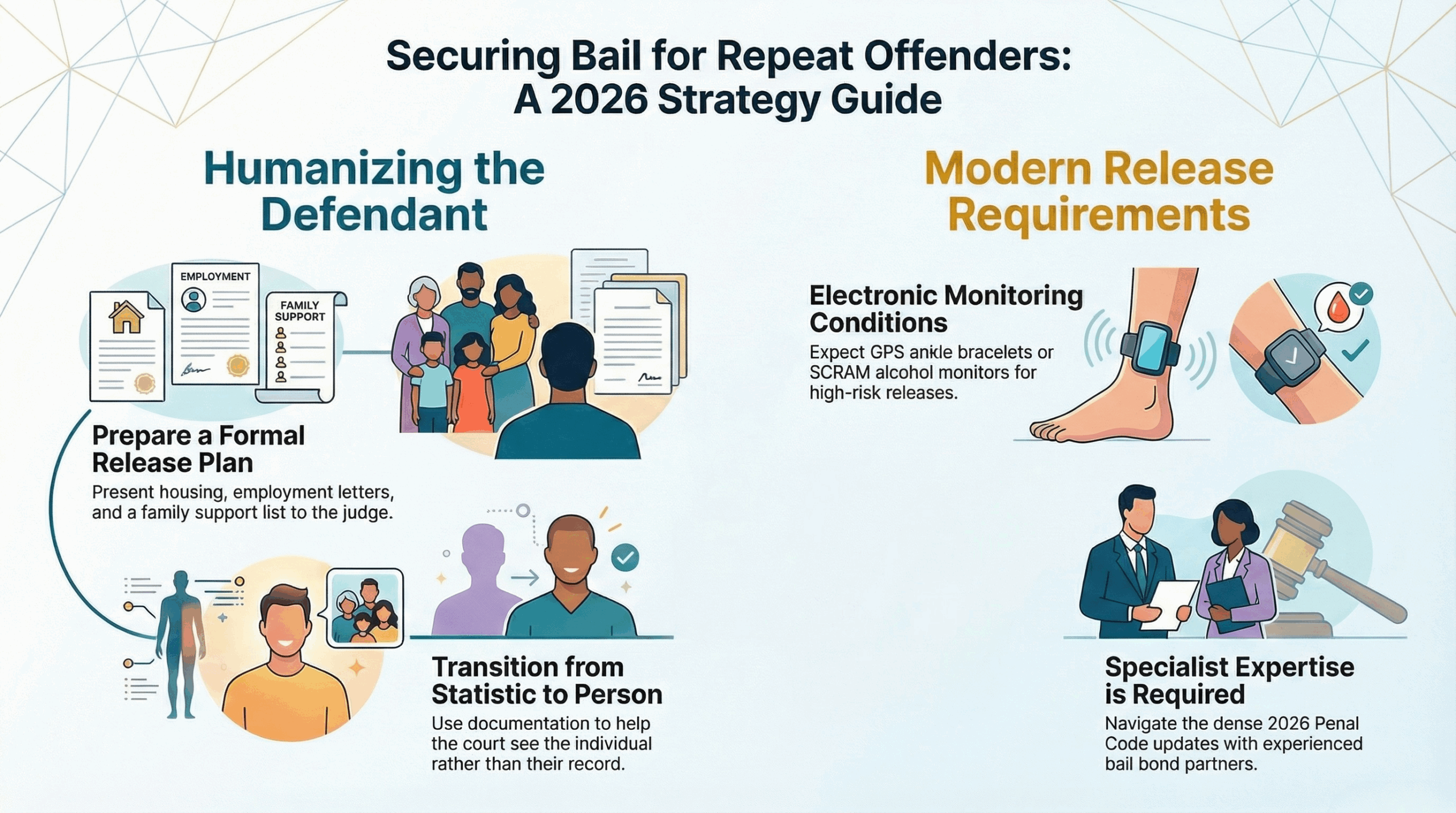
Preparing a “Release Plan” A “Release Plan” is a document presented to the judge. It should include a guaranteed place to live, a letter from an employer, and a list of family members who will ensure the defendant gets to court. Having a solid plan makes a judge much more comfortable granting bail.
The Role of Electronic Monitoring In 2026, many repeat offenders are only granted bail on the condition of electronic monitoring. This may include GPS ankle bracelets or SCRAM (Secure Continuous Remote Alcohol Monitor) devices. While these come with a monthly cost, they are often the only way a judge will agree to release a high-risk defendant.
Why Specialist Expertise Matters The 2026 Penal Code updates are dense. You need a partner who understands the nuances of the new laws. Armstrong Bail Bonds specializes in high-stakes cases involving repeat offenders. They understand how to work with the 2026 bail schedules to find the most affordable path to freedom.
Frequently Asked Questions (FAQ)
Can I still use a bail bondsman in 2026?
Yes. Bail bonds remain a legal and vital resource in California. A bondsman typically charges a 10% fee (or less in some cases) of the total bail amount, allowing you to secure a release without paying the full amount to the court.
Does my “Strike” status automatically mean no bail?
Not necessarily. While a “Strike” makes bail more difficult, it is not an automatic disqualification. It does, however, mean that the judge will look much more closely at your “Release Plan.”
How do the 2026 rules affect out-of-state priors?
California courts now have improved access to national databases. A felony conviction in another state will likely be treated as a prior offense under California’s 10-year look-back rule.
Is there a path to “Zero Bail” for non-violent repeaters?
It is very rare in 2026. However, if the crimes are strictly related to substance abuse and the defendant agrees to court-mandated rehab, a judge may consider a reduced or $0 bail.
What happens if I can’t afford the new higher bail amounts?
This is where a bail review hearing is essential. Your lawyer will argue that the bail is “constitutionally excessive.” Partnering with a flexible company like Armstrong Bail Bonds can also help through payment plans.
Conclusion: Secure Your Freedom Today
The 2026 laws in California have made the road to release much harder for repeat offenders, but the doors are not closed. You need an advocate who knows the system, understands the new felony schedules, and treats you with the respect you deserve.
Don’t let a past mistake dictate your future. If you or a loved one is facing a difficult bail situation under the new 2026 rules, contact the experts at Armstrong Bail Bonds immediately. We are available 24/7 to help you navigate this complex landscape and bring your family back together.
Contact Armstrong Bail Bonds today for a free, confidential consultation.