

22 Jun How High Speed and Excessive BAC Impact Your Bail Set
When a person faces an arrest for driving under the influence, the financial and emotional toll hits immediately. Navigating how high speed and excessive BAC impact your bail set is one of the most critical parts of securing a quick release. If aggravating factors like extreme intoxication or reckless driving are present, your phone call to a licensed professional is the most important step you can take.
Understanding Blood Alcohol Content (BAC) and the Legal Limits
What is Blood Alcohol Content (BAC)?
Blood Alcohol Content, commonly known as BAC, is the metric used by law enforcement and medical professionals to measure the amount of alcohol present in an individual’s bloodstream. For example, a BAC of 0.08% means that there is 0.08 grams of alcohol for every 100 milliliters of blood.
What is the Legal Blood Alcohol Level for Driving?
Across the United States, the legal limit for operating a motor vehicle is 0.08% for drivers aged 21 or older. For commercial drivers, the limit is lower at 0.04%. For drivers under the legal drinking age of 21, zero-tolerance laws mean that any measurable amount of alcohol in the system can trigger an arrest.
Factors That Can Affect Your Absolute BAC Levels
Two people can drink the exact same amount of alcohol and register completely different BAC readings. This variation happens because of how individual bodies process toxins.
Height and Weight: Larger body masses naturally have more blood and water content. This dilutes the concentration of alcohol compared to a smaller individual who consumes the same amount.
Age and Biological Gender: As the body ages, its metabolism slows down. Additionally, biological women generally possess fewer enzymes called alcohol dehydrogenase, which are responsible for breaking down alcohol in the stomach.
Rate of Consumption and Food Intake: Gulping drinks quickly over-saturates the liver’s ability to process alcohol. Conversely, having a full meal in the stomach slows down how fast alcohol enters the bloodstream.
The Mechanics of Pretrial Release: How Bail is Set
What is a County Bail Schedule and How Does It Work?
When a person is booked into a jail facility, the staff refers to a document known as the county bail schedule. This schedule lists fixed dollar amounts for every category of criminal offense. It allows jail staff to accept payment and release an inmate before they ever have to stand in front of a judge.
Release on Own Recognizance (ROR) vs. Monetary Bail
For low-level offenses, a court might grant a Release on Own Recognizance (ROR). This means the defendant is released based on a signed promise to return to court, with no money exchanged. However, if the crime is severe or poses a threat to public safety, the court requires monetary bail—a financial deposit that acts as collateral to guarantee the defendant returns for trial.
Standard Bail Ranges for a First-Time, Non-Aggravated DUI
For a basic, first-time misdemeanor DUI with no accidents and a low BAC, bail is often modest. Depending on the county, standard schedule amounts typically range between $1,500 and $5,000. In some areas, an individual might even be released after sobered up without paying a financial bond, provided they have deep ties to the community.
Aggravating Factors: The Cost of Excessive BAC on Your Bail
What Do Different High Blood Alcohol Levels Indicate to a Judge?
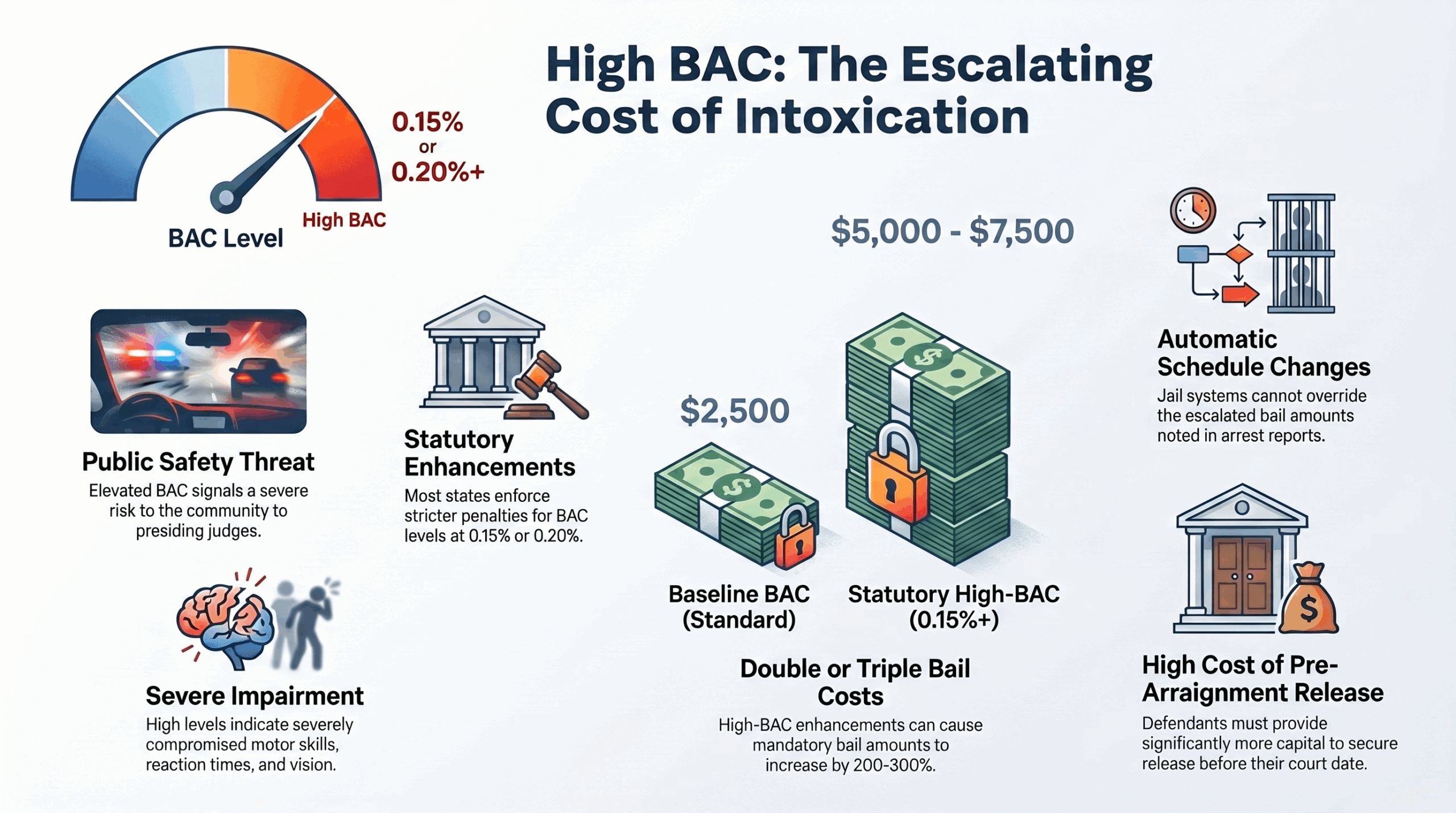
A low BAC indicates poor judgment, but a heavily elevated BAC signals a severe threat to public safety. Judges look at the raw data to gauge the level of risk a defendant poses to the community if they are released back onto the street.
Statutory High-BAC Enhancements (e.g., Over 0.15% or 0.20% BAC)
Most states enforce penalty enhancements for drivers whose chemical tests reveal an excessive BAC, typically defined as 0.15% or 0.20% and higher. These laws recognize that a driver at more than double the legal limit has severely compromised motor skills, slow reaction times, and highly impaired vision.
How Extreme Intoxication Automatically Escalates Bail Schedule Amounts
When an arrest report notes a statutory high-BAC enhancement, the standard bail schedule changes immediately. Instead of the baseline $2,500 amount, the excessive alcohol reading can cause the mandatory bail to double or triple. The jail cannot override this schedule, meaning the defendant must come up with significantly more money to secure a pre-arraignment release.
The Recklessness Multiplier: High Speed and Exhibition of Speed
Combining High Speed with DUI: The Judicial View on Public Safety
Operating a heavy vehicle under the influence is dangerous, but adding excessive speed multiplies the force of any potential impact. Judges view a high-speed DUI not as a simple mistake, but as an act of extreme recklessness that shows total disregard for human life.
Speed Enhancements and Separate Reckless Driving Charges Added to Bail
If a driver is caught speeding excessively—such as traveling 20 to 30 miles per hour over the posted limit while intoxicated—prosecutors will tack on separate criminal charges. You will not just face a DUI; you will also face charges for reckless driving or exhibition of speed. Each additional charge carries its own independent bail amount on the schedule, stacking the total costs on top of each other.
When High Speed Elevated a Misdemeanor DUI to a Felony Bail Schedule
If high-speed driving results in property damage, bodily injury, or a high-stakes police pursuit, prosecutors can elevate a standard misdemeanor DUI to a felony. Felony charges change your legal status completely. A felony DUI bail schedule can instantly skyrocket from a few thousand dollars into tens or hundreds of thousands of dollars.
Beyond Money: Non-Financial Bail Conditions for High BAC & Speed
Mandatory Ignition Interlock Devices (IIDs) Pre-Trial
Judges frequently impose non-financial restrictions alongside a monetary bail requirement to ensure public safety. A common condition is the mandatory installation of an Ignition Interlock Device (IID). The defendant must pay to install this breathalyzer unit into their car, and the vehicle will not start unless the driver blows a clean sample.
SCRAM Bracelets and Continuous Alcohol Monitoring
For cases involving extreme BAC levels, a judge might order the defendant to wear a Secure Continuous Remote Alcohol Monitor (SCRAM) ankle bracelet. This device samples the wearer’s sweat every 30 minutes to check for alcohol consumption. Any positive reading is transmitted directly to the court as a bail violation.
Court-Ordered Alcoholics Anonymous (AA) Attendance for Release
As a condition of staying out of jail while awaiting trial, the court can order a defendant to attend multiple Alcoholics Anonymous (AA) meetings each week. The individual must keep a physical sign-in sheet signed by meeting leaders to prove compliance to the judge at every follow-up court date.
What to Expect Immediately After Arrest for High-BAC and High-Speed DUI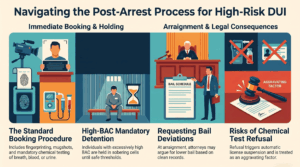
What to Expect During and After Pre-Arraignment Booking
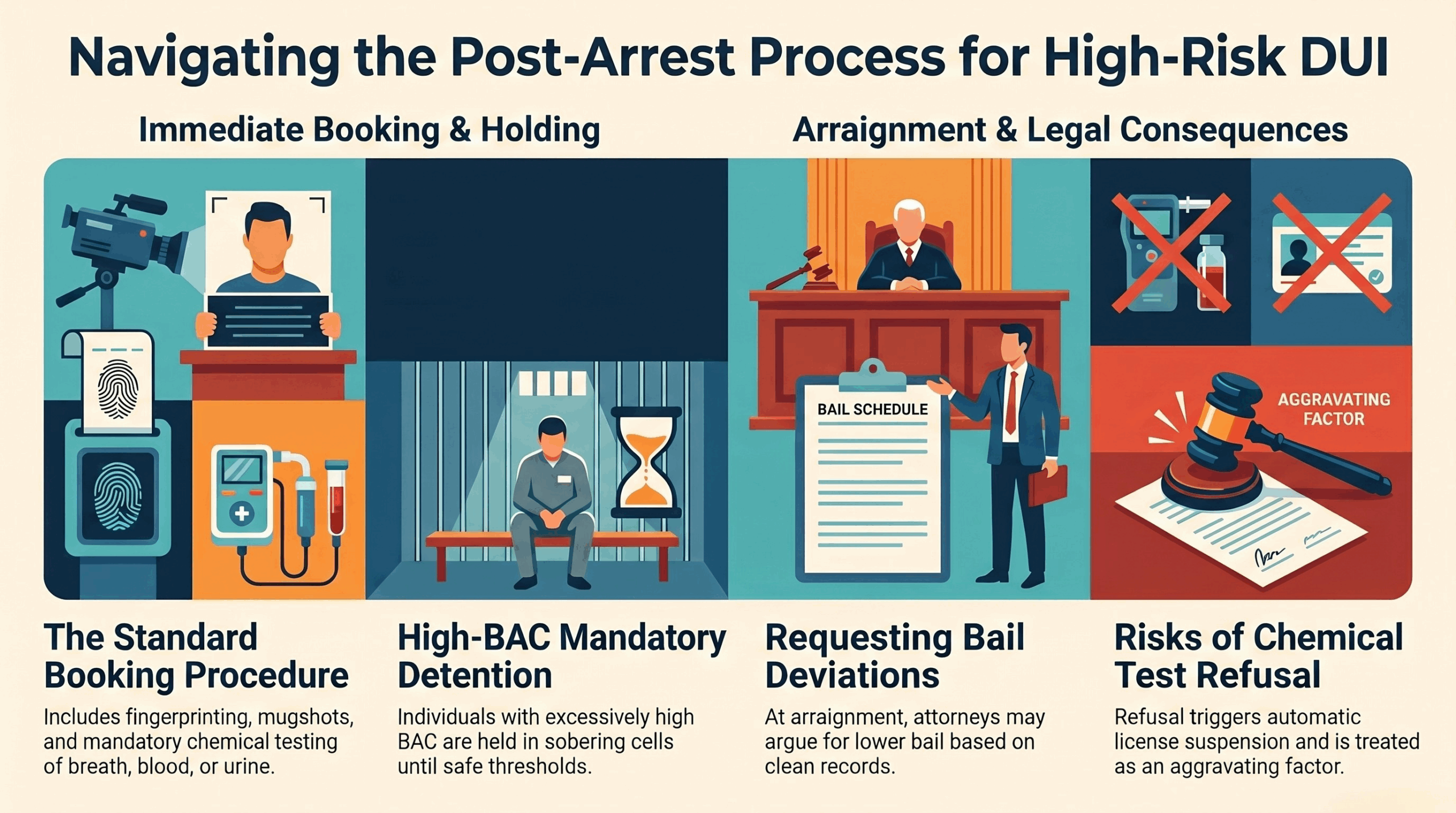
Following an arrest, you will be taken to a local police station or county jail for booking. This process includes fingerprinting, mugshots, and a mandatory chemical test via breath, blood, or urine. If your BAC is excessively high, you will be held in a sobering cell for several hours until your levels drop to a safe threshold before you can finalize your release.
The Arraignment Hearing: Requesting a Bail Deviation from the Judge
If you cannot afford the elevated bail amount on the county schedule, you must stay in custody until your arraignment hearing, which usually happens within 48 to 72 hours. At this hearing, a defense lawyer can ask the judge for a bail deviation. The attorney will argue to lower the financial amount based on your clean record or financial hardship.
The Risks of Chemical Test Refusal on Your Pretrial Release
Refusing to take a chemical breath or blood test after a lawful DUI arrest does not protect you. In fact, most states impose an automatic, long-term driver’s license suspension for a refusal. Furthermore, courts treat a test refusal as an aggravating factor, which often leads to higher bail settings and tougher release terms.
How a DUI Defense Attorney Can Argue to Reduce an Elevated Bail
Challenging Inaccurate Chemical Test Results
A skilled lawyer can argue for lower bail by casting doubt on the prosecution’s evidence. If the defense can show that the breathalyzer machine was poorly calibrated, or that blood samples were stored improperly, the judge may agree that the high-BAC enhancement is unreliable and lower the bail.
Demonstrating Community Ties and Mitigating Flight Risk
To reduce your financial burden, your attorney will emphasize your deep connections to the local area. By presenting proof of steady employment, nearby family members, and a clean criminal past, the lawyer demonstrates that you are not a flight risk, giving the judge a solid reason to reduce the bail amount.
People Also Ask (FAQs)
How much does a bail bond cost for an enhanced DUI in California?
In California, the cost to hire a bail bondsman is standardly set at a maximum non-refundable fee of 10% of the total bail set by the court. If your high-BAC or high-speed enhancement pushes your total bail to $25,000, the fee to secure your release through an agency will be $2,500.
Can I get out of jail without bail if my BAC was over 0.15%?
It is highly unlikely. An individual with a BAC above 0.15% is considered a significant safety risk on public roads. Jails and courts almost always require a financial bond or strict release conditions, such as an ankle monitor, before allowing a release.
Does a high-speed DUI mean I automatically have to stay in jail until trial?
No. Unless your reckless driving caused a fatal accident or you are deemed an extreme flight risk, you retain the constitutional right to bail. You can secure your release as soon as the booking process is complete by paying the scheduled bail amount.
What happens if I cannot afford the high bail amount after my arrest?
If the bail is out of reach, you can contact a licensed bail bond company to post the bond for a fraction of the cost. If that is not an option, you must remain in custody until your first court date, where an attorney can formally ask the judge to lower the amount.
Will a speed contest or street racing charge increase my baseline DUI bail?
Yes. Facing charges for a speed contest or street racing alongside a DUI adds independent offenses to your case. The jail will add the scheduled bail amounts for both charges together, resulting in a much higher total financial requirement.
Need Help Fast? Contact Armstrong Bail Bonds Today
When an arrest involves aggravating factors like excessive speed or an enhanced blood alcohol level, the resulting bail amounts can feel completely overwhelming. You do not have to handle the complex legal system on your own. Armstrong Bail Bonds has spent more than 88 years helping families across Los Angeles, Orange County, and San Diego navigate the jail system to secure fast, reliable, and compassionate releases.
Our licensed bail agents operate 24 hours a day, 7 days a week, and offer flexible payment plans designed to fit your financial situation. We know exactly how to manage escalated bail amounts and work quickly to bring your loved one home safely. Contact Armstrong Bail Bonds today to get the professional help you need right now.