

10 Mar HS 11350 vs. HS 11377: The Definitive Guide to California Drug Possession & Bail
If you or a loved one has been arrested for drug possession, understanding the difference between HS 11350 and HS 11377 is the first step toward regaining your freedom. While both codes deal with “simple possession,” the specific charge depends on the type of substance found and carries different legal implications. Armstrong Bail Bonds is here to help you navigate the legal system and secure a fast, affordable release from custody.
Understanding Simple Possession in California
In California, “simple possession” means having a controlled substance for personal use rather than for sale or distribution. The law divides these substances into different categories based on their chemical makeup and the potential for abuse.
The Legal Definition of a Controlled Substance
A controlled substance is any drug or chemical regulated by the government. This includes “street drugs” like heroin or methamphetamine, as well as prescription medications like hydrocodone or Xanax if you do not have a valid prescription for them.
Why You Were Charged: The Difference Between Narcotics and Stimulants
The primary reason you are charged with one code over the other is the nature of the drug. HS 11350 generally applies to “narcotics” (derived from opiates or coca leaves), while HS 11377 applies to “non-narcotic” stimulants and synthetic drugs. This distinction is based on the California Health and Safety Code’s classification system.
Common Drugs Involved: From Fentanyl to Methamphetamine
HS 11350: Heroin, Cocaine, Fentanyl, Peyote, and certain prescription opioids.
HS 11377: Methamphetamine, PCP, Anabolic Steroids, and “Ecstasy” (MDMA).
Deep Dive into HS 11350: Possession of Narcotics
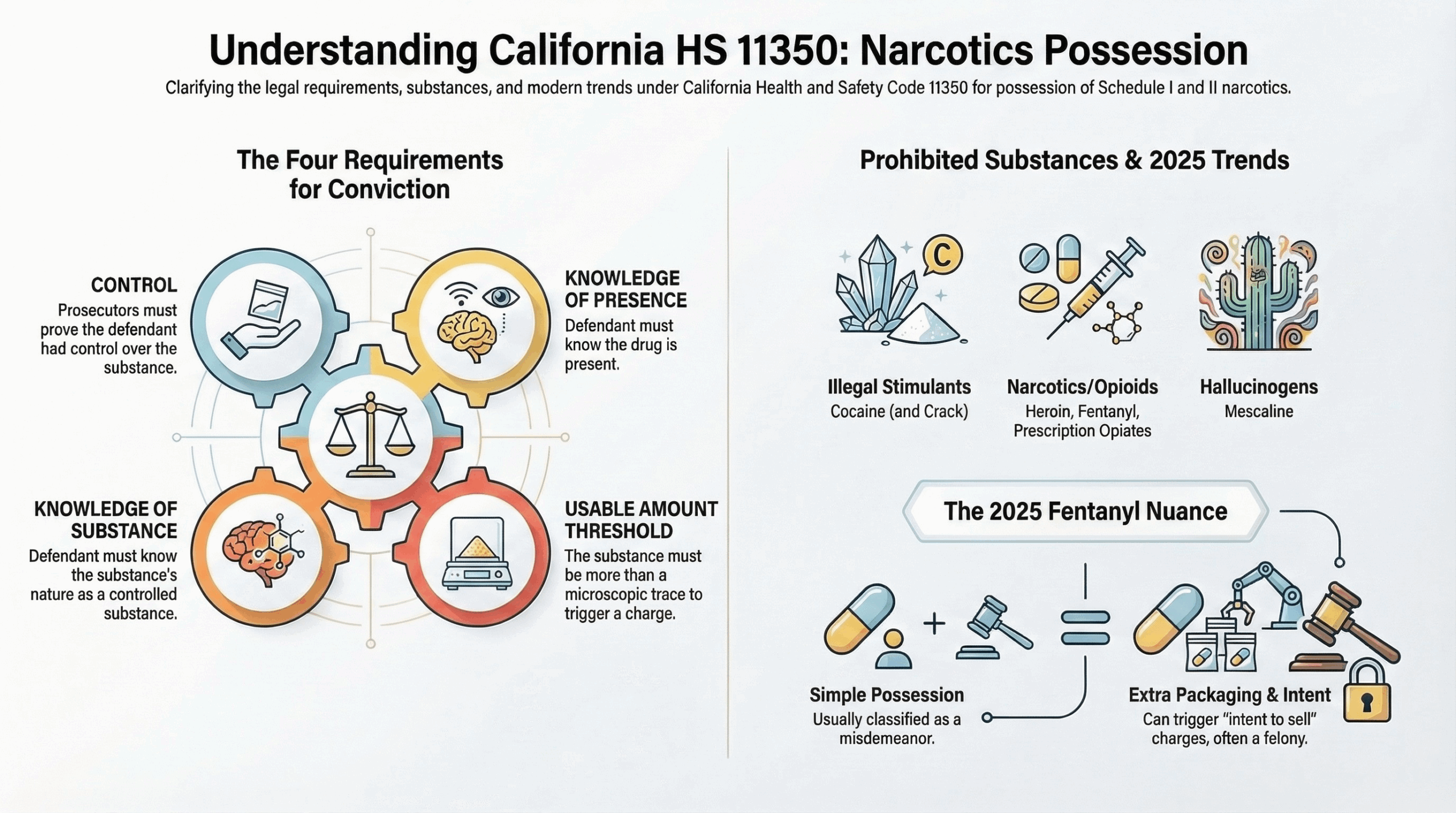
Health and Safety Code 11350 is one of the most common drug charges in the state. It focuses on substances that are considered highly addictive narcotics.
List of Prohibited Substances
Most HS 11350 charges involve “Schedule I” or “Schedule II” drugs. These include:
Cocaine and Cocaine Base (Crack)
Heroin
Mescaline
Prescription opiates (Codeine, Hydrocodone) without a script.
Elements of the Crime: What the Prosecution Must Prove
To get a conviction, a prosecutor must prove:
You had “possession” (control) over the drug.
You knew of the drug’s presence.
You knew the drug was a controlled substance.
There was a “usable amount” (more than just a microscopic trace).
How Fentanyl is Treated Under HS 11350 in 2025
Due to the ongoing opioid crisis, California law enforcement has increased focus on Fentanyl. While simple possession of Fentanyl is still usually a misdemeanor under HS 11350, prosecutors are increasingly looking for ways to charge “possession with intent to sell” if there is even a small scale or extra packaging present. Understanding this nuance is critical for your defense.
Deep Dive into HS 11377: Possession of Meth & Stimulants
HS 11377 is the specific statute used for dangerous non-narcotic drugs. It is most frequently cited in arrests involving methamphetamine.
Why Methamphetamine has its Own Statute
Because methamphetamine is synthetically produced and has a high potential for creating public health issues, California maintains HS 11377 to specifically track and penalize its possession and use.
Meaning of “Possession,” “Knowledge,” and “Usable Quantity”
“Possession” does not just mean the drugs were in your pocket. It can also mean they were in your car, your locker, or a drawer in your home that only you use. A “usable quantity” means there was enough of the drug to actually be used as a drug; if there is only “residue” on a pipe, a skilled attorney may be able to get the charges dropped.
Comparing the Penalties: Misdemeanors vs. Felonies
For years, California shifted toward lighter sentencing for drug users. However, recent legal changes have added more “teeth” back into the law for certain offenders.
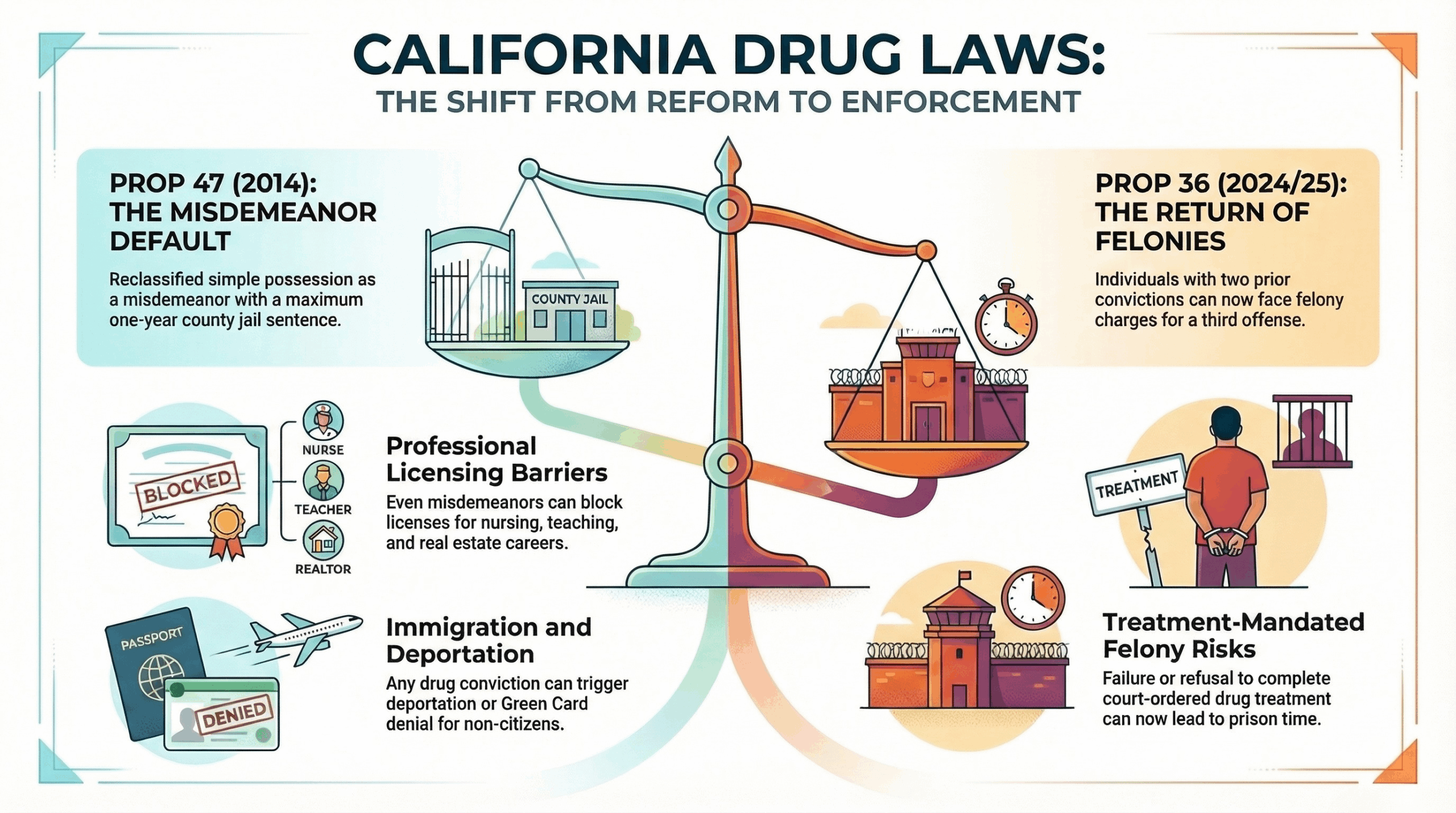
Proposition 47 and the Misdemeanor Default
Passed in 2014, Prop 47 turned most simple possession charges from felonies into misdemeanors. This meant that instead of prison time, most people faced a maximum of one year in county jail.
The Prop 36 Update (2024/2025): The Return of Felony Charges
In late 2024, California voters passed a new initiative (Prop 36) that modified the rules for repeat offenders. Now, if a person has two or more prior drug convictions, a third charge for HS 11350 or HS 11377 can be charged as a “treatment-mandated felony.” This means you may face prison time if you refuse or fail court-ordered drug treatment.
Long-term Consequences: Professional Licenses and Immigration
Even a misdemeanor drug conviction can stay on your record. This can prevent you from getting a nursing license, a teaching credential, or working in real estate. For non-citizens, any drug conviction—even a minor one—can lead to deportation or being denied a Green Card.
The Bail Process for Drug Charges
When someone is arrested for drug possession, the priority is getting them out of jail so they can keep their job and find a lawyer.
Why Bail is Set: Risk Factors and the County Bail Schedule
Bail is a financial guarantee that you will return to court. Each county has a “Bail Schedule” that sets a dollar amount for HS 11350 and HS 11377. If you have a prior record or were on probation at the time of the arrest, the bail amount may be higher.
How Long Does Release Take?
At Armstrong Bail Bonds, we pride ourselves on speed. While the jail’s processing time varies, our agents are often able to complete the paperwork and secure a “bond out” in as little as 30 to 60 minutes once the defendant is booked.
Why Families Choose Armstrong Bail Bonds
We understand that an arrest is a financial shock. We have designed our services to be as accessible as possible for California families.
1% Bail Bonds: Affordable Solutions
For many drug possession cases, we offer a 1% bail bond option for qualified clients. This means if bail is set at $10,000, you may only need to pay $100 upfront to secure a release. This is the lowest rate allowed in the state and helps families keep their savings intact.
No-Collateral Bail Options: Keeping Your Assets Safe
Many people worry they have to sign over their house or car to get a bond. At Armstrong Bail Bonds, we frequently offer no-collateral bonds. If you have a steady job or a co-signer with good credit, we can often skip the collateral requirement entirely.
Interest-Free Payment Plans
If the 1% or 10% premium is still too much to pay at once, we offer flexible, interest-free payment plans. We believe that financial status shouldn’t determine whether you stay in jail or go home to your family.
Diversion Programs: Your Path to Case Dismissal
If you are a first-time offender, you may be eligible for “Diversion.” This allows you to complete a program instead of going to jail.
PC 1000: You enter a “guilty” plea, but the judge puts the case on hold. If you complete drug education classes, the case is dismissed, and you have no conviction on your record.
Military Diversion: Special programs exist for veterans and active-duty members whose drug use may be linked to PTSD or service-related trauma.
Proven Legal Defenses for HS 11350 & 11377
Just because you were arrested doesn’t mean you are guilty. Common defenses include:
Illegal Search and Seizure: If the police searched your car or home without a warrant or “probable cause,” the evidence they found may be thrown out of court.
Lack of Knowledge: If someone else left the drugs in your car and you didn’t know they were there, you are not legally in “possession.”
The “Fleeting Possession” Defense: This applies if you only held the drugs for a moment for the purpose of throwing them away or destroying them.
Valid Medical Prescription: If the substance is a pill like Xanax or Vicodin and you have a doctor’s note, the charges should be dismissed.
Life After Arrest: Records and Expungement
Once your case is over, you can apply for an “expungement” under PC 1203.4. This effectively cleans your record for most private employer background checks. Being out on bail with Armstrong allows you the time and freedom to work closely with an attorney to ensure your case is handled in a way that makes you eligible for expungement later.
Frequently Asked Questions (FAQ)
1. Can I be charged with both HS 11350 and HS 11377 at once? Yes. If you are found with both cocaine (HS 11350) and methamphetamine (HS 11377), you can be charged with two separate counts of possession.
2. What happens if the drugs were found in a shared vehicle? This is called “joint possession.” The police may arrest everyone in the car. However, a defense attorney will argue that the prosecution cannot prove which person specifically had control and knowledge of the drugs.
3. Does Armstrong Bail Bonds offer mobile services to jails? Yes. Our agents can meet you at any jail, courthouse, or even your home to complete the paperwork. We serve all major hubs including Los Angeles, Orange County, and San Diego.
4. What is the “1% Bail Bond” and who qualifies? The 1% bond is a special rate for clients who meet certain criteria, such as having a qualified co-signer or being a first-time offender. It allows you to pay a tiny fraction of the total bail to get out of jail.
5. If I miss my court date, what happens to my bail? If you miss court, the bail is “forfeited” and a warrant is issued. However, Armstrong Bail Bonds works with you to “reassume” the bond, meaning we help you get a new court date and keep the warrant away without you having to pay the full bail amount to the court.
6. Is simple possession always a misdemeanor? Not anymore. Following the 2024 passage of Prop 36, repeat offenders with two or more prior convictions can now face felony charges for simple possession.
Contact Armstrong Bail Bonds Today
An arrest for HS 11350 or HS 11377 is a serious matter, but you don’t have to face it alone. Armstrong Bail Bonds provides fast, confidential, and affordable bail services starting as low as 1%. We are available 24/7 to answer your questions and bring your loved one home.
Call us now at 818-241-2171 or visit Armstrong Bail Bonds to start the release process immediately.