

27 Mar Is a Hit and Run a Felony in California?
Whether you were involved in a minor fender bender or a serious collision, the legal fallout of leaving the scene can be life-altering. Understanding if a hit and run is a felony in California is the first step toward protecting your future, as the state imposes some of the nation’s strictest penalties for drivers who fail to stop. If you or a loved one is currently facing these charges, Armstrong Bail Bonds is available 24/7 to provide the fast release and expert guidance you need to navigate the California legal system.
California Hit and Run Laws: Misdemeanor vs. Felony
In California, hit and run laws are governed by two primary sections of the Vehicle Code: VC 20001 and VC 20002. The law does not focus on who caused the accident; rather, it focuses on your behavior afterward.
The “Injury Rule” is the most important factor in how you are charged. If only property was damaged—such as a parked car, a fence, or a mailbox—the state typically files misdemeanor charges. However, if any person other than yourself sustained an injury or was killed, the case immediately elevates to a potential felony.
Armstrong Insight: It is common for a person to be booked on a felony charge initially while the police investigate the extent of a victim’s injuries. At Armstrong Bail Bonds, we often see these charges adjusted once medical reports are finalized, but securing a bond early ensures you are home while that process unfolds.
VC 20002: Misdemeanor Hit and Run (Property Damage)
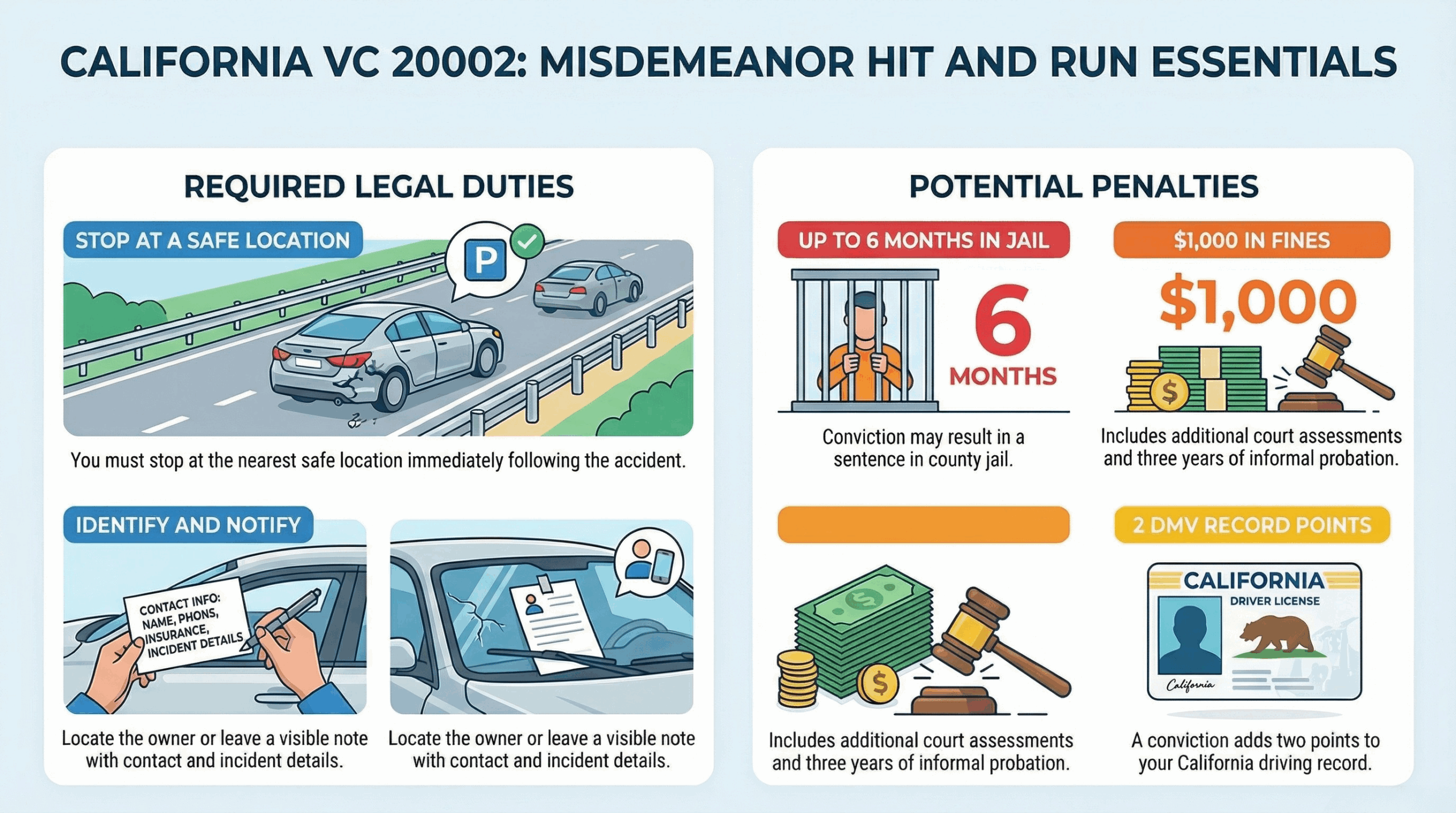
A misdemeanor hit and run occurs when a driver leaves the scene of an accident that resulted only in property damage. Under California law, your duties are clear: you must stop at the nearest safe location and either locate the owner to exchange information or leave a visible note with your contact details and a summary of what happened.
Typical Penalties for Misdemeanors:
Up to 6 months in county jail.
Fines of up to $1,000 plus court assessments.
Three years of informal probation.
Two points on your California DMV driving record.
VC 20001: Felony Hit and Run (Injury or Death)
VC 20001 is a “wobbler” in California, meaning the prosecutor can choose to charge it as either a misdemeanor or a felony. This decision is based on your criminal history and the severity of the victim’s injuries. If the accident resulted in “Great Bodily Injury” (GBI) or death, the state almost always pursues felony charges.
To secure a conviction, the prosecution must prove you knew (or should have known) that an accident occurred and that someone was likely injured, yet you willfully failed to stop and render aid.
The Penalties for a Felony Hit and Run Conviction
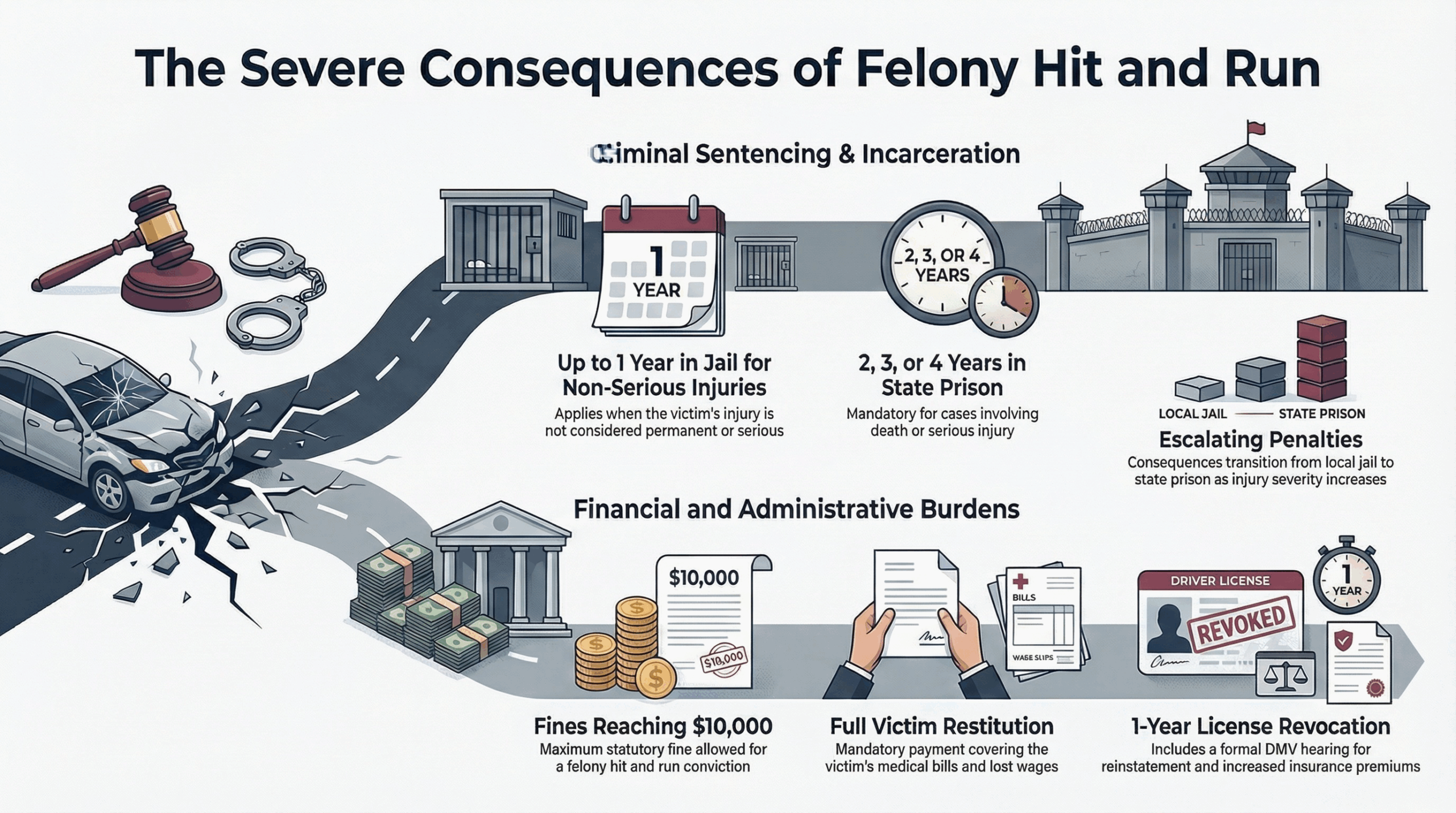
The consequences of a felony conviction are designed to be punitive. If the injury is not “permanent or serious,” you may face up to one year in jail. However, if serious injury or death occurred, the penalties escalate:
Prison Time: 2, 3, or 4 years in California State Prison.
Fines: Up to $10,000.
Restitution: You may be ordered to pay for the victim’s medical bills and lost wages.
Driver’s License: Unlike misdemeanors, a felony conviction often leads to a mandatory one-year revocation of your driver’s license by the DMV. Reinstating your license requires a formal hearing and often results in significantly higher insurance premiums for years.
Bail Amounts for Hit and Run in California
When a person is arrested for a hit and run, the “Bail Schedule” determines the cost of their release. This schedule is a list of pre-set amounts for specific crimes, though a judge can adjust them at an arraignment.
Misdemeanor Bail: Usually ranges from $5,000 to $10,000.
Felony Bail: Typically starts at $50,000 and can exceed $100,000 if there is a fatality or if the defendant is considered a flight risk.
Bail is not a fine; it is a financial guarantee to the court that you will show up for your dates. Because these amounts are often more than a family has in savings, a bail bond allows you to pay a small percentage (usually 10%) to secure a release.
Common Legal Defenses
An experienced attorney will often look at several strategies to fight a hit-and-run charge:
Lack of Knowledge: You genuinely didn’t realize you hit anything (common in large trucks or high-noise environments).
Self-Preservation: You left the scene because you felt physically threatened by the other party or were in an unsafe neighborhood.
The “Only You” Rule: If you were the only person injured in the accident, you cannot be charged under VC 20001.
What to Do If You Realize You Left the Scene
If you panicked and left, the first 24 hours are critical. This is known as the “Golden Window.”
Consult an Expert: Talk to a lawyer and a bail bondsman immediately.
The “Pre-Arranged” Surrender: Armstrong Bail Bonds can help you coordinate with a lawyer to turn yourself in. This shows the court you are taking responsibility and often makes the judge more likely to keep your bail at a reasonable amount.
Avoid Direct Contact: Never call the victim or their insurance company yourself, as anything you say can be used as a confession in court.
How Armstrong Bail Bonds Can Help
Since 1926, the Armstrong family has helped Southern Californians regain their freedom. We understand that a felony hit and run is a high-stress situation that requires more than just a financial transaction.
Fast Release: We have established relationships with jails in Los Angeles, Orange County, and San Diego. We can often have your loved one home in as little as 30 to 60 minutes after the bond is posted.
Payment Plans & Financing: We know that $50,000+ bail is a burden. Armstrong offers 0% interest financing and flexible payment plans for qualified clients.
Credit Checks & Collateral: We simplify the process. For many clients, we offer “No Collateral” bonds where your signature and a stable job are all that’s required. We perform a quick, empathetic review of your situation—similar to how a bank checks credit—but with the goal of saying “yes” to your family’s needs.
People Also Ask (FAQ)
Q: Can a hit and run be dropped if I pay for the damage later? A: While paying for damages (civil compromise) can help in misdemeanor cases, it does not automatically stop criminal charges, especially in felony cases involving injuries.
Q: Does a hit and run count as a “Strike” in California? A: Generally, no. However, if the hit and run involved specific circumstances like vehicular manslaughter or assault with a deadly weapon, it could impact your record under the Three Strikes Law.
Q: Will I lose my job if I’m charged with a felony hit and run? A: Many employers have policies regarding felony arrests. Securing a fast release through Armstrong Bail Bonds allows you to return to work immediately while your lawyer handles the case.
Q: How much does a bail bond actually cost? A: In California, the standard rate is 10% of the total bail. For a $50,000 felony bail, the fee is $5,000. Armstrong offers payment plans to break this into manageable monthly amounts.
Q: Can I bail someone out at night? A: Yes. Armstrong Bail Bonds is open 24 hours a day, 7 days a week, including holidays.
Q: What happens if I miss a court date? A: The court will forfeit the bond and issue a warrant. If this happens, contact Armstrong immediately so we can help you “re-assume” the bond and stay out of jail.
Secure Your Freedom Today
A felony charge doesn’t have to mean the end of your career or your family’s stability. With over 88 years of experience, Armstrong Bail Bonds provides the professional and empathetic support you need to fight your case from home.
Don’t wait behind bars—call Armstrong Bail Bonds now at (818) 241-2171 or visit www.armstrongbailbonds.net for a free consultation.