

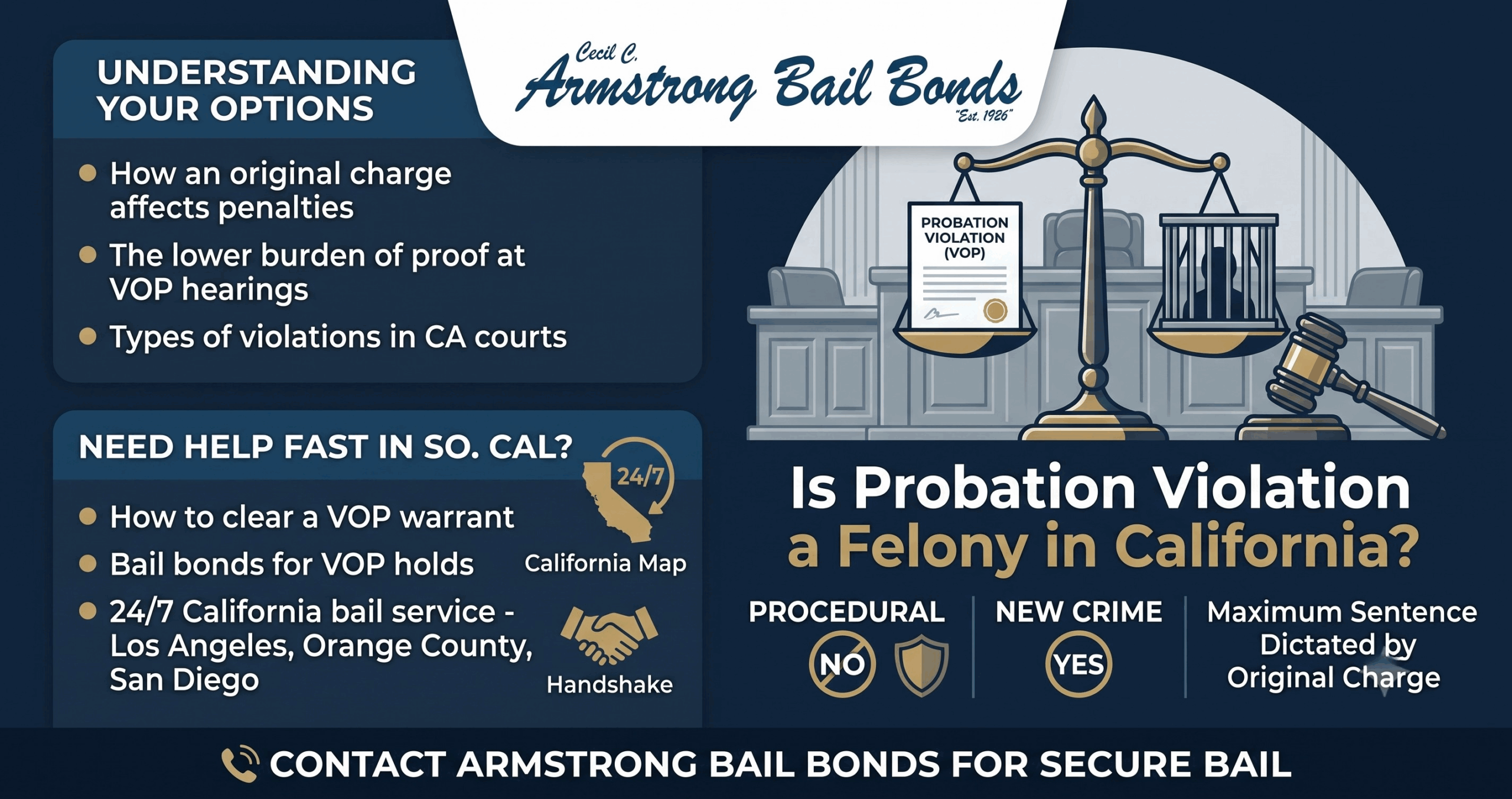
02 Jul Is Probation Violation a Felony?
If you or someone you love is facing a probation violation, you might be terrified that this mistake will automatically result in a brand-new felony charge on your record. The reality is that navigating the legal system after a violation can be incredibly confusing, but understanding how the law treats these situations can give you immense peace of mind. Let’s break down exactly how probation violations work, whether they count as felonies, and how a trusted partner like Armstrong Bail Bonds can help you regain your freedom.
Is a Probation Violation a Felony?
The short answer is no. A probation violation (often called a VOP) is not a brand-new criminal charge. Instead, it is considered a procedural violation of a court order. When you are placed on probation, a judge lets you stay out of jail on the condition that you follow strict rules. If you break those rules, you are not committing a new felony; you are simply breaking the agreement you made with the court.
Why a VOP Is Usually a Procedural Violation, Not a New Charge
Because a probation violation is procedural, you cannot be hit with a completely separate felony conviction just for violating the terms themselves. For example, if you miss a meeting with your probation officer, you cannot be charged with a new “felony of missing a meeting.” The court will handle the situation within the boundaries of your original, underlying case.
When a Probation Violation Does Involve a New Felony Charge
The rules change if you violate your probation by committing a brand-new crime. If you are on probation and get arrested for a separate felony—such as grand theft or assault—the state will prosecute you for that new crime. In this scenario, you will face two separate legal issues: the procedural probation violation for breaking your court rules, and an entirely new, independent felony charge.
Understanding the Underlying Crime: Misdemeanor vs. Felony Probation
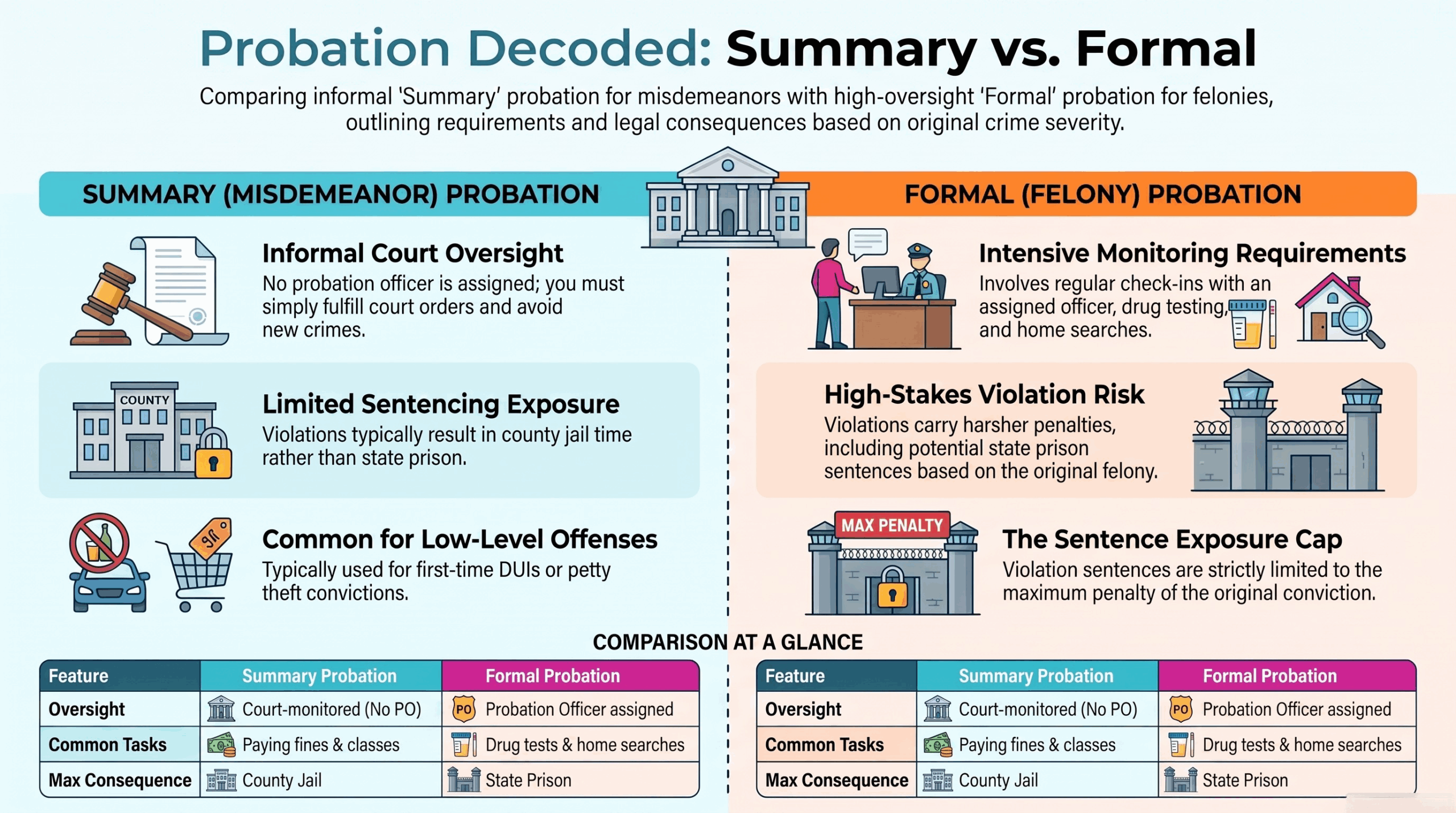
How severely the court treats a probation violation depends almost entirely on the original crime that put you on probation in the first place.
Summary (Misdemeanor) Probation in Southern California
Summary probation, also known as informal probation, is typically used for misdemeanor offenses like a first-time DUI or petty theft. You generally do not have to report to a probation officer. Instead, you are required to keep your clean record and fulfill court orders, like paying fines or attending classes. Violating summary probation rarely leads to state prison, but it can land you in county jail.
Formal (Felony) Probation and Its Strict Requirements
Formal probation is reserved for felony offenses. If you are on felony probation, you will be assigned a specific probation officer (PO) and must comply with intense oversight. This often includes regular check-ins, random drug testing, and home searches. Because the underlying crime is a felony, the consequences of a violation are far harsher.
How the Original Charge Dictates Your Maximum Sentence Exposure
When you violate probation, the maximum amount of time you can serve in jail or prison is capped by your original conviction. The judge cannot sentence you to five years in state prison for a probation violation if your original crime only carried a maximum penalty of one year in county jail.
Types of Probation Violations in California Courts
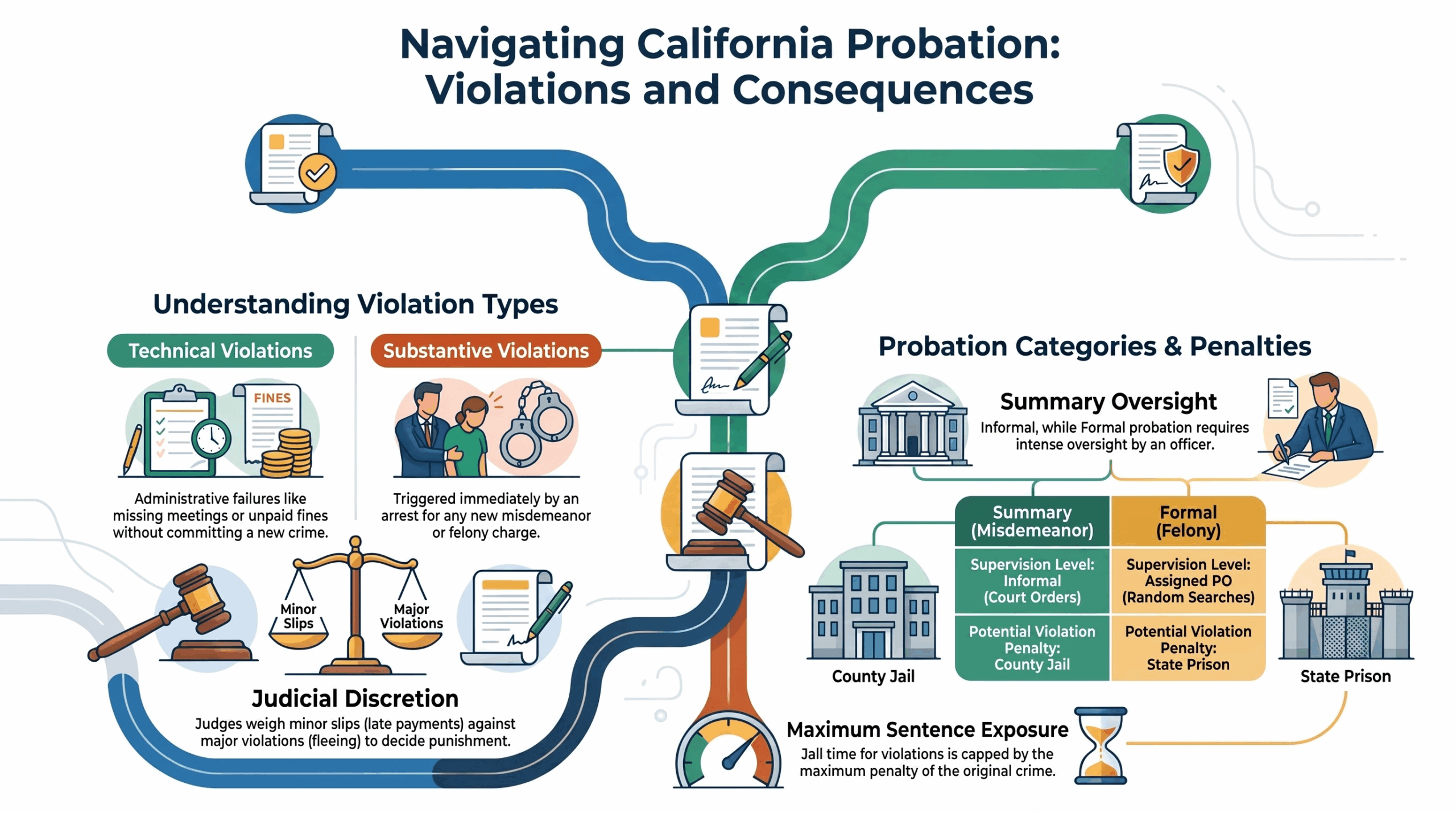
Courts generally split probation violations into two main categories.
Technical Violations
A technical violation happens when you fail to follow the specific administrative rules set by the judge. No new crime has been committed. Common examples include:
Missing a scheduled meeting with your probation officer.
Failing a random drug or alcohol screening.
Forgetting to pay court-ordered restitution or fines.
Failing to complete community service or mandatory counseling classes by the deadline.
Substantive Violations
A substantive violation occurs the moment you are arrested for breaking a new law while on probation. It does not matter if the new arrest happens in your hometown or a different county—any new misdemeanor or felony charge will immediately trigger a probation violation.
Major vs. Minor Violations: How Judges Decide Your Fate
Judges look at the big picture to determine the severity of the violation. A minor violation, like being late on a payment, is usually handled leniently. A major violation, like fleeing the state or committing a violent crime, will cause the judge to take aggressive action.
What Happens Immediately After a Probation Violation?
The moments directly following an alleged violation can move incredibly fast.
The Probation Officer’s Discretion: Warning vs. Formally Filing a VOP
Your probation officer holds a lot of power. If you have been compliant in the past and commit a minor technical violation, your PO might give you a stern warning. However, if the violation is severe or repetitive, the PO will file a formal “Notice of Violation” with the court.
The Arrest Process and California VOP Warrants
Once the court receives the notice, a judge will typically issue a bench warrant for your arrest. This means law enforcement can take you into custody at any time—during a routine traffic stop, at your workplace, or at your home.
Can You Get a Bail Bond for a Probation Violation in California?
If you are arrested on a probation violation warrant, securing your release is a bit different than a standard arrest.
+---------------------------+-------------------------------------------------------+
| Type of Arrest            | Standard Bail Availability                            |
+---------------------------+-------------------------------------------------------+
| New Criminal Charge       | Usually eligible for immediate bail via a bail schedule|
| Probation Violation (VOP) | Often subject to a temporary "No Bail" hold by a judge|
+---------------------------+-------------------------------------------------------+
| Strategy: Contact Armstrong Bail Bonds immediately to track the warrant and check your bail eligibility status. |
+---------------------------+-------------------------------------------------------+
The “No Bail” Hold: Why VOP Warrants Are Different from Initial Arrests
Under California Penal Code 1203.2, judges frequently place a “No Bail” hold on individuals arrested for probation violations. The court does this because they want you to remain in custody until you can speak directly to the judge at a hearing.
How a Defense Attorney and a Bail Bondsman Work Together to Lift a Hold
If you are hit with a “No Bail” hold, a criminal defense attorney can file a motion asking the judge to set a dollar amount for your bail. Once the judge approves a bail amount, you can immediately contact Armstrong Bail Bonds to post the bond and get out of jail while you await your formal hearing.
Posting Bail for a Substantive Violation
If your violation was caused by a brand-new arrest, you will have to deal with two separate issues. You will need to post bail for the new crime based on the local county bail schedule, and you must have your attorney address the probation hold. Armstrong Bail Bonds can help you navigate both of these pieces simultaneously to get you home as quickly as possible.
What to Expect at a California Probation Revocation Hearing
A probation revocation hearing is not like a standard criminal trial. There is no jury, and the rules are heavily skewed in favor of the prosecution.
Your Legal Rights Before a Judge
Even though it is not a trial, you still have critical rights. You have the right to be represented by an attorney, the right to see the evidence against you, and the right to present witnesses in your defense.
The Burden of Proof: Why VOP Hearings Favor the Prosecution
In a normal trial, the state must prove you are guilty “beyond a reasonable doubt.” In a probation violation hearing, the standard drops to a preponderance of the evidence. This means the prosecutor only needs to convince the judge that there is a 51% chance you violated your terms.
Potential Outcomes: Reinstatement, Modification, or State Prison Sentences
If the judge decides you did violate your probation, they have three options:
Reinstatement: The judge gives you a second chance and lets you back on probation with the exact same terms.
Modification: Your probation is reinstated, but the judge adds harsher terms, like longer community service, more drug testing, or a brief stay in county jail.
Revocation: The judge cancels your probation entirely and orders you to serve your original suspended jail or state prison sentence.
Frequently Asked Questions (FAQs)
Can a technical probation violation turn my original misdemeanor into a felony?
No. A technical violation cannot change the underlying nature of your crime. A misdemeanor will always remain a misdemeanor. However, a violation can result in you serving the maximum jail time allowed for that misdemeanor.
How long can they hold you in jail for a probation violation in Southern California?
If you are placed on a “No Bail” hold, you will generally remain in custody until your revocation hearing. California law requires these hearings to happen within a reasonable timeframe, which usually means anywhere from a few days to a few weeks after your arrest.
What should I do if I know there is a VOP warrant out for my arrest?
Do not try to hide or run from the warrant. The best strategy is to be proactive. Contact an attorney and call Armstrong Bail Bonds immediately so you can arrange a planned surrender and have your bail options ready to go the moment you see the judge.
Can you get a bail bond on a felony probation violation?
Yes, but only if the judge chooses to set a bail amount. Because many felony violations trigger an automatic “No Bail” hold, your lawyer must first convince the judge to grant bail. Once a bail amount is set, a licensed bondsman can post it.
How much does a bail bond cost for a probation violation in California?
In California, the cost of a bail bond is legally regulated. Most agencies charge a non-refundable premium of 10% of the total bail amount. For example, if the judge sets your violation bail at $20,000, the fee to secure your release through a bondsman will be $2,000.
Facing a VOP Warrant in Southern California? Armstrong Bail Bonds Can Help
A probation violation warrant can turn your life upside down, but you do not have to handle the stress alone. Since 1926, Armstrong Bail Bonds has provided fast, compassionate, and highly professional bail bond services to families across Los Angeles, Orange County, and San Diego.
How to Check for Active Warrants Discreetly
If you suspect a probation officer has filed a violation against you, our experienced team can help you look up active warrants discreetly without tipping off law enforcement. This gives you the valuable time you need to build a plan with a lawyer.
24/7 Fast, Professional Bail Solutions
We are a family-owned and operated business available 24 hours a day, 7 days a week. We offer flexible payment plans tailored to your financial situation to make the process as stress-free as possible. Don’t wait for the police to show up at your door—contact Armstrong Bail Bonds today or call us directly to speak with a licensed agent right now.