

01 Mar The “Failure to Appear” Crisis: Understanding PC 1320 vs. PC 1320.5
Missing a court date in California can instantly transform a manageable legal issue into a high-stakes criminal crisis. Understanding the difference between Penal Code 1320 and 1320.5 is essential for anyone navigating the justice system. If you or a loved one are facing a “Failure to Appear” charge, Armstrong Bail Bonds provides the expert guidance needed to resolve warrants and protect your freedom.
Understanding the “Failure to Appear” (FTA) Charge in California
In California, a “Failure to Appear” (FTA) isn’t just a procedural hiccup; it is a separate criminal offense. To be convicted, the prosecution must prove you acted “willfully.” This means you intentionally skipped court with the specific purpose of avoiding the legal process.
The 14-Day Rule
Under California law, there is a significant legal “trap” known as the 14-day rule. If you fail to appear for a felony charge and remain at large for more than 14 days, the law may automatically presume you intended to evade the court. This presumption makes it much easier for a prosecutor to secure a conviction. Waiting even two weeks to address a missed date significantly weakens your defense, which is why contacting a bondsman like Armstrong Bail Bonds immediately is vital.
Elements the Prosecution Must Prove
To find you guilty of an FTA, the District Attorney must establish three specific facts:
You were charged with or convicted of a specific crime.
You were released from custody, either on your “Own Recognizance” (O.R.) or by posting bail.
You willfully failed to show up in court on the required date to evade the court’s authority.
PC 1320 vs. PC 1320.5: What Is the Difference?
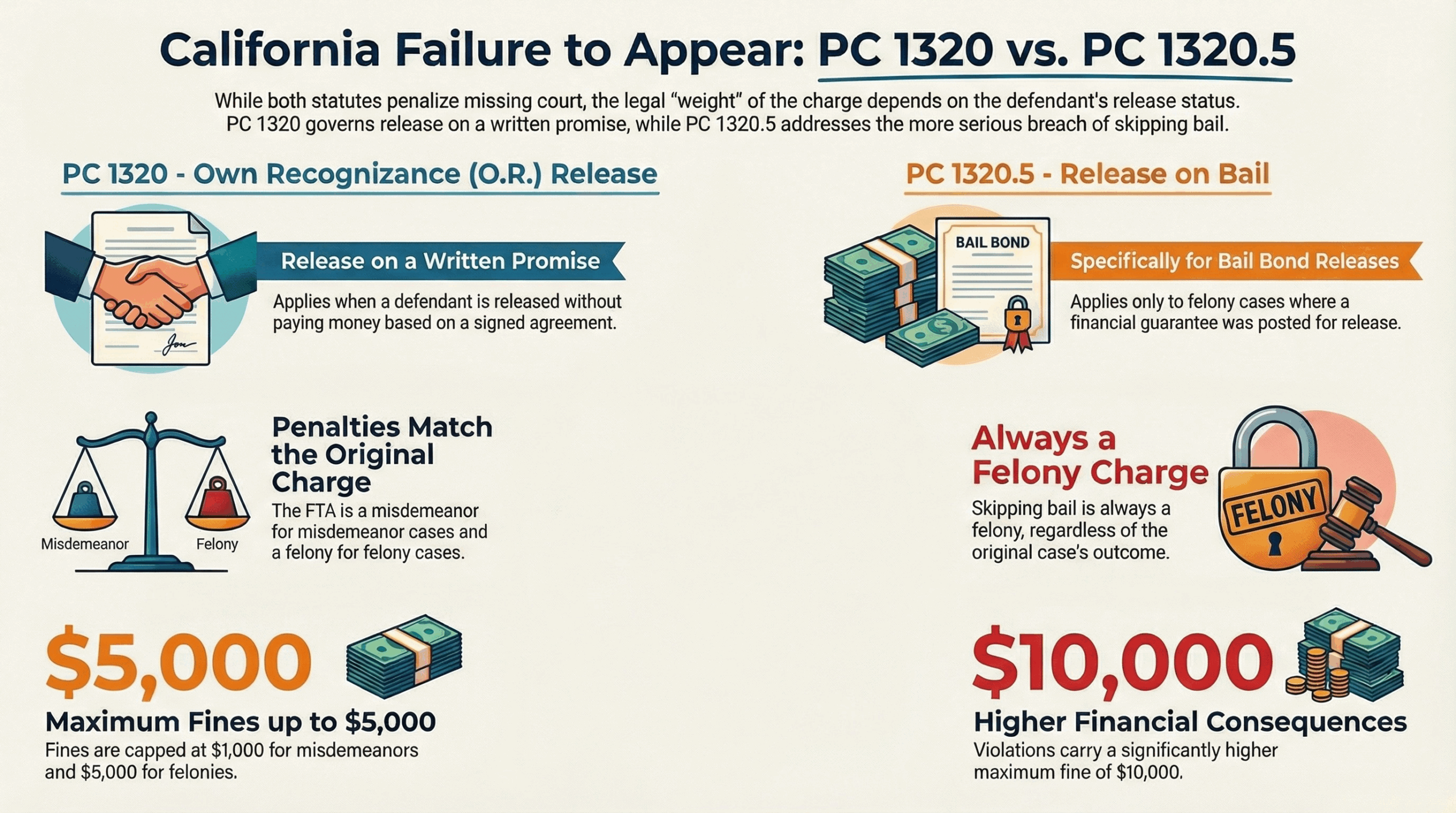
While both codes deal with missing court, they apply to different types of release. The consequences and the legal “weight” of each vary significantly.
Penal Code 1320: Release on Own Recognizance (O.R.)
PC 1320 applies when a defendant is released without having to pay money. You sign a written promise—a “recognizance”—stating you will return.
Misdemeanors: If your original case was a misdemeanor, the FTA is a misdemeanor.
Felonies: If your original case was a felony, the FTA is a felony.
Penal Code 1320.5: Release on Bail
PC 1320.5 is specifically for defendants who were out on a bail bond. This code only applies to felony cases. Because you were released under a financial guarantee, the law views “skipping bail” as a more serious breach of trust. A violation of PC 1320.5 is always a felony, regardless of the outcome of your original case.
Summary Table: PC 1320 vs. PC 1320.5 at a Glance
| Feature | PC 1320 (O.R. Release) | PC 1320.5 (Bail Release) |
| Release Type | No money paid; signed promise | Bail bond posted |
| Case Level | Misdemeanor or Felony | Felony only |
| FTA Charge | Matches original charge level | Always a Felony |
| Max Fine | $1,000 (Misd) / $5,000 (Fel) | $10,000 |
The Hidden Penalties: Beyond Fines and Jail Time
The immediate threat of jail time is terrifying, but the secondary consequences of an FTA can haunt your life for years.
Prison Sentences: A felony FTA can lead to 16 months, two years, or even three years in state prison.
Bail Forfeiture: If you miss court while on bond, the court “forfeits” the bail. This means the person who signed for you (the indemnitor) is now legally responsible for paying the full amount of the bond to the court.
Driver’s License Suspension: The court often notifies the DMV of your failure to appear. This results in an automatic suspension. Driving on a suspended license leads to further arrests and can make holding a job nearly impossible.
Future Release Eligibility: Once you have an FTA on your record, you are labeled a “flight risk.” In future cases, judges are almost certain to deny you O.R. release and will likely set bail much higher than the standard schedule.
The Bench Warrant: What Happens After You Miss Court?
As soon as your name is called in court and you aren’t there, the judge will likely issue a Bench Warrant. Unlike an arrest warrant, which is issued at the start of a case, a bench warrant is issued “from the bench” because you disobeyed a court order.
The “Statewide Visibility” of Warrants
Many people believe that if they miss court in Los Angeles, they are safe in San Diego or Orange County. This is a dangerous myth. Bench warrants are entered into a statewide database (CLETS). If you are pulled over for a broken taillight or even go through a security checkpoint at an airport, the warrant will appear. You will be handcuffed and held in custody until you can be transported back to the original court.
Does a Bench Warrant Ever Expire?
Bench warrants do not have an expiration date. They do not “go away” with time. You could be arrested ten years from now for a missed court date today. The only way to remove a warrant is for a judge to “quash” or recall it.
Legal Defenses and Strategies to Fight FTA Charges
A missed court date doesn’t always have to result in a conviction. Valid defenses include:
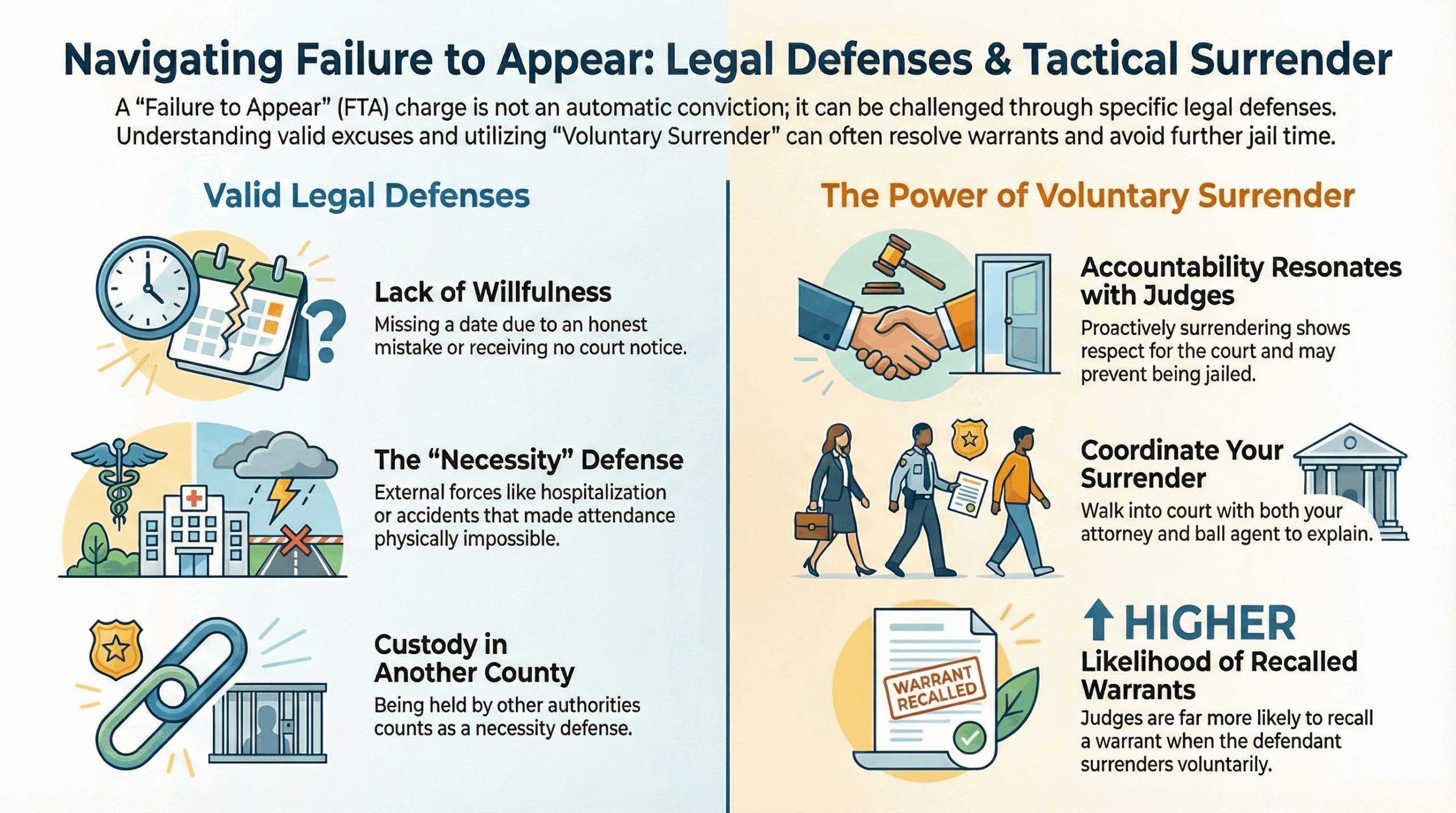
Lack of Willfulness: You missed the date due to an honest mistake or a lack of notice from the court.
The “Necessity” Defense: This applies if an external force made it impossible to attend. Examples include being hospitalized, being involved in a car accident on the way to court, or being held in custody in another county.
The Power of Voluntary Surrender: Judges despise being ignored, but they respect accountability. If you proactively walk into court with your attorney and your bail agent to “surrender” and explain the situation, the judge is far more likely to recall the warrant without throwing you back in jail.
How Armstrong Bail Bonds Helps You Resolve an FTA
Since 1926, Armstrong Bail Bonds has been the trusted partner for Southern California families facing legal crises. We do more than just post bail; we help you fix mistakes.
Warrant Resolution: We work closely with your attorney to facilitate warrant recalls, often preventing you from spending another night in a cell.
Flexible Financing for “Re-Bail”: If your original bail was forfeited, you may need a new bond to stay free while the case continues. We offer flexible payment plans and low down payments to make “re-bailing” affordable.
The “Indemnitor Advocate”: We understand that the person who signed for your bail is under immense stress. We provide resources to help co-signers protect their assets and collateral during an FTA crisis.
24/7 Rapid Response: With deep roots in Los Angeles, Orange County, and San Diego, our agents are available day and night to provide an immediate inmate search and bail assistance.
FAQ: People Also Ask
Q: Can I just pay a fine to make a bench warrant go away? A: No. A bench warrant requires you to appear before a judge. However, in some misdemeanor cases, an attorney can appear on your behalf to resolve it and pay any associated fines.
Q: Will I go to jail if I turn myself in on a warrant? A: Not necessarily. If you arrange a “voluntary surrender” with a bail bondsman and a lawyer, you can often be processed and released the same day without being booked into the general jail population.
Q: How do I know if I have a Failure to Appear warrant? A: You can perform a warrant search through the local Sheriff’s department website, or you can call Armstrong Bail Bonds for a free, confidential warrant and inmate check.
Q: Does an FTA show up on a background check? A: Yes. An active warrant and an FTA conviction will appear on most standard background checks, which can affect employment and housing applications.
Q: Can Armstrong Bail Bonds help if my warrant is from another county? A: Yes. Armstrong Bail Bonds has a wide network and can assist with bonds and warrant information throughout California.
Resolve Your Failure to Appear Today
The longer you wait, the worse the “Failure to Appear” crisis becomes. Don’t let a simple mistake turn into years in prison or the loss of your driver’s license. Armstrong Bail Bonds has spent nearly a century helping people regain their freedom and protect their families.
Call Armstrong Bail Bonds today at 800-224-5266 for a free consultation. We are available 24/7 to help you quash your warrant and get back on track.