

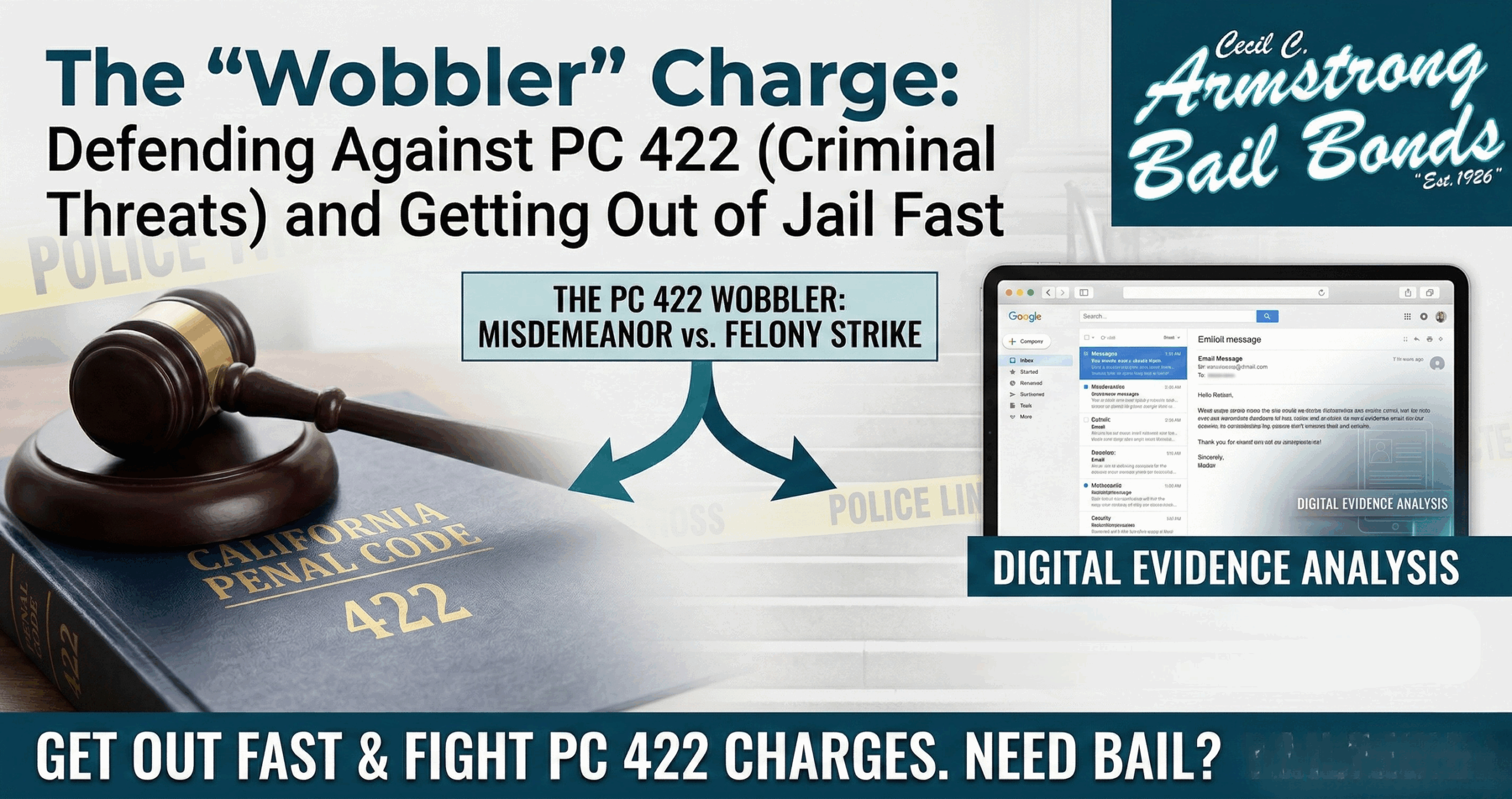
26 Feb The “Wobbler” Charge: Defending Against PC 422 (Criminal Threats) in California
Facing a charge under California Penal Code 422 is a frightening experience that often leaves individuals and their families scrambling for answers. Understanding the nature of this “wobbler” offense and the importance of securing your release is the first step toward building a successful legal defense. This guide outlines how California law views criminal threats and why getting out of custody with the help of Armstrong Bail Bonds is essential to protecting your future.
Understanding PC 422: What Constitutes a “Criminal Threat”?
California Penal Code 422, commonly known as “Criminal Threats,” is a serious charge that alleges an individual has communicated a threat to commit a crime that will result in death or great bodily injury. Contrary to what many people believe, this law is not meant to police simple arguments or heated debates.
The legal definition requires more than just angry words. For a statement to qualify under PC 422, it must be unequivocal, unconditional, immediate, and specific enough to convey a gravity of purpose and an immediate prospect of execution. While an emotional outburst might feel like a threat in the moment, the law specifically requires a “willful” communication of intent. This distinction is vital, as it separates a momentary loss of temper from a genuine criminal threat.
Why PC 422 Often Triggers High Bail
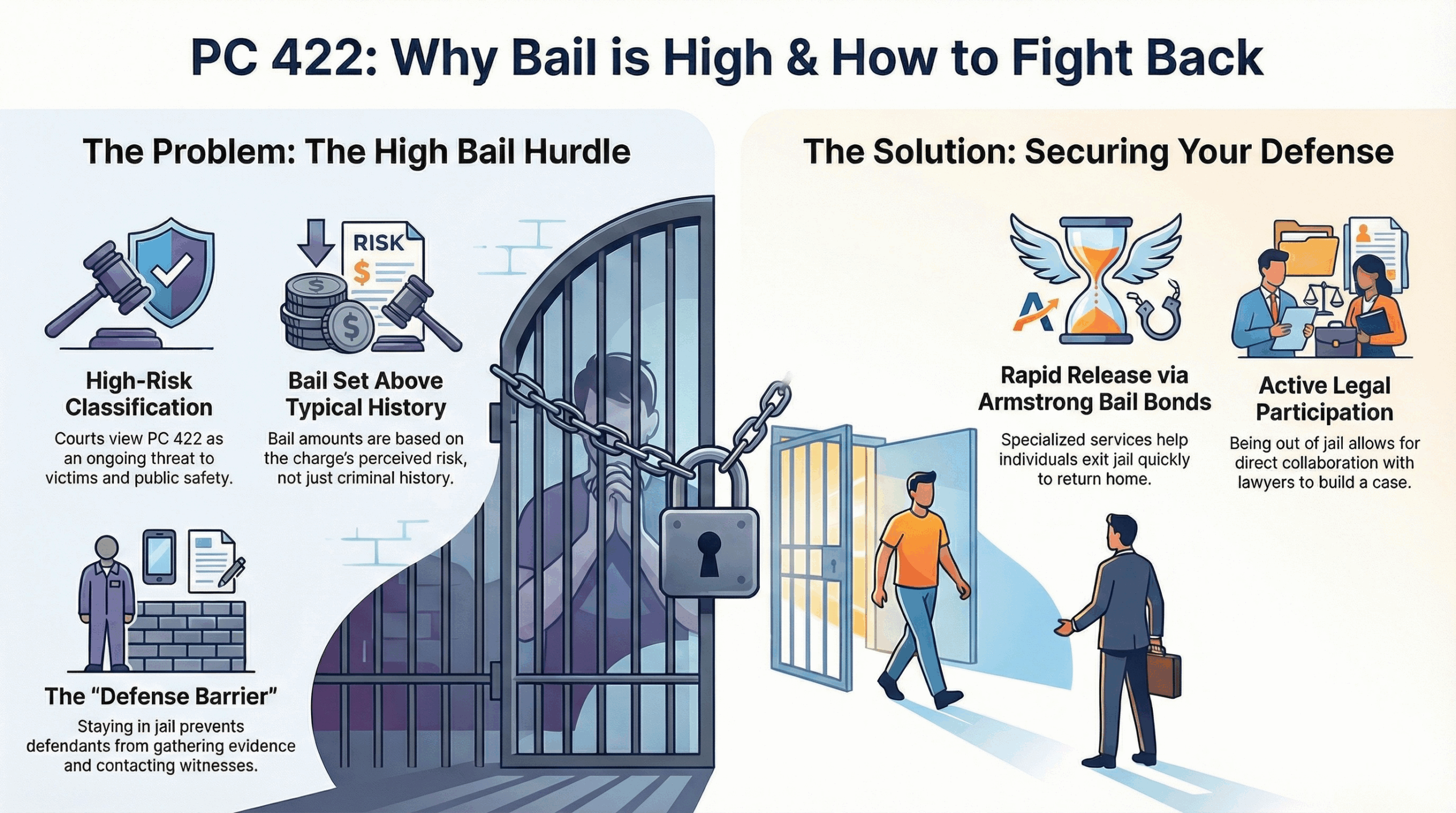
When someone is arrested for a criminal threat, the arrest is often accompanied by an unusually high bail amount. This is not necessarily a reflection of the person’s criminal history, but rather how the justice system views the charge.
Because PC 422 involves the threat of violence, police officers and judges often classify these cases as high-risk to ensure the safety of the alleged victim and the public. Courts operate under the assumption that the “threat” is ongoing, leading them to set bail at a level that can feel impossible to pay. This creates a difficult situation: you or your loved one remains in jail, unable to work with a lawyer, gather evidence, or contact witnesses.
If you are facing this situation, you do not have to wait for the system to change. Armstrong Bail Bonds specializes in helping individuals get out of jail quickly, allowing them to return home and actively participate in their legal defense.
The “Wobbler” Reality: Misdemeanor vs. Felony
The most critical aspect of PC 422 is that it is a “wobbler” offense. This means that, depending on the circumstances, the prosecutor can file the charge as either a misdemeanor or a felony.
Misdemeanor Penalties: If reduced to a misdemeanor, the consequences are less severe, often involving shorter jail time (up to one year in county jail), summary probation, and fines.
Felony Penalties: If charged as a felony, the stakes are significantly higher. It can result in imprisonment in state prison, heavy fines, and the charge counts as a “strike” under California’s Three Strikes Law.
The Strategic Pivot: The goal of a defense attorney is often to convince the prosecutor to file the charge as a misdemeanor or to reduce a felony charge during the negotiation process. Having the freedom to consult with an attorney immediately—rather than sitting in a jail cell—is your greatest advantage in negotiating this outcome. Armstrong Bail Bonds provides the essential bridge to that freedom, helping you get home so you can build your defense strategy.
The 5 Elements the Prosecution Must Prove
For the prosecution to secure a conviction under PC 422, they must prove five specific elements beyond a reasonable doubt. If any of these are missing, the case can be dismantled.
The Threat: The defendant must have threatened to commit a crime that would result in death or great bodily injury.
The Communication: The threat must have been communicated to the victim. This can be verbal, in writing, or via electronic communication.
The Intent: The defendant must have intended for the communication to be taken as a threat.
The Immediacy: The threat must be specific, unequivocal, and unconditional, conveying an immediate prospect of execution.
The Victim’s Reaction: The victim must have been reasonably in sustained fear for their own safety or the safety of their immediate family.
The “Sustained Fear” Threshold: Why Cases Often Fall Apart Here
Many PC 422 cases hinge on the requirement of “sustained fear.” This is a frequent point of weakness in the prosecution’s argument.
The law requires that the victim’s fear was not just momentary, but “sustained.” If a victim felt scared for a split second during an argument but then continued to engage in conversation or went about their day, the element of sustained fear may not exist.
Furthermore, the law applies an “objective test.” A jury must ask: Would a reasonable person in the victim’s position feel threatened? If the alleged threat was made in a context that makes it clearly non-threatening—such as during a sarcastic remark or a heated but empty argument—the case often falls apart. Defense attorneys often scrutinize the victim’s behavior following the alleged threat to show that they did not, in fact, experience sustained, reasonable fear.
Common Defense Strategies
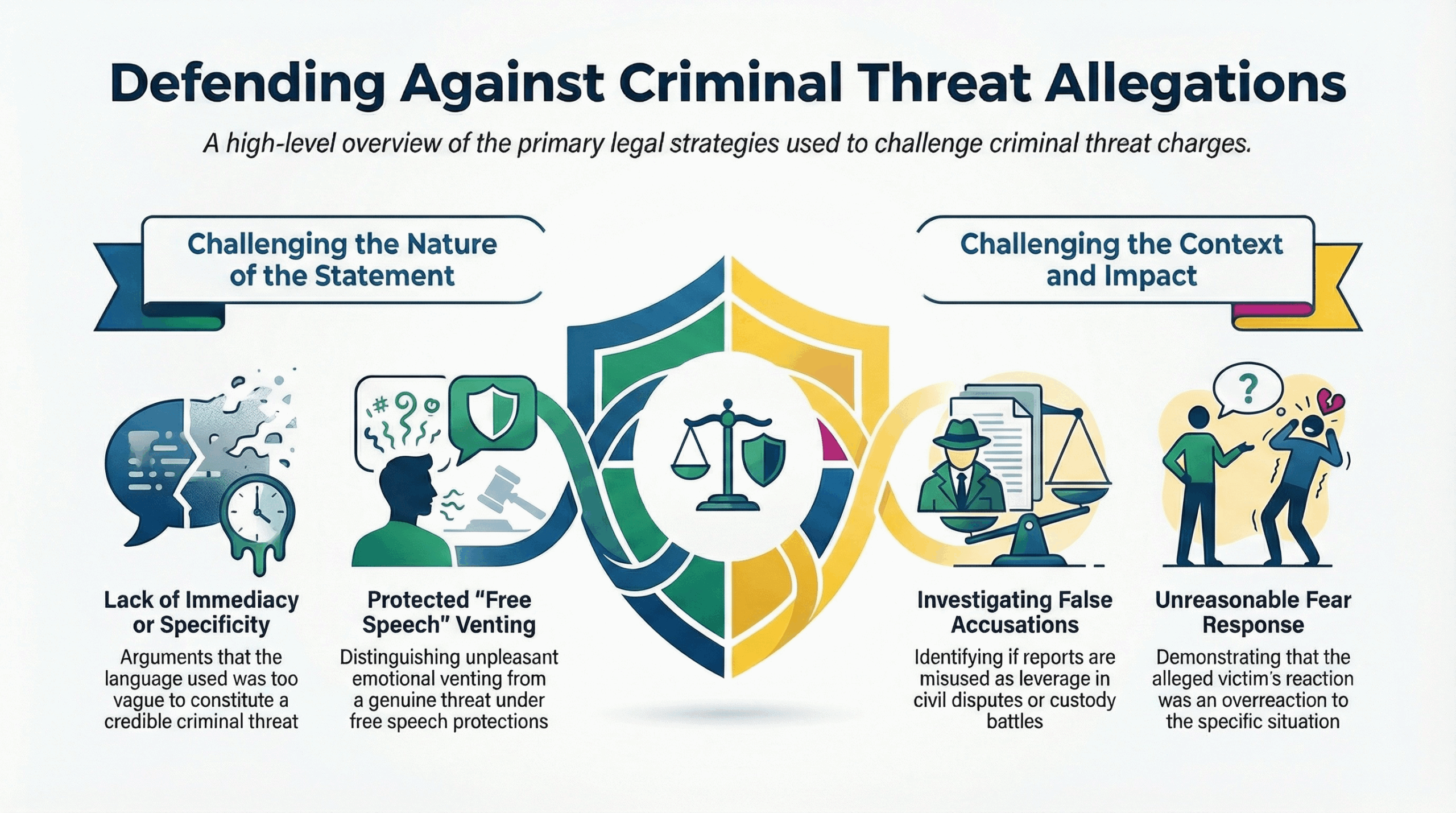
A skilled criminal defense attorney will look for holes in the prosecution’s case. Common defense strategies include:
The Threat Was Not Immediate or Specific: Arguing that the words used were too vague to qualify as a criminal threat.
The “Protected Speech” Argument: Distinguishing between a genuine threat and “free speech” venting, which is protected even if the words are unpleasant.
False Accusations: Investigating if the threat report is being used as leverage in a divorce, custody battle, or civil dispute.
The Fear Was Not Reasonable: Demonstrating that the victim’s reaction was an overreaction to the situation.
Digital Forensics: Defending Against Electronic Threats
In the modern age, many PC 422 charges stem from text messages, emails, or social media posts. While these provide a “paper trail,” they often lack the nuance of human interaction.
Digital forensics is a powerful tool in a defense strategy. Attorneys can use full conversation histories to show that a message was taken out of context. For example, a “threat” sent in a text might look alarming in isolation but appear as a misunderstood joke or a frustrated vent when viewed alongside the full conversation. Furthermore, defense experts can challenge the authenticity of digital evidence, questioning whether the defendant was actually the person who sent the message or if accounts were accessed by others.
Collateral Consequences: Beyond Jail Time
A criminal conviction for PC 422 can have ripple effects that extend far beyond the courtroom. Understanding these stakes is why many people choose to fight these charges vigorously.
Immigration Consequences: PC 422 is often categorized as a “crime of moral turpitude,” which can have devastating effects on a person’s immigration status, potentially leading to deportation or inadmissibility.
Professional Licenses: Doctors, lawyers, teachers, and other licensed professionals may face disciplinary action or loss of their license if convicted of a crime involving violence.
Firearm Rights: A conviction often includes the loss of the right to own or possess a firearm.
Related Offenses
It is not uncommon for PC 422 to be filed alongside or in conjunction with other charges. These include:
Domestic Violence (PC 273.5): Often charged when the threat involves a spouse or partner.
Stalking (PC 646.9): Charged when there is a pattern of harassing behavior.
Assault with a Deadly Weapon (PC 245): Charged if the threat involved a weapon.
The Armstrong Difference: Why We Are the Partner You Need
When you or a loved one is facing a PC 422 charge, you need more than just a bail bond agent; you need a partner who understands the urgency of your situation. At Armstrong Bail Bonds, we are committed to helping you regain your freedom so you can focus on what matters most: your defense.
Fast-Track Bail Service: We know that time is of the essence. We process bonds 24/7, ensuring that you don’t spend a moment longer in custody than necessary.
Compassionate Guidance: Being accused of a crime is stressful. We treat every client with dignity and respect, never judgment. We are here to help, not to criticize.
Flexible Payment Plans: Financial stress is often part of an arrest. We offer flexible payment options to help you secure the bond without an overwhelming upfront cost.
Local Authority: As a locally trusted bail agency, we understand the local court systems and how to navigate the bail process effectively.
Next Steps: Protecting Your Future
The most important step you can take right now is to remain silent. Do not discuss the incident with the police, as anything you say can be used to strengthen the prosecution’s case. Your priority is to secure your release and consult with a criminal defense attorney.
Call Armstrong Bail Bonds today at (818) 241-2171. We are ready to help you navigate this process, provide the support you need, and get you back home to start building your defense.
Frequently Asked Questions (FAQ)
1. How fast can Armstrong Bail Bonds get me out of jail? We prioritize “fast-track” service. Once the bond is processed and the paperwork is complete, we work diligently to post it with the facility. The actual release time depends on the jail’s processing speed, but we work to minimize that wait as much as possible.
2. Can I get a PC 422 charge dropped? While we are bail agents and not lawyers, many PC 422 cases are dismissed or reduced to lesser charges through skilled legal negotiation. This is exactly why getting out of jail immediately is so important—it gives your attorney the time and access needed to fight for a dismissal.
3. What happens if I can’t afford the full bail amount? This is where Armstrong Bail Bonds helps. We offer flexible payment plans to make the bail process manageable, allowing you to pay a fraction of the total bail amount to secure your release.
4. Will a PC 422 conviction definitely result in a “Strike”? Not necessarily. Because PC 422 is a “wobbler,” it can be reduced to a misdemeanor. A misdemeanor conviction is not a strike. A skilled attorney works specifically to avoid the felony classification.
5. Should I talk to the police if they call me about a PC 422 report? It is generally advised to speak with a defense attorney before speaking with the police. Anything you say can be used to build a case against you. Your focus should be on getting legal representation, not giving a statement to the police.
6. Does Armstrong Bail Bonds offer confidential services? Yes. We prioritize your privacy and handle all interactions with the utmost discretion.