

26 Feb Theft Thresholds: Understanding California’s $950 Rule (PC 484 vs. PC 487)
Being charged with theft in California is a frightening experience, especially when you are unsure how the law classifies your actions. Understanding Theft Thresholds: PC 484 vs. PC 487 and the $950 Rule is essential to knowing what kind of penalties you might face. This guide explains the law and your options if you or a loved one are currently facing charges.
The $950 Rule: California’s Theft Threshold Explained
For many years, California law had rigid definitions for theft. However, the legal landscape shifted significantly with the passage of Proposition 47. This change was designed to reduce overcrowding in jails and prisons by reclassifying certain non-violent crimes from felonies to misdemeanors.
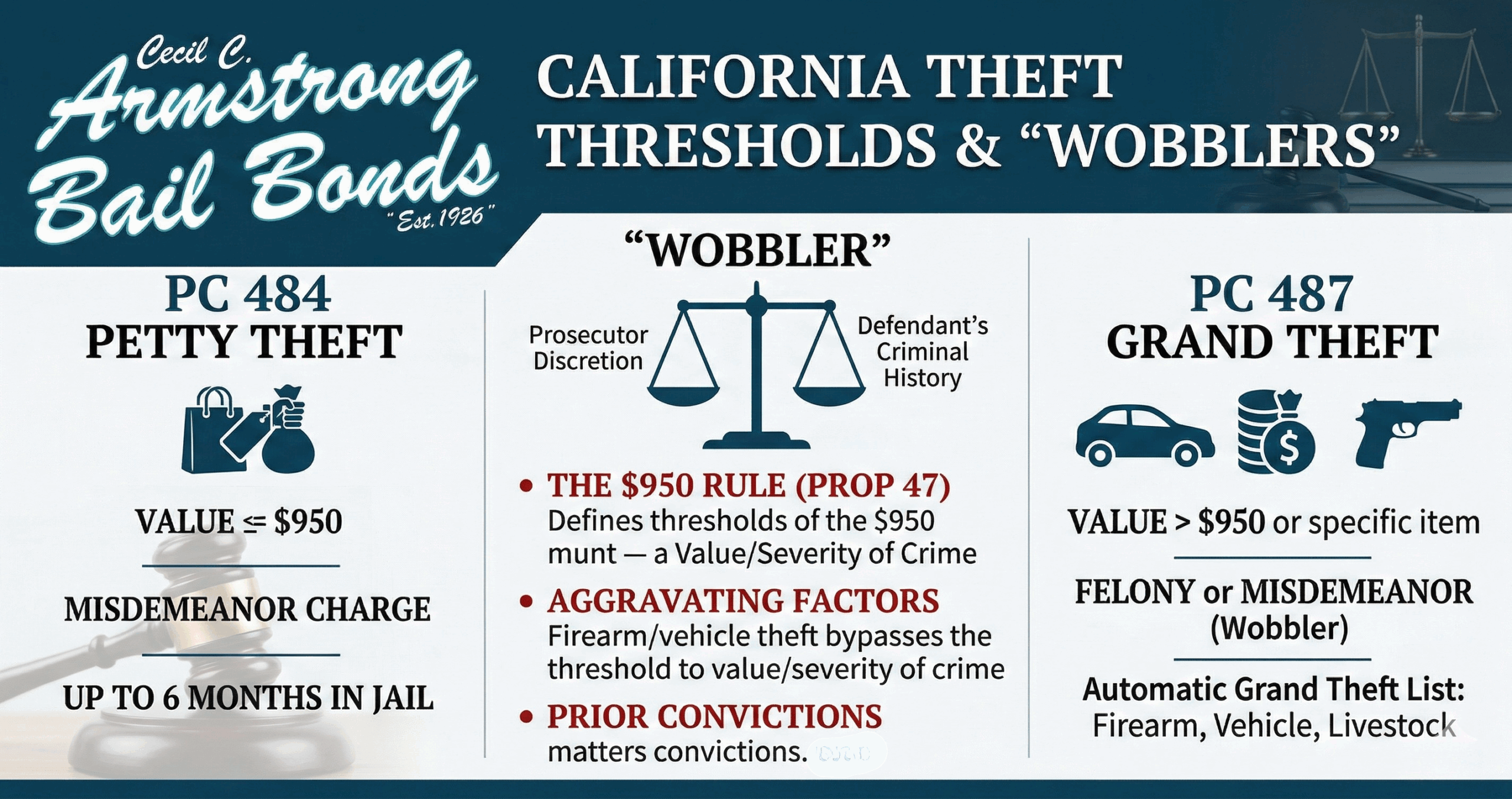
At the heart of this change is the $950 rule. In California, the value of the property taken is the primary factor in determining whether a theft is classified as “Petty Theft” or “Grand Theft.”
Defining PC 484 (Petty Theft)
California Penal Code (PC) 484 defines theft as the unlawful taking of someone else’s property. When that property is valued at $950 or less, it is generally charged as Petty Theft under PC 484. This is the most common theft charge and is typically handled as a misdemeanor.
Defining PC 487 (Grand Theft)
Grand Theft, defined under PC 487, occurs when the property taken exceeds $950 in value. While this is the general rule, it is important to note that grand theft can be charged as a felony or a misdemeanor depending on the specific circumstances and the defendant’s criminal history.
The Impact of Proposition 47 on Theft Classification
Before Proposition 47, prosecutors had much broader discretion to charge lower-level thefts as felonies. Now, because of the $950 threshold, the system is more standardized. If the property value is below $950, prosecutors are generally required to charge the offense as a misdemeanor, unless specific “aggravating factors” are present.
Petty Theft (PC 484): What You Need to Know
Petty theft is often what people refer to as “shoplifting” or “simple theft.” It involves the intentional taking of property that does not belong to you, without the owner’s permission, with the intent to permanently deprive them of that property.
What Constitutes Petty Theft?
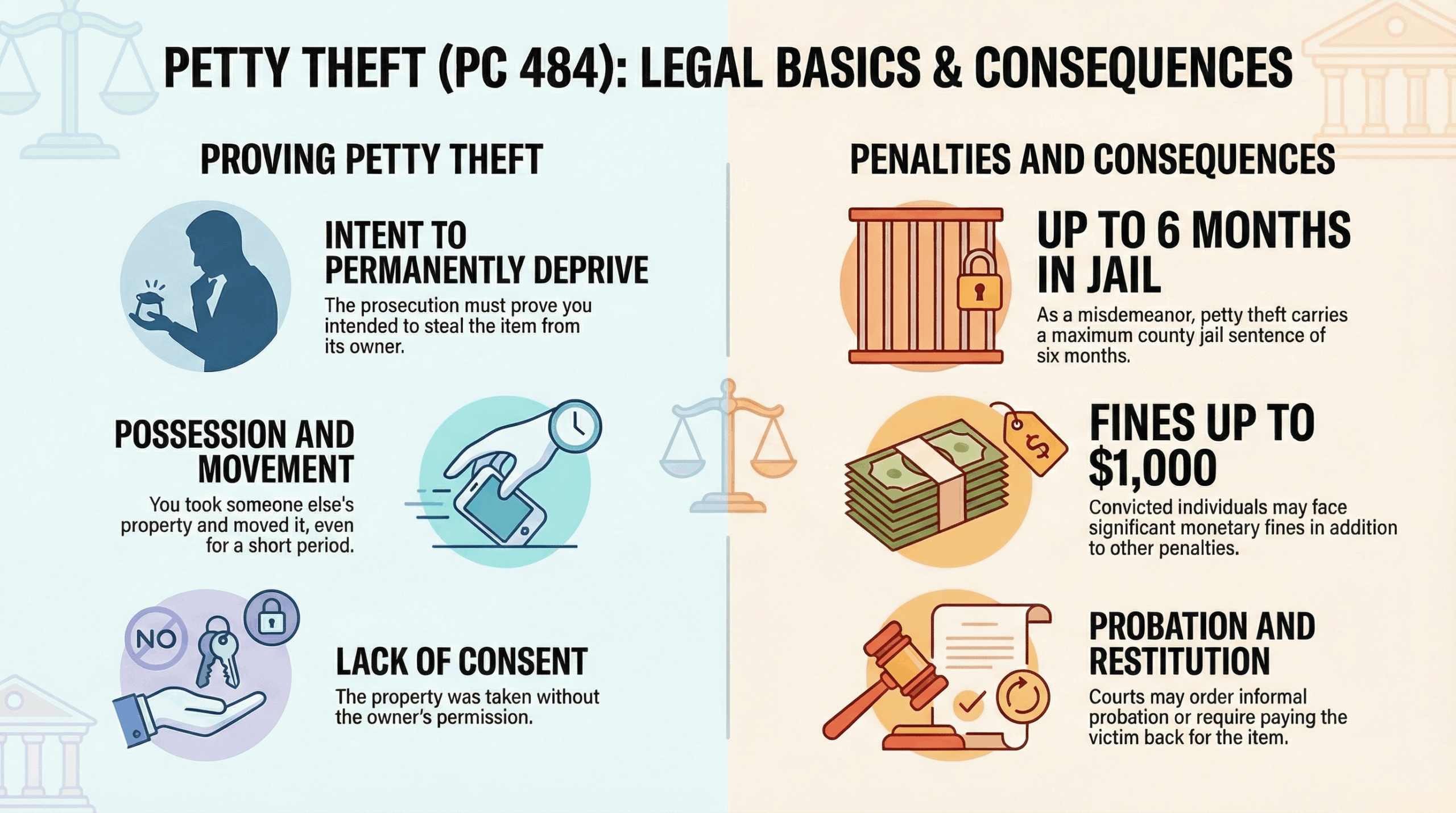
To prove petty theft, the prosecution must show:
You took possession of someone else’s property.
You moved the property and kept it for even a short period.
You did not have the owner’s consent.
You intended to steal the item.
Penalties for Petty Theft (Jail Time and Fines)
Because petty theft is a misdemeanor, the penalties are less severe than those for grand theft. However, they are still significant:
Jail Time: Up to six months in county jail.
Fines: Monetary fines that can reach up to $1,000.
Probation: Often, courts will order informal or summary probation instead of jail time.
Restitution: You may be required to pay back the value of the stolen item to the victim or store.
Grand Theft (PC 487): Understanding Serious Charges
Grand Theft is a much more serious offense because it involves higher-value property or specific types of items that the law considers highly protected.
What Constitutes Grand Theft?
Beyond the $950 threshold, Grand Theft can also be charged if you steal:
An automobile (regardless of the car’s value).
A firearm (regardless of the gun’s value).
Livestock, such as horses, cattle, or sheep.
Property taken directly from the person of another (like pickpocketing).
Penalties for Grand Theft
Because Grand Theft is often a “wobbler” offense, sentencing can vary wildly:
Misdemeanor Charge: Up to one year in county jail and fines up to $1,000.
Felony Charge: Up to three years in state prison, though recent sentencing reforms often favor county jail time or probation for first-time offenders.
How Prior Convictions Influence Sentencing
If you have a history of theft-related offenses, your current charge is much more likely to be elevated. A simple petty theft can be “pushed up” to a felony charge if the prosecutor determines your history warrants a harsher response.
When $950 Doesn’t Matter: Aggravating Factors
It is a common misconception that any theft under $950 is automatically a “minor” incident. There are several scenarios where the $950 rule is bypassed entirely, or where the consequences become much more severe.
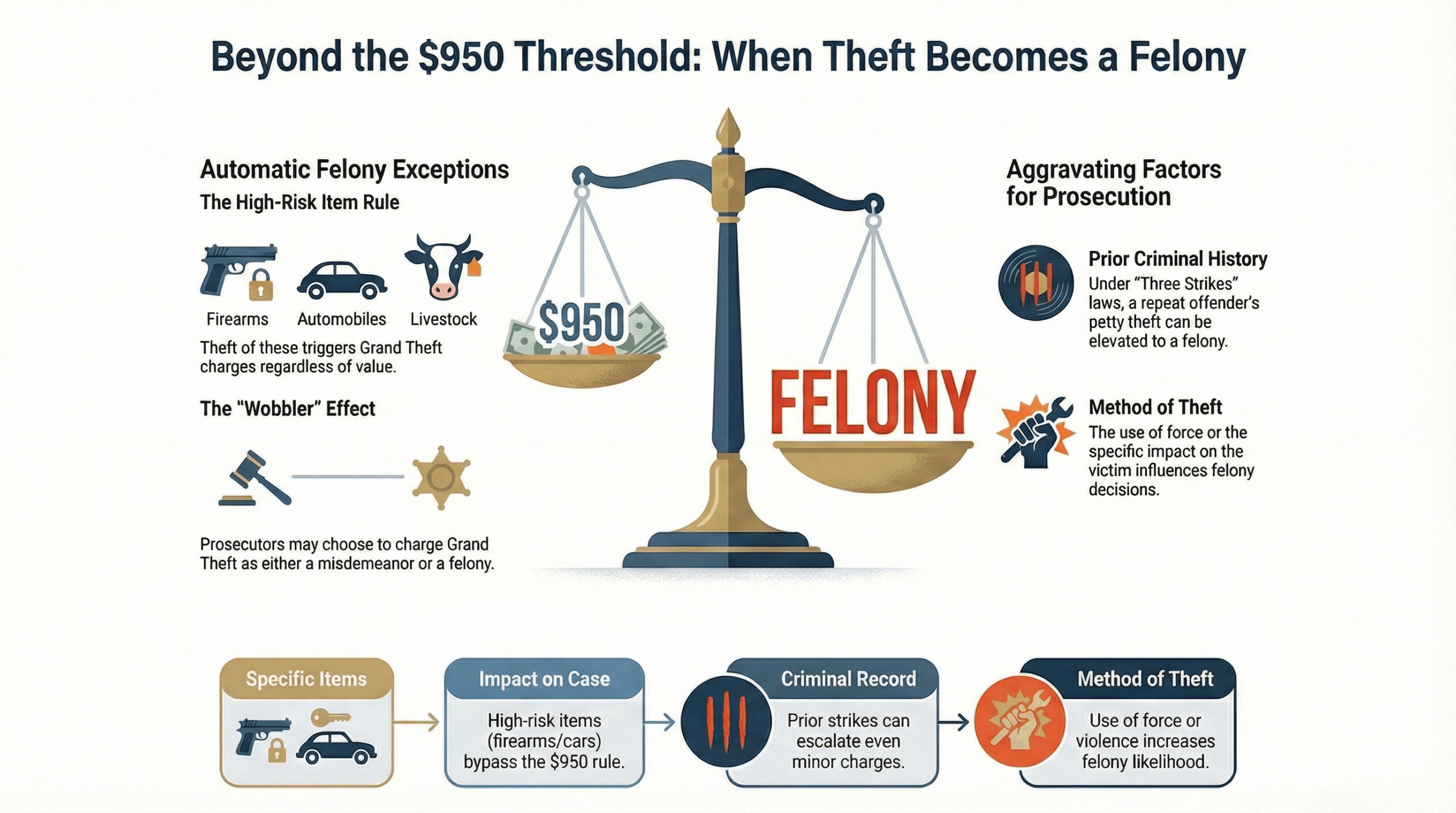
Theft of Firearms, Automobiles, and Livestock: Automatic Grand Theft
The $950 rule does not apply to all items. Even if you steal a firearm that is worth less than $950, you can still be charged with Grand Theft. The law treats these items as inherently dangerous or high-value, meaning the standard threshold is irrelevant.
The “Wobbler” Effect: How Prosecutors Decide Between Misdemeanor and Felony
A “wobbler” is a crime that can be charged as either a misdemeanor or a felony. In California, Grand Theft is a classic wobbler. Prosecutors look at:
The specific items stolen.
The defendant’s prior criminal record.
The method of theft (e.g., was force used?).
The victim’s impact statement.
If the prosecutor views the circumstances as particularly egregious, they may choose the felony route, even if the value of the goods is relatively low.
Aggravated Theft: When Prior Records Escalate Charges
Under California’s “Three Strikes” law and other sentencing enhancements, prior criminal history plays a massive role. If you are a repeat offender, a petty theft charge can sometimes be elevated to a felony. This is why legal representation is critical from the very start.
Facing Arrest for a Theft Charge? Your Next Steps
The moment you or a loved one are taken into custody for a theft-related offense, the clock starts ticking. It is a stressful, disorienting experience. You may be worried about your job, your family, and your future. The most important thing you can do is secure your release so you can return home and begin planning your defense.
The Importance of Securing Release Quickly
Staying in jail while waiting for a court date can have devastating real-world consequences. It can lead to job loss, strain on family relationships, and, most importantly, it makes it much harder to communicate effectively with an attorney to build your defense strategy.
Understanding the Bail Process in California Theft Cases
When an individual is arrested, a judge or a pre-set bail schedule determines the amount of money required to ensure the defendant returns for their court date. Bail is not a fine; it is a financial guarantee. If you cannot afford to pay the full bail amount set by the court, you need a professional service to help facilitate the process.
Why Experienced Bail Assistance Matters
Navigating the bail process alone can be overwhelming. This is where Armstrong Bail Bonds provides essential support.
When a loved one is arrested, you do not have time to waste on confusing paperwork or slow administrative processes. You need a team that understands the local legal landscape and can act immediately to secure a release. Armstrong Bail Bonds offers:
Fast, 24/7 Availability: Arrests don’t happen on a schedule, and neither should your support system.
Professional Guidance: They demystify the booking process, explaining exactly what is happening and what the next steps are.
Confidentiality: They understand the sensitive nature of criminal charges and handle every case with the utmost privacy.
If you are facing an arrest, contacting Armstrong Bail Bonds can be the difference between spending days behind bars and returning home to consult with your lawyer. They are dedicated to helping you navigate the system so you can focus on what matters most: your defense and your future.
Defenses Against Theft Charges in California
Just because you were charged does not mean you will be convicted. An experienced attorney can explore several defense strategies to help your case.
Common Defense Strategies: Lack of Intent
Theft is a “specific intent” crime. This means the prosecution must prove you intended to steal. If you can show that you honestly forgot to pay for an item or that you believed you had the right to take the property, you may have a valid defense.
The “Claim of Right” Defense
This defense applies when you truly believe the property belongs to you. If you take an item because you mistakenly believe it is yours, you lack the criminal intent required for a theft conviction.
Mistake of Fact
If you were under a reasonable (though incorrect) belief regarding the facts of the situation, this can be used as a defense. For example, if someone leaves an item in a public place and you pick it up thinking it was discarded trash, you might argue that you did not have the specific intent to commit theft.
Frequently Asked Questions (FAQ)
Q: Is the $950 threshold an exact amount? A: Yes. Under California law, $950 is the specific cutoff. Property valued at $950.01 is technically enough to trigger a potential Grand Theft charge, though prosecutors often exercise discretion.
Q: Does the $950 rule apply to shoplifting? A: Yes. Shoplifting is generally charged as petty theft if the value of the stolen goods is $950 or less, provided the store was open to the public and you entered with the intent to commit theft.
Q: Can I be charged with Grand Theft if I didn’t know the value of the item? A: Yes, you can be charged. However, lack of knowledge about the item’s value can be a factor in your defense. Your attorney may argue that you did not have the specific intent to steal something of “grand” value, which could help in plea negotiations.
Q: Can theft charges be expunged from my record? A: In many cases, yes. If you are convicted of a misdemeanor, you may be eligible to apply for an expungement after completing your probation and meeting other court requirements. This effectively clears the conviction from your record for most employment purposes.
Q: How does a theft charge affect my bail amount? A: Bail is set based on the severity of the charge and your criminal history. Generally, Grand Theft carries a higher bail amount than Petty Theft. Contacting a professional like Armstrong Bail Bonds as soon as possible can help you understand the specific bail requirements for your situation.
Q: What is a “wobbler” and why does it matter? A: A “wobbler” is a crime that can be charged as either a misdemeanor or a felony. It matters because it gives the prosecutor power to decide the severity of your potential punishment, which is why having strong legal and bail assistance is so vital.
Conclusion
Navigating California’s theft laws is complex, and the consequences of a conviction can be severe. Whether you are dealing with a petty theft accusation or a more serious grand theft charge, understanding your rights and the legal process is your first line of defense.
If you or a family member has been arrested, don’t wait in uncertainty. Take the first step toward resolution and regain your peace of mind. Contact Armstrong Bail Bonds today for professional, 24/7 assistance and expert guidance through the bail process. Let us help you return home so you can focus on your legal defense.