

04 Feb What is the Difference Between Battery and Assault?
If you or a loved one has been arrested in Southern California, you might be confused by the charges of assault and battery. While these terms are often grouped together, they are distinct legal concepts with different consequences under California law. Understanding these differences is the first step toward securing your freedom and building a strong legal defense.
Defining the Core Concepts: Assault vs. Battery
In the California legal system, assault and battery are defined under two separate sections of the Penal Code. Although they are frequently charged at the same time, they focus on two different parts of a conflict.
Defining Assault (PC 240): Under California Penal Code 240, assault is an “unlawful attempt” to commit a violent injury on someone else. Crucially, no physical contact is required. If you swing a fist at someone and miss, you have committed assault because you created a “reasonable apprehension” of harm.
Defining Battery (PC 242): California Penal Code 242 defines battery as the “willful and unlawful use of force or violence” upon another person. Battery is the completed act of physical contact.
The “Swing and a Miss” Rule: Think of assault as the “attempt” and battery as the “hit.” You can have assault without battery (the miss), but you almost never have battery without an initial assault (the attempt).
Key Differences at a Glance
To the average person, a fight is just a fight. To a prosecutor in Los Angeles or Orange County, the specific details of the incident determine whether you face a minor misdemeanor or a serious felony.
Intent vs. Contact: Assault focuses on the threat and the intent to cause harm. Battery focuses on the contact itself.
The Role of Physical Injury: Surprisingly, battery does not require the victim to be injured. In California, even a slight touch—if done in an offensive or angry manner—can be charged as battery. Spitting on someone or grabbing their shirt can result in a battery charge.
The Legal Intersection: Because one usually leads to the other, police officers often write “Assault and Battery” on booking sheets. However, they remain separate counts in court.
Real-World Examples of Assault and Battery
Understanding how these laws apply to daily life can help clarify your situation. Here are common scenarios that lead to arrests in Southern California:
Scenario A (Assault): Two people get into a heated argument at a bar in San Diego. One person raises a glass bottle as if to strike the other but is tackled before they can swing. Even though no contact was made, the act of raising the bottle is an assault.
Scenario B (Battery): During a dispute over a parking spot in Glendale, one person shoves the other. There are no bruises or broken bones, but the “unlawful touching” constitutes battery.
Scenario C (Aggravated Charges): If a person uses a deadly weapon (like a knife or firearm) or causes “Great Bodily Injury” (like a broken jaw), the charges are elevated to Aggravated Assault (PC 245) or Battery with Serious Bodily Injury (PC 243d).
Understanding Bail for Assault and Battery
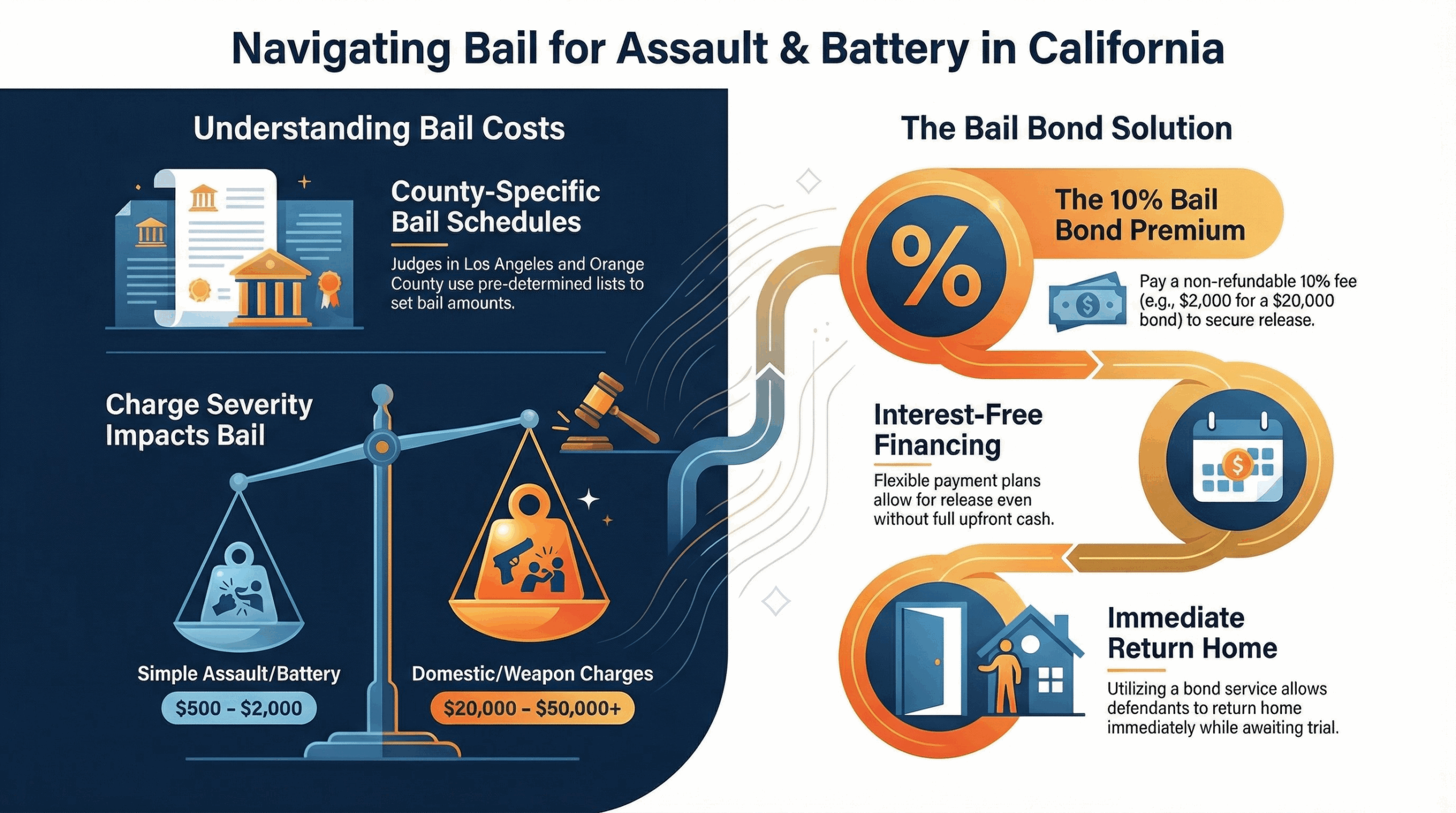
When an arrest happens, the first concern is always the cost of release. In California, bail is set based on “Bail Schedules” that vary by county.
How Bail is Set: Judges in Los Angeles and Orange County use a pre-determined list to set bail. For “Simple Assault” or “Simple Battery,” bail might be relatively low (often between $500 and $2,000). However, if the charges involve a domestic partner or a weapon, bail can skyrocket to $20,000, $50,000, or more.
The 10% Bail Bond Solution: Most people cannot afford to pay $20,000 in cash to the court. By working with Armstrong Bail Bonds, you typically only pay a 10% premium (e.g., $2,000 for a $20,000 bond). This fee is non-refundable, but it allows the defendant to return home immediately.
Financial Flexibility: Armstrong Bail Bonds understands that legal trouble is unexpected. We offer flexible payment plans and interest-free financing for those who qualify, ensuring that a lack of upfront cash doesn’t keep your loved one behind bars.
The Arrest Process in Southern California
Navigating the jail system in a massive area like Southern California is overwhelming. Knowing the timeline can ease the stress of a crisis.
Booking and Processing: After an arrest in cities like Los Angeles, Pasadena, or San Diego, the individual is taken to a local station or county jail. They are fingerprinted, photographed, and their charges are entered into the system. This “booking” process can take several hours.
The “One Phone Call”: Once booked, the defendant is usually allowed to make phone calls. This is the critical moment to call a family member and Armstrong Bail Bonds at (818) 241-2171.
The Local Advantage: Since 1926, the Armstrong family has navigated the SoCal jail systems. We have established relationships with jailers in Glendale, Orange County, and beyond. This local expertise often allows us to secure a release in as little as 30 to 60 minutes once the bond is posted.
Common Legal Defenses
Being charged does not mean you are guilty. There are several legal defenses that an attorney may use to fight assault and battery charges.
Self-Defense: This is the most common defense. If you used “reasonable force” because you feared you were about to be harmed, the law may protect your actions.
Consent: In certain situations, such as a sanctioned boxing match or competitive sports, physical contact is expected and consented to, which can negate a battery charge.
Lack of Intent: If the contact was accidental—for example, you tripped and knocked someone over—it does not meet the “willful” requirement for battery.
Defense of Others: Similar to self-defense, you may be justified in using force if you were protecting someone else from an immediate threat.
People Also Ask (FAQ)
Q: Can I go to jail for simple assault in California? A: Yes. Simple assault is a misdemeanor. If convicted, you could face up to six months in county jail and a fine of up to $1,000.
Q: Does battery always require an injury? A: No. Under California law, any “offensive” touching counts. You can be charged with battery even if the victim suffered no pain or visible injury.
Q: How much does a bail bond cost for battery? A: In California, the standard rate is 10% of the total bail amount. If the judge sets bail at $10,000, you would pay a bail bondsman $1,000 to secure release.
Q: What is the difference between a misdemeanor and a felony battery? A: “Simple” battery is a misdemeanor. However, if the victim is a peace officer, or if the battery causes serious injury, it can be charged as a felony, leading to years in state prison.
Q: How long does it take to get out of jail with a bail bond? A: In Southern California, the release process usually takes between 30 minutes and a few hours after the bond is posted, depending on how busy the specific jail is.
Q: Can I be sued in civil court for assault? A: Yes. A victim can file a civil lawsuit to seek money for medical bills, lost wages, and emotional distress, even if the criminal charges were dropped.
Contact Armstrong Bail Bonds Today
If you or a family member are facing assault or battery charges in Southern California, do not wait. Since 1926, Armstrong Bail Bonds has been the trusted name for fast, professional, and empathetic bail services. We are available 24/7 to help you navigate the Los Angeles, Orange County, and San Diego jail systems.
Call us now at (818) 241-2171 for a free, confidential consultation. Let our family help yours.