

16 May Will a DUI Arrest Result in a Bail Increase for Repeat Offenders?
Facing a DUI arrest is stressful, but the stakes rise significantly when a DUI arrest results in a bail increase for repeat offenders. In California, the legal system treats recidivism with high levels of scrutiny, often leading to much higher financial requirements for release. Understanding how prior convictions impact your current situation is the first step toward regaining your freedom and preparing your defense.
Understanding the Correlation Between Repeat Offenses and Higher Bail
When a person is arrested for a second, third, or subsequent DUI, the court’s primary concern shifts. While a first-time offender is often viewed as someone who made a singular mistake, a repeat offender is viewed through the lens of public safety risks.
The Legal Theory of Recidivism and Public Safety
Courts operate on the principle that if a previous punishment (like a first DUI conviction) did not deter a person from drinking and driving again, a more restrictive approach is necessary. Bail is not intended to be a punishment, but it is used as a tool to ensure the defendant adheres to the law while awaiting trial.
Why California Judges View Repeat Offenders as a “Flight Risk”
Judges often associate repeat offenses with a higher “flight risk.” As the potential penalties for a conviction grow more severe—including mandatory jail time or prison—the court worries that a defendant may be more likely to skip their court dates to avoid sentencing. Consequently, they set bail at a higher “pain point” to ensure the individual has a significant financial incentive to return to court.
The Shift from Rehabilitation to Incapacitation in Pretrial Decisions
For a first offense, the court may focus on rehabilitation. However, for repeat offenders, the focus shifts toward incapacitation. By setting a higher bail, the court makes it more difficult for a high-risk individual to return to the road immediately, effectively prioritizing the safety of the community over the immediate liberty of the defendant.
How Prior Convictions Impact the California Bail Schedule
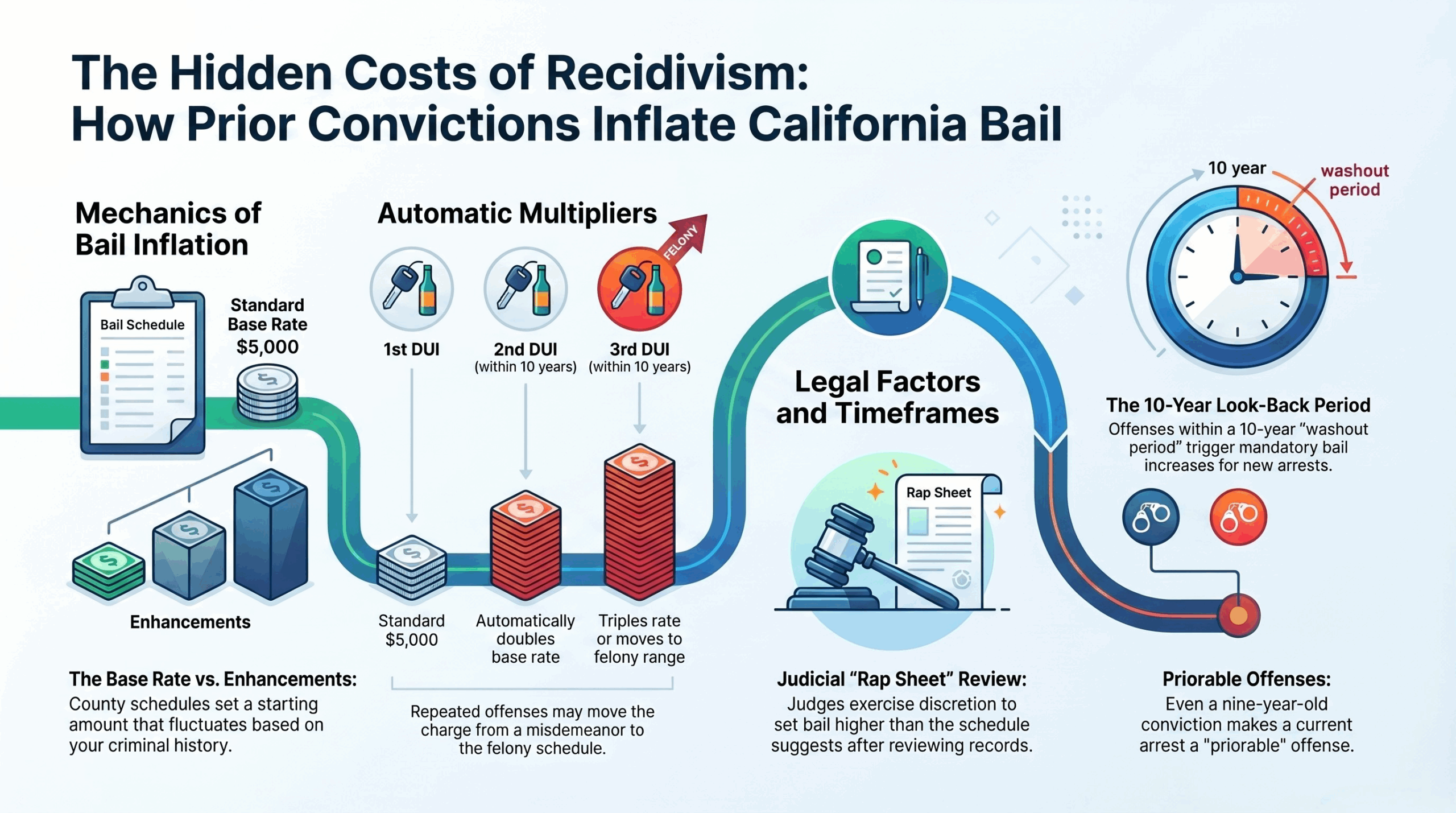
California uses a “Bail Schedule” to provide a standard framework for bail amounts based on the specific crime charged. However, these numbers are not set in stone and can fluctuate wildly based on your history.
The Role of the Los Angeles & Orange County Bail Schedules
In counties like Los Angeles and Orange County, the bail schedule provides a “base rate.” For a standard misdemeanor DUI, bail might be set at $5,000. However, the schedule often includes “enhancements” for prior convictions. For example, a second DUI within ten years might automatically double the bail amount, while a third could triple it or move it into the felony range.
Judicial Discretion: Why “Standard Bail” Rarely Applies to Repeaters
Even with a schedule in place, judges have the final say. At an arraignment or bail hearing, a judge will review your “rap sheet.” If they see a pattern of alcohol-related offenses, they can use their judicial discretion to set bail significantly higher than the county schedule suggests, especially if the previous offenses occurred recently.
The “Look-Back Period”: How 10-Year Prior Convictions Affect Today’s Bail
California law utilizes a 10-year look-back period (also known as a “washout period”). If you have a prior DUI conviction within the last ten years, your current arrest is charged as a “priorable” offense. Even if your last conviction was nine years ago, the court treats the current arrest as a second offense, leading to a mandatory bail increase.
Estimated Bail Ranges: First Offense vs. Repeat Offenses in Southern California
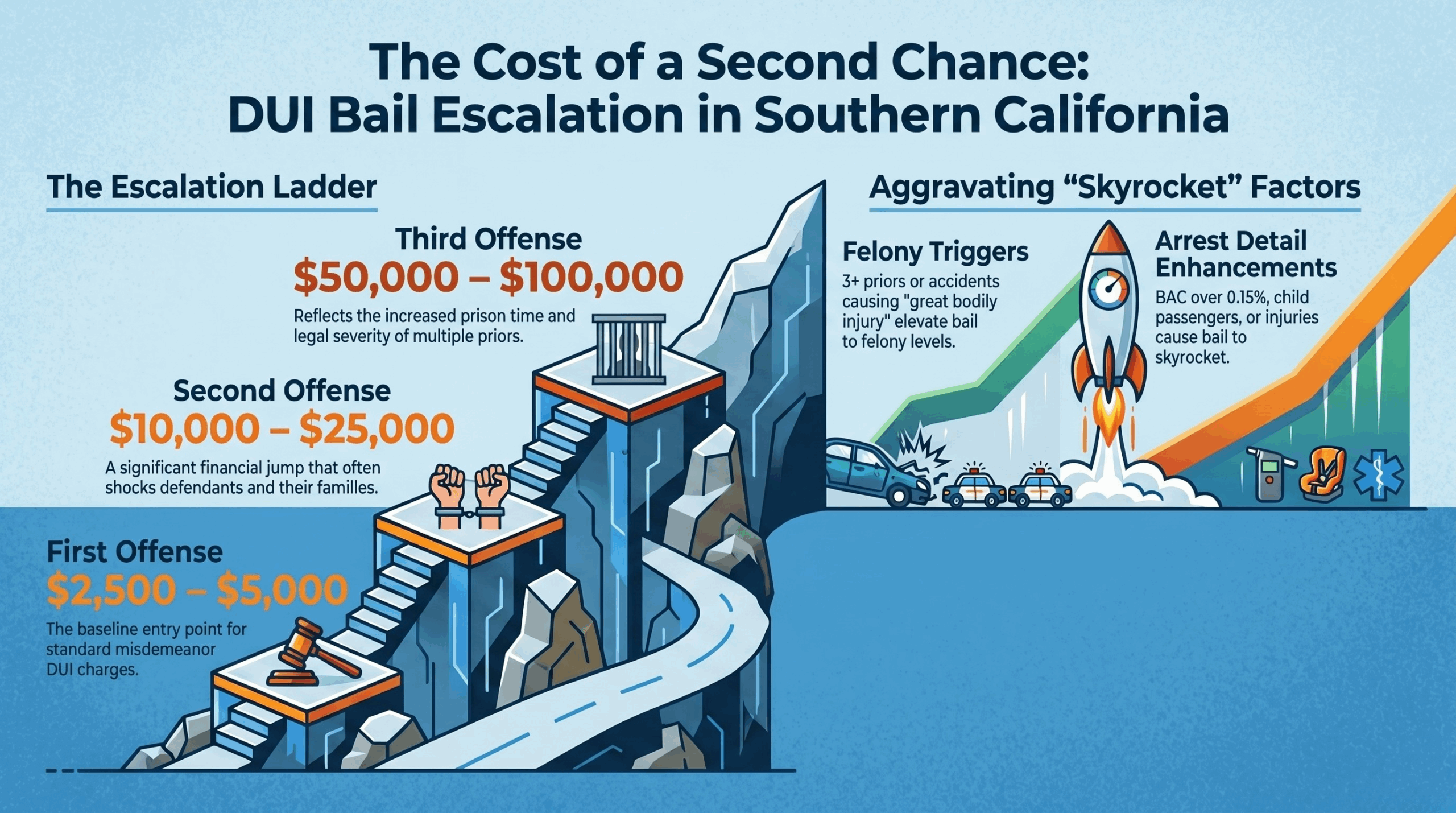
The financial jump between a first and second DUI is often the most shocking part of the arrest process for many families.
Typical Bail Costs for Second and Third DUI Charges
While every case is unique, standard bail ranges in Southern California typically follow this trajectory:
First Offense: $2,500 – $5,000
Second Offense: $10,000 – $25,000
Third Offense: $50,000 – $100,000
Aggravating Factors: High BAC, Injuries, and Minors in the Vehicle
Bail increases aren’t just about your history; they are about the details of the current arrest. If a repeat offender was driving with a Blood Alcohol Content (BAC) of 0.15% or higher, had a child in the car, or caused an accident involving an injury, the bail can easily skyrocket into the hundreds of thousands of dollars.
When a DUI Becomes a Felony: The Dramatic Bail Increase
A DUI is usually a misdemeanor, but it can be elevated to a felony if you have three or more prior convictions or if you caused an accident that resulted in a “great bodily injury.” Felony bail is significantly higher—often starting at $50,000 to $100,000—reflecting the increased prison time the defendant faces.
Stricter Pretrial Release Conditions for Repeat Offenders
Money is only one part of the equation. For repeat offenders, the “cost” of freedom often includes intrusive monitoring.
Mandatory Ignition Interlock Devices (IID) as a Condition of Bail
Judges frequently require repeat offenders to install an Ignition Interlock Device (IID) in their vehicle as a condition of remaining out on bail. This breathalyzer prevents the car from starting if alcohol is detected. You are responsible for the installation and monthly rental costs of this device.
SCRAM Bracelets and Continuous Alcohol Monitoring
In high-risk cases, the court may order a SCRAM (Secure Continuous Remote Alcohol Monitor) bracelet. This is an ankle monitor that tests your perspiration for alcohol every 30 minutes. If you consume even a single drink, the court is notified immediately, and your bail may be revoked.
Travel Restrictions and Mandatory Check-ins
Repeat offenders may be restricted from leaving the state or even the county. You may be required to surrender your passport or check in weekly with a pretrial services officer to prove you are complying with all court orders.
How to Navigate High Bail with Armstrong Bail Bonds
When bail is set at $20,000 or $50,000, most families do not have that much cash sitting in a bank account. This is where professional assistance becomes vital.
1% and 2% Bail Bond Options for Qualified Cases
At Armstrong Bail Bonds, we understand that a high bail amount can feel like a dead end. We offer specialized 1% and 2% bail bond options for clients who meet specific criteria, such as having a private attorney or qualifying collateral. This allows you to secure a release for a fraction of the standard cost.
Cash Bail vs. Surety Bonds: Which is Better for High-Value Repeat DUIs?
Paying the full cash amount to the court is often unwise because that capital is tied up for months or years. A surety bond through Armstrong Bail Bonds allows you to pay a small, non-refundable premium while we guarantee the full amount to the court. This keeps your cash available for your legal defense fees.
Using Property and Collateral for Large Felony Bonds
If bail is set in the felony range, the court may require collateral. Armstrong Bail Bonds can help you use equity in a home or other real estate to secure a bond, providing a lifeline for families who don’t have liquid cash but do have assets.
Flexible Payment Plans for Families
We believe that everyone deserves their day in court, regardless of their current financial status. We offer flexible payment plans that break down the premium into manageable monthly installments. We look at your overall financial picture, not just a credit score, to find a solution that works for you.
Strategies for Reducing Bail in Repeat Offender Cases
You don’t always have to accept the initial bail amount set at the jail.
Filing a Motion for Bail Reduction
Your attorney can request a Bail Revision Hearing. During this hearing, the defense argues that the set bail is “excessive” under the Eighth Amendment. If successful, the judge may lower the amount to something more attainable.
Demonstrating Community Ties and Financial Hardship
To get bail lowered, you must prove you aren’t going to run. Providing proof of a steady job, deep family roots in Southern California, and a lack of financial resources to pay a high bond can influence a judge to be more lenient.
Enrolling in Voluntary Treatment to Show Good Faith
One of the most effective ways to lower bail for a repeat offender is to voluntarily enroll in an Alcoholics Anonymous (AA) program or a residential treatment center before your first court date. This shows the judge you are taking the issue seriously and are not a current threat to public safety.
California Bail Reform Update: 2026 Rules
The legal landscape in California is constantly shifting. As of 2026, new regulations have changed how bail is handled for “high-risk” crimes.
How 2026 California Laws Impact No-Cash Bail for DUI Recidivists
While California has moved toward “no-cash bail” for many minor offenses, repeat DUI offenders are often excluded from these programs. Because DUIs are considered a threat to public safety, recidivists are usually required to post a financial bond to ensure they remain sober and compliant while their case is pending.
The Advantage of a Legacy Bondsman in a Changing Legal Landscape
Since 1926, Armstrong Bail Bonds has seen every major shift in California law. Our deep-rooted relationships with the courts in Los Angeles, San Diego, and Orange County allow us to move faster and navigate new 2026 regulations more effectively than newer agencies.
People Also Ask (FAQs)
1. Will my bail be higher if my last DUI was over 10 years ago? Generally, no. In California, if your prior DUI was more than 10 years ago, the current charge is usually treated as a “first offense” for sentencing and bail schedule purposes. However, a judge may still see the old conviction on your record and factor it into their personal decision.
2. How fast can Armstrong Bail Bonds secure a release for a 2nd DUI? We operate 24/7. Once the paperwork is processed and the premium is handled, we can often have a loved one released in as little as 30 to 60 minutes, depending on the specific jail’s processing speed.
3. Can I get a bail refund if I am a repeat offender? If you paid the full cash amount to the court, you receive it back (minus minor court fees) once the case is closed, provided you didn’t miss any dates. If you used a bail bond, the premium you paid to the bondsman is a fee for their service and is non-refundable.
4. Can a lawyer help me get out on my own recognizance (OR) with a prior? It is very difficult for a repeat offender to get an “OR” release (release without paying bail). However, a skilled lawyer can use your enrollment in treatment programs to argue for a lower bail or a “supervised release” program.
5. What happens if I miss a court date while out on a repeat DUI bond? The court will issue a “bench warrant” for your arrest and “forfeit” the bond. This means the full amount of the bail becomes due, and the bondsman will have to locate you to return you to custody to protect the collateral.
Contact Armstrong Bail Bonds Today
If you or a loved one is facing a DUI arrest, don’t wait for the bail amount to climb. Armstrong Bail Bonds has been Southern California’s most trusted name in bail since 1926. We provide fast, professional, and empathetic service to help you navigate the complexities of the California legal system.
Whether you need a 1% bond, a flexible payment plan, or expert advice on collateral, we are here to help 24 hours a day.
Call us now at (818) 241-2171 or visit our Contact Page to start the release process immediately.